


















Lesson 32 of 45 · Nutrition and Labeling
Nutrition and Labeling: The Big Picture
Overview of food nutrition for food science: the six nutrient classes, energy units, essential nutrients, dietary reference values and how processing and labels connect.
Every food is a mixture of nutrients, and the job of a food scientist includes knowing which nutrients a product contains, how processing changes them, and how to describe them honestly on a label. This chapter gives you the vocabulary and the calculations: energy from macronutrients, the fragility of vitamins, and how the Nutrition Facts label turns a laboratory analysis into numbers that shoppers see on the pack. It teaches food science, not personal diet advice.
Educational information only. This chapter explains how nutrients and labels work. It is not medical or dietary advice. Individual needs vary with age, health, medicines and circumstances; a registered dietitian or doctor can advise you personally.
What you will learn
- Name the six classes of nutrients and the difference between macro- and micronutrients.
- Convert between kilocalories and kilojoules.
- Explain what dietary reference values are, and what essential means.
- Describe where processing and labeling fit in nutrition science.
Key terms
Nutrient: a substance in food that the body uses for energy, growth, repair or regulation.
Essential nutrient: one the body cannot make, or cannot make in sufficient amounts, so it must come from food.
Macronutrient: a nutrient needed in large amounts (grams per day): carbohydrate, protein, fat, and water.
Micronutrient: a nutrient needed in small amounts (milligrams or micrograms per day): vitamins and minerals.
Dietary reference value: a number set by an expert body to describe the intake of a nutrient that meets the needs of most healthy people.
The six classes of nutrients
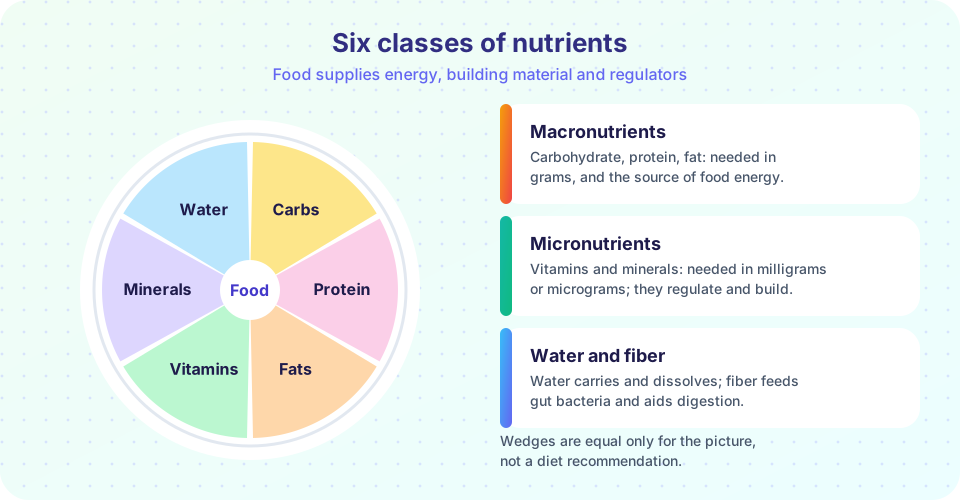
Nutrition scientists sort nutrients into six classes.
- Carbohydrates: sugars, starches and fibers. Main fuel for the body and the brain.
- Proteins: chains of amino acids that build tissue, enzymes and hormones, and can also be burned for energy.
- Fats (lipids): the most concentrated energy source, carriers of fat-soluble vitamins and part of every cell membrane.
- Vitamins: organic compounds needed in tiny amounts, such as vitamin C, the B vitamins, and vitamins A, D, E and K.
- Minerals: inorganic elements such as calcium, iron, zinc, potassium and sodium.
- Water: the largest component of the body and of most foods.
Carbohydrates, proteins and fats are the macronutrients, and they supply food energy. Vitamins and minerals are the micronutrients; they supply no usable energy themselves, but many enzymes and structures depend on them. Dietary fiber is a special case: it is a carbohydrate that human enzymes do not digest, but gut bacteria ferment part of it, so it delivers a small amount of energy (about 2 kilocalories per gram in the EU system) and it affects digestion and gut health.
Macronutrients give energy
Micronutrients regulate
The food scientist's part
Numbers, then meaning.
Essential nutrients
A nutrient is called essential if the body cannot make it, or cannot make it fast enough, so it has to come from the diet. There are essential amino acids (nine for adults), essential fatty acids (linoleic and alpha-linolenic acid), all of the vitamins in the human diet (with a few exceptions such as vitamin D, which skin makes in sunlight, and vitamin K and some B vitamins, which gut bacteria contribute), and a list of minerals. A lack of an essential nutrient over time leads to a deficiency disease, such as scurvy from too little vitamin C. Too much of some nutrients can also cause harm, so reference values include upper limits for several nutrients.
Energy: kilocalories and kilojoules
Food energy is measured in kilocalories (kcal, commonly called "calories" on labels) or in kilojoules (kJ), the SI unit. The conversion is:
1 kcal = 4.184 kJ
So a 170 kcal snack contains about 711 kJ. Many countries print both on the label. Food energy used to be measured by burning the food in a bomb calorimeter; today it is calculated from composition using the Atwater factors, which you will use in the next lesson.
Dietary reference values
Expert bodies publish reference values for nutrient intake. In the United States and Canada, the Dietary Reference Intakes (DRIs) include the Recommended Dietary Allowance (RDA), the intake that meets the needs of nearly all healthy people in a group, and the Adequate Intake (AI), used when evidence is weaker. Europe's EFSA publishes dietary reference values, and the WHO and FAO publish global guidance. Values differ by age and sex, and the numbers are updated as evidence improves. Labels use a simplified single reference number called the Daily Value (DV) in the US and the Nutrient Reference Value in the EU, which you will meet in the labeling lesson.
Where food science fits
- Analysis: measuring protein, fat, carbohydrate, minerals and vitamins in foods, and keeping databases of food composition.
- Processing and nutrition: heat, light, oxygen and water change nutrient content, as the lesson on vitamins, minerals and nutrient loss shows.
- Fortification and reformulation: adding iron or folic acid to flour, iodine to salt, or reducing sugar and salt in recipes.
- Labeling and claims: following the rules for what can be printed on the pack, which is the topic of nutrition labels and claims.
Common misconceptions
"Calories are bad." A calorie is a unit of energy, just as a liter is a unit of volume. Food energy is necessary; questions about health involve how much, from which foods, and for which person.
"Vitamins give you energy." Vitamins help enzymes release energy from food but are not themselves a source of calories.
"Natural means more nutritious." Nutrient content depends on composition and handling, not on a marketing word.
Try it
First, a calculator for energy units, handy when labels from different countries show different units.
Press Run (or Ctrl + Enter) to see the console output here.
No output.
Second, an interactive look at the macronutrient makeup of some foods. The values are rounded, typical figures per 100 g from public food composition tables; real products vary, and the energy shown is calculated with general Atwater factors, so it can differ a little from the tables' own entries.
In this chapter
| Lesson | What it covers |
|---|---|
| Energy and macronutrients | Atwater factors, carbohydrate, protein and fat quality |
| Vitamins, minerals and nutrient loss | What is fragile and how processing affects it |
| Nutrition labels and claims | Reading and building a label; %DV; claims |
| Chapter 7 review | Recap, one-picture summary, 9-question quiz |
Check your understanding
Quick check · 4 questions
of 4 answered You scored / 4 · perfect!
-
1. Which nutrients are macronutrients that supply food energy?
Carbohydrates, proteins and fats supply energy and are needed in grams. -
2. How many kilojoules are in 100 kcal?
100 × 4.184 = 418.4 kJ. -
3. What does it mean for a nutrient to be essential?
Essential nutrients must be obtained from the diet. -
4. Which statement is true about vitamins?
Vitamins give no usable energy but are needed in small amounts for regulation.
Summary
- The six nutrient classes are carbohydrates, proteins, fats, vitamins, minerals and water; fiber is a special carbohydrate.
- Macronutrients supply energy and are needed in grams; micronutrients are needed in milligrams or micrograms.
- Energy is measured in kcal or kJ (1 kcal = 4.184 kJ) and calculated from composition.
- Essential nutrients must come from food; reference values describe typical needs.
- Food science analyzes, protects and describes nutrients; this course gives information, not personal advice.
Track your progress
Create a free account to tick off lessons and pick up where you left off on any device.
of Food Science lessons completed