


















Lesson 34 of 45 · Nutrition and Labeling
Vitamins, Minerals and Nutrient Loss
Learn what vitamins and minerals do, which are fragile in heat, light, oxygen and water, how to model vitamin loss with first-order kinetics, and how fortification works.
A tomato, a glass of orange juice and a slice of bread are different at the vitamin level when they reach your plate than when they left the farm. Some nutrients survive almost anything; others vanish in a few minutes of boiling or a few weeks on a shelf in the light. Food scientists want to know which is which, by how much, and what can be done about it. This lesson sorts the vitamins and minerals, explains the causes of loss, gives you a kinetic model for predicting it, and covers the main strategy for putting nutrients back: fortification.
What you will learn
- Distinguish fat-soluble and water-soluble vitamins and name the major minerals.
- List the causes of nutrient loss and which vitamins are most vulnerable.
- Use first-order kinetics and the Arrhenius equation to predict vitamin loss in storage.
- Explain fortification, enrichment and overage, and why bioavailability matters.
Key terms
Water-soluble vitamins: vitamin C and the B vitamins; they dissolve in water, so they can be lost by leaching, and they are not stored much by the body.
Fat-soluble vitamins: vitamins A, D, E and K; they dissolve in fat and are stored in tissues.
Bioavailability: the share of a nutrient that is absorbed and used by the body.
Fortification and enrichment: adding nutrients to a food, either to replace those lost in processing (enrichment) or to supply nutrients not originally present (fortification).
Overage: extra nutrient added so that the label amount is still present at the end of shelf life.
The two vitamin families
Vitamins are organic compounds needed in tiny amounts. They fall into two groups.
| Group | Vitamins | Main food sources | Typical behavior |
|---|---|---|---|
| Water-soluble | C, thiamin (B1), riboflavin (B2), niacin (B3), pantothenic acid (B5), B6, biotin, folate (B9), B12 | Fruit, vegetables, cereals, meat, dairy | Leach into cooking water; many are sensitive to heat |
| Fat-soluble | A, D, E, K | Oils, fish, eggs, dairy, green vegetables | Survive water, but oxidize in air and light |
Vitamin B12 occurs naturally almost only in animal foods and some fermented or fortified foods, which is why fortification matters for people eating no animal products. Some vitamins come in several chemical forms, such as the provitamin A carotenoids (beta-carotene) in plants and retinol in animal foods.
The major and trace minerals
Minerals are chemical elements. Major minerals are needed in amounts of more than about 100 mg per day: calcium, phosphorus, magnesium, sodium, potassium, chloride and sulfur. Trace minerals are needed in small amounts: iron, zinc, iodine, selenium, copper, manganese, fluoride and others. Minerals are elements, so unlike vitamins they cannot be broken down by heat, light or oxygen. Food scientists worry about them in other ways: they are removed (white flour has less iron, zinc and magnesium than whole grain, because the bran and germ are milled off), leached into cooking water, or made unavailable (for example, phytates in whole grains bind iron and zinc so they are absorbed poorly).
Why nutrients are lost
Six main causes explain most losses.
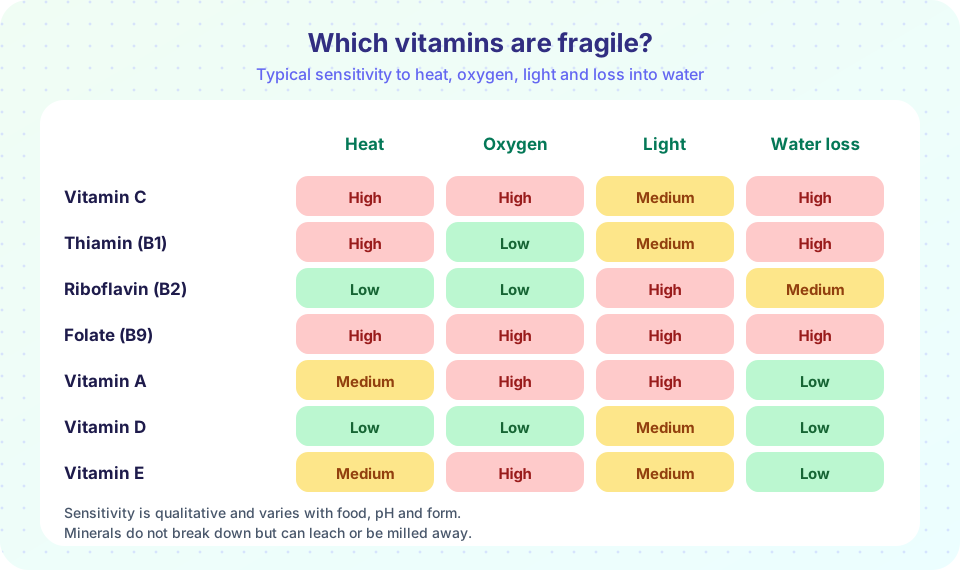
- Heat: speeds up the breakdown of vitamin C, thiamin and folate.
- Oxygen: oxidizes vitamin C, vitamin A, vitamin E and unsaturated fats (which also destroys the vitamins in them).
- Light: destroys riboflavin, vitamin A and vitamin K. This is why milk is sold in opaque or tinted containers.
- Water: dissolves water-soluble vitamins and minerals. Boiling vegetables in a lot of water and discarding it removes more than steaming does, and the same nutrients may be eaten if the water is used in a soup.
- pH: thiamin breaks down faster in neutral and alkaline conditions; vitamin C is more stable in acid.
- Enzymes: when a plant is cut, enzymes such as ascorbic acid oxidase can destroy vitamin C. Blanching (a brief heating) inactivates them before freezing.
Processing is not always a loss, though. Cooking tomatoes in oil increases the absorption of lycopene, freezing shortly after harvest can preserve vitamin C better than days of transport, and cooking breaks down plant cell walls, so some carotenoids become more available. Different nutrients move in different directions.
Modeling vitamin loss: first-order kinetics
For many vitamins the loss in storage follows first-order kinetics, just like the microbial kill from the thermal processing lesson:
C(t) = C₀ × e^(−k t) half-life t½ = ln 2 / k
k is the rate constant (per day, say) and it rises with temperature according to the Arrhenius equation:
k(T) = k_ref × exp[ −(Ea / R) × (1/T − 1/T_ref) ]
Ea is the activation energy (J/mol), R = 8.314 J/(mol·K) the gas constant, and the temperatures are in kelvin. For many degradation reactions in foods, Ea is of the order of tens of kJ/mol; for example, an Ea of 50 kJ/mol corresponds to a loss rate that is roughly doubled by a 10 °C rise, which is a Q10 of about 2. This is the basis of the accelerated shelf-life tests you will use in the project lesson.
Worked example. Suppose the vitamin C in a juice has k = 0.02 per day at 20 °C, so after 30 days C/C₀ = e^(−0.6) = 0.55: 55 percent is left. At 4 °C with Ea = 50 kJ/mol, k is about 0.3 times as large: 0.006 per day, so after 30 days about 83 percent is left. The refrigerator buys a lot of vitamin.
Fortification, enrichment and overage
Food fortification is one of the great public health tools. Common examples include iodized salt (to prevent iodine deficiency and goiter), folic acid in flour in many countries (to reduce neural tube defects in babies), vitamin D in milk and some plant drinks, iron and B vitamins in cereals and flour (enrichment), and in some countries vitamin A in cooking oil or sugar. Each program depends on a vehicle, a food that is eaten regularly by the target group in fairly steady amounts, and on a form of the nutrient that is stable in the food and well absorbed.
Two practical problems face the manufacturer. The first is stability: vitamins degrade during processing and storage, so a food must contain more than the label amount at the time of manufacture. That extra is the overage: if a product loses 20 percent over shelf life and the label says 100 units, you must add 1 / 0.80 = 125 units. The second is bioavailability: not every form of a mineral is absorbed equally. The iron in meat (heme iron) is absorbed better than iron in plant foods (non-heme iron); vitamin C in the same meal improves absorption of non-heme iron, while phytates and some polyphenols reduce it. Regulators set maximum levels because some nutrients are harmful in excess.
Common misconceptions
"Cooking destroys all the vitamins." Some are lost, others survive, and a few become more available. The amount lost depends on the nutrient, temperature, time, water and food.
"Frozen vegetables have no nutrients." Frozen vegetables are often frozen soon after harvest and can retain their vitamins well; blanching causes some loss, but long storage and transport of fresh produce can also lose some.
"Minerals are destroyed by cooking." Minerals are elements, so they do not break down; they can only be removed (milling, leaching) or made less available.
"Taking a vitamin is the same as eating the food." Foods supply fiber, other compounds and the matrix that affects absorption. This chapter describes nutrient science, not a recommendation to use supplements; a dietitian or doctor can advise on that.
Try it
First, a simulation of vitamin loss at three storage temperatures. The rate constant at 20 °C and the activation energy are hypothetical illustration values, not data for any particular juice.
Press Run (or Ctrl + Enter) to see the result here.
Program input · what you'd type while the program runs
Type the answers before you press Run, one per line. Each time the program reads a line (with input()), it gets the next line from this box.
Second, a retention calculator for a multi-step process. Losses from separate steps multiply. The default percentages are hypothetical numbers for practice; replace them with measured values.
Third, an overage calculator for fortification.
Press Run (or Ctrl + Enter) to see the console output here.
No output.
Check your understanding
Quick check · 5 questions
of 5 answered You scored / 5 · perfect!
-
1. Which vitamin group is easily lost by leaching into cooking water?
Water-soluble vitamins dissolve in water, so boiling and discarding the water removes them. -
2. Why does milk packaging often block light?
Riboflavin is photosensitive; light damages it and also causes oxidative off-flavors. -
3. A vitamin has k = 0.03 per day. What is its half-life?
t½ = ln 2 / k = 0.693 / 0.03 = 23.1 days. -
4. A product loses 20 percent of a vitamin over its shelf life. To meet a label claim of 100 units, how much must be added?
Retention is 0.80, so the amount to add is 100 / 0.80 = 125 units. -
5. Which is true of minerals in cooking?
Minerals are elements: milling and leaching remove them, and phytates reduce absorption.
Summary
- Vitamins are water-soluble (C and B group) or fat-soluble (A, D, E, K); minerals are major or trace elements.
- Losses come from heat, oxygen, light, water, pH and enzymes; vitamin C and folate are the most fragile, vitamin D the most stable.
- Minerals cannot be destroyed, only removed (milling, leaching) or made less available (phytate).
- Vitamin loss often follows first-order kinetics,
C = C₀ e^(−kt), with k rising with temperature by the Arrhenius law. - Fortification and enrichment restore or add nutrients; overage covers storage losses, and bioavailability affects the benefit.
Track your progress
Create a free account to tick off lessons and pick up where you left off on any device.
of Food Science lessons completed