


















Lesson 13 of 45 · Food Microbiology and Safety
Chapter overview: Food Microbiology and Safety
Preview Chapter 3: useful and harmful microbes in food, how they grow, which pathogens cause illness and how HACCP and hygiene prevent outbreaks.
Food is full of life you cannot see. Yogurt, bread, cheese, wine, kimchi and salami exist because microbes were put to work. Spoiled milk, moldy bread and food poisoning exist because microbes were not controlled. The same species of invisible organisms can feed us or make us ill, depending on which ones they are, how many there are, and whether they have the conditions to grow.
This chapter covers the microbial side of food science. You will learn what microbes need, how fast they multiply, which ones cause disease and how the food industry and the home cook prevent trouble. The big message is hopeful: microbial risks are well understood, and a small set of controls (temperature, time, hygiene, acidity, dryness and heat) handles most of them.
What you will learn
- Distinguish useful microbes, spoilage microbes and pathogens.
- Understand the basic factors that control microbial growth.
- See how the lessons in this chapter connect to prevention.
Key terms
Microorganism: a living thing too small to see without a microscope (bacteria, yeasts, molds, and, though not alive on their own, viruses). Pathogen: a microorganism that causes disease. Spoilage organism: one that makes food unacceptable without necessarily causing illness. Foodborne illness: disease caused by eating contaminated food. HACCP: Hazard Analysis and Critical Control Points, a system for preventing hazards.
Three roles
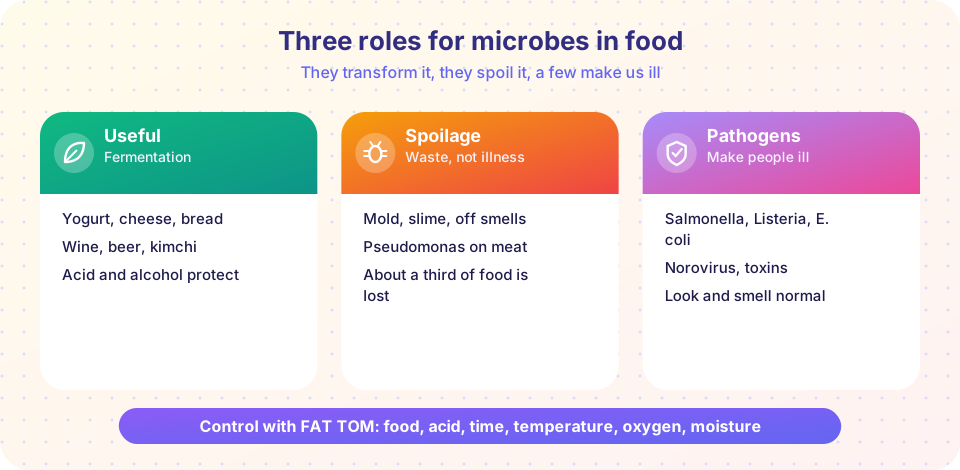
Useful microbes. Lactic acid bacteria turn milk into yogurt and cabbage into sauerkraut by making acid; yeasts make bread rise and ferment grape juice into wine; molds ripen blue cheese and make soy sauce. These fermentations preserve food, add flavor and in many cases improve safety, because the acid and alcohol they make stop harmful species. Chapter 4 returns to them as a preservation tool.
Spoilage organisms. These make food smell, taste or look bad: slime on meat from Pseudomonas, sour milk from lactic bacteria in the wrong place, moldy bread, fizzy fruit juice from wild yeast. Spoilage rarely causes disease, but it wastes food. Roughly a third of food produced for people worldwide is lost or wasted, and spoilage is a major reason.
Pathogens. A small number of species cause illness: bacteria such as Salmonella, Campylobacter, Listeria and certain E. coli; viruses such as norovirus and hepatitis A; parasites; and toxins made by bacteria or molds. A contaminated food often looks, smells and tastes normal, so you cannot rely on your senses. The World Health Organization estimated in 2015 that unsafe food causes about 600 million cases of illness and 420,000 deaths each year worldwide, with children under five carrying a large share of the burden.
The controls in one list
What does a microbe need to grow? Food scientists use the memory aid FAT TOM: Food, Acidity (a suitable pH), Time, Temperature, Oxygen (or its absence, depending on the organism) and Moisture (water activity). Remove or limit one or more and growth slows or stops. Most prevention is one of these:
- Temperature: keep cold foods cold and hot foods hot; cook thoroughly.
- Time: do not leave perishable food in the warm zone for long.
- Acidity: pickling, fermentation and acidified products.
- Moisture: drying, sugar, salt.
- Oxygen: vacuum and modified atmosphere packs (with care for anaerobes).
- Hygiene: stop contamination getting in or spreading.
Microbes in food
FAT TOM
Prevention
What each lesson covers
- The growth of microbes: growth curves, generation time, temperature, pH, oxygen and a predictive model.
- Foodborne pathogens: the main bacteria, viruses, parasites and toxins, how they cause illness and where they hide.
- HACCP and hygiene: the seven principles, critical limits, allergen control and good practice.
- Chapter review: a one-picture summary and a quiz.
A first look at exponential growth
A bacterium divides into two cells, each divides again, and so on. This exponential growth is why small numbers become big numbers surprisingly fast. If a bacterium divides every 20 minutes (a generation time of 20 min), one cell becomes eight cells in an hour and about 2,000 in 4 hours, and 16 million after 8 hours. The next lesson explains why real growth is slower than this ideal.
Common misconceptions
"If it smells fine, it is safe." Many pathogens do not change smell, taste or look. "Bacteria are always bad." Most microbes in food are harmless or helpful. "Freezing kills bacteria." Freezing stops growth but does not reliably kill microbes; they resume growth when the food thaws. "Only dirty kitchens cause food poisoning." Raw foods naturally carry some pathogens; careful handling is needed everywhere.
Try it
Press Run (or Ctrl + Enter) to see the result here.
Program input · what you'd type while the program runs
Type the answers before you press Run, one per line. Each time the program reads a line (with input()), it gets the next line from this box.
Press Run (or Ctrl + Enter) to see the result here.
Program input · what you'd type while the program runs
Type the answers before you press Run, one per line. Each time the program reads a line (with input()), it gets the next line from this box.
Check your understanding
Quick check · 4 questions
of 4 answered You scored / 4 · perfect!
-
1. Which of the following is a useful microbial role?
Fermentation by lactic acid bacteria is a beneficial use; the others are pathogens or spoilage. -
2. What does the T in FAT TOM stand for (two of them)?
FAT TOM: Food, Acidity, Time, Temperature, Oxygen, Moisture. -
3. If a bacterium divides every 30 minutes, how many cells come from one cell in 3 hours (ideal growth)?
3 hours is 6 generations, and 2 to the power 6 is 64. -
4. Which statement about freezing is correct?
Freezing halts growth but most microbes survive and resume growth after thawing.
Summary
- Microbes play three roles in food: useful, spoilage and pathogenic.
- Growth depends on FAT TOM: food, acidity, time, temperature, oxygen and moisture.
- Contaminated food often looks and smells normal, so prevention relies on controls, not senses.
- This chapter covers growth, pathogens and HACCP.
Next: The growth of microbes
Track your progress
Create a free account to tick off lessons and pick up where you left off on any device.
of Food Science lessons completed