


















Lesson 27 of 45 · Sensory Science
Sensory Science: The Big Picture
Meet sensory science: how taste, smell, sight, sound and touch combine into flavor, why thresholds and expectations matter, and how this chapter is organized.
A food can be perfectly safe, nutritious and cheap, and still fail because people do not like it. Sensory science is the discipline that measures and explains how people perceive food with their senses, and it is the only way to turn the sentence "this tastes better" into evidence. In this chapter you learn how the senses work, why texture is as important as flavor, and how to run a test that tells a real difference from a lucky guess.
What you will learn
- Define sensory science and say why industry depends on it.
- Name the five senses involved in eating and what each contributes.
- Explain thresholds, the just-noticeable difference and Weber's law.
- Describe how expectation and context change what people report.
Key terms
Sensory evaluation: the scientific use of human senses to evoke, measure, analyze and interpret responses to food.
Threshold: the lowest intensity of a stimulus that a person can detect (detection threshold) or identify (recognition threshold).
Just-noticeable difference (JND): the smallest change in a stimulus that a person can notice.
Panel: a group of people who evaluate samples under controlled conditions.
Hedonic: relating to liking; a hedonic scale rates how much people like a product.
Flavor is a team effort
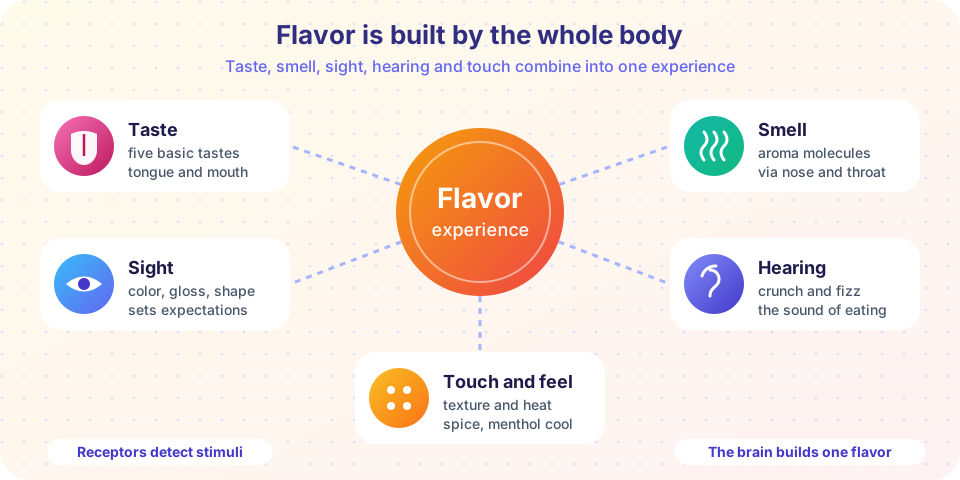
People often say "taste" when they mean flavor, but the two are different. Taste is what the taste buds detect in the mouth: sweet, sour, salty, bitter and umami. Flavor is the overall experience, which adds smell, touch, temperature, sight and even sound. Close your nose while you eat a jelly bean: you can still tell if it is sweet or sour, but the fruit identity disappears until you let go and air flows through your nose again. The aroma molecules were reaching your smell receptors from behind the mouth all along, a route called retronasal smell.
The senses work together:
- Sight gives the first impression. Color sets expectations about flavor and ripeness.
- Smell supplies most of the variety of flavor, from thousands of volatile compounds.
- Taste reports the basic chemical messages: sweet, sour, salty, bitter, umami.
- Touch (in the mouth and on the lips) detects texture, temperature, and chemical sensations such as the burn of chili or the cooling of menthol.
- Hearing adds crunch, crackle and fizz. People rate chips as fresher and crisper when the crunch sounds louder, according to experiments on this effect.
What is in this chapter?
Then measurement
Why it matters
People are the instrument.
People are the measuring instrument
Chemistry can tell you how much sugar and acid a drink contains, but not whether it tastes balanced. Only people can say that. Sensory scientists therefore treat humans like instruments that must be calibrated and used carefully:
- Tests are run in booths with controlled light and temperature, so the room does not influence the answer.
- Samples carry random three-digit codes, so panelists cannot be swayed by a name or position.
- The order of samples is randomized or balanced, because the first sample tends to be rated differently from later ones.
- Panelists rinse between samples with water and plain crackers.
Two kinds of panel are used. A trained (analytical) panel of 8 to 12 people learns to describe and rate specific attributes precisely, much like a laboratory instrument. A consumer panel of 50 to over 100 untrained people (often many more) reports their liking, which tells you what customers will buy. You will meet both in the lesson on sensory testing methods.
Thresholds and the just-noticeable difference
Every sense has a detection threshold: the weakest stimulus that is noticed. Thresholds vary enormously by compound. Humans detect some aroma molecules at parts per trillion in air, while for other compounds much more is needed. They also vary between people: some people cannot smell certain compounds at all, a condition called a specific anosmia.
Above threshold, the question becomes how large a change you can notice. Ernst Weber, a nineteenth-century physiologist, found that the just-noticeable difference is roughly a constant fraction of the starting intensity:
ΔI / I = k (Weber's law, k = Weber fraction)
If the Weber fraction for the sweetness of a drink is, for example, 0.2, then you would need to raise a 5 percent sugar solution by about 1 percentage point to notice the change, but a 10 percent solution by about 2. In practice Weber's law holds well over the middle of the range and breaks down near the threshold and at very high intensities, and the fraction depends on the stimulus and the person. For food developers the lesson is practical: a small recipe change is invisible, so you can cut sugar or salt in small steps that panelists do not notice.
Expectation and context
Perception is not a camera. The brain combines what the senses report with what you expect. In well-known experiments, wine tasters described a white wine that had been dyed red with the vocabulary of red wine; more recent work shows that the effect depends on the tasters and the conditions, but the lesson stands: color and labels can change reports of flavor. Packaging, price, brand and even the plate color have measurable effects on liking. Sensory scientists control for these with blind testing, and when the effect of the information is itself the question, they test with and without it.
Common misconceptions
"Flavor is just taste." Taste is one input. Smell contributes most of the variety, and texture, temperature and sound also change liking.
"The tongue map shows where each taste is detected." The famous map with sweet at the tip and bitter at the back is a myth. All five tastes can be detected on all parts of the tongue that carry taste buds.
"If a trained panel cannot tell two products apart, nobody can." Consumers may have different sensitivities, and a panel test with few people can miss small differences. Test size matters, which is why statistics comes later in this chapter.
Try it
First, a demonstration of the nose-pinch idea. Choose a flavor and a nose setting to see which parts of the experience survive. It is a teaching table, not a measurement.
Second, Weber's law as a sugar-reduction planner: starting from a sweet drink, how many just-noticeable steps are there on the way down? The Weber fraction here is an illustrative assumption.
Press Run (or Ctrl + Enter) to see the console output here.
No output.
In this chapter
| Lesson | What it covers |
|---|---|
| Taste, smell and flavor perception | Receptors, five tastes, aroma and flavor |
| Texture and rheology | Viscosity, flow curves and the language of texture |
| Sensory testing methods | Panels, discrimination tests and statistics |
| Chapter 6 review | Recap, one-picture summary and a 9-question quiz |
Check your understanding
Quick check · 4 questions
of 4 answered You scored / 4 · perfect!
-
1. What is the difference between taste and flavor?
Taste means the five basic tastes. Flavor is the whole experience, including aroma and texture. -
2. Why are samples in sensory tests given random three-digit codes?
Blind coding stops panelists from being influenced by what they think a sample is. -
3. A Weber fraction is 0.1. About how big a change in a 20-unit stimulus is just noticeable?
The JND is k times the starting intensity: 0.1 × 20 = 2 units. -
4. Which statement about the tongue map is correct?
The tongue map is a myth based on a misreading of early data.
Summary
- Sensory science uses people, under controlled conditions, to measure how foods are perceived.
- Flavor combines taste, smell (including retronasal), touch, sight and sound.
- Detection thresholds and just-noticeable differences set how small a change can be before people notice; Weber's law says the JND is roughly a fixed fraction of intensity.
- Expectation, labels and color change reports of flavor, so tests are blind and balanced.
- Trained panels describe attributes; consumer panels measure liking.
Track your progress
Create a free account to tick off lessons and pick up where you left off on any device.
of Food Science lessons completed