


















Lesson 3 of 45 · Getting Started
What is food science? Disciplines, history and careers
Meet the sciences behind food, a timeline from canning and pasteurization to Codex, and the jobs food scientists do, with a timeline plot and explorer.
Humans have preserved, cooked and fermented food for thousands of years, long before anyone knew what a microbe or a molecule was. Bread, cheese, beer, dried fish and salted meat all appeared by trial and error. Food science is what happens when we explain why those traditions work and use the explanation to do better: safer canned vegetables, longer-lasting milk, crispier snacks with less oil, or a plant-based burger that browns as it cooks.
The field is young. It took shape in the nineteenth and twentieth centuries as chemistry, microbiology and engineering reached the kitchen and the factory. Today it is both an academic subject and a global industry that employs scientists in laboratories, factories, regulators, supermarkets and start-ups.
What you will learn
- Describe food science and separate it from cooking, nutrition and farming.
- Name the disciplines that contribute to the field and what each one asks.
- Place five milestones (canning, pasteurization, Pure Food law, Codex, modern HACCP) on a timeline.
- Describe typical careers and the skills they use.
Key terms
Food technology: using science to design and run food production. Food safety: preventing food from causing harm. Food quality: how well a food meets expectations for taste, appearance, texture and consistency. Codex Alimentarius: international food standards, guidelines and codes of practice set by a joint body of the FAO and WHO.
The disciplines
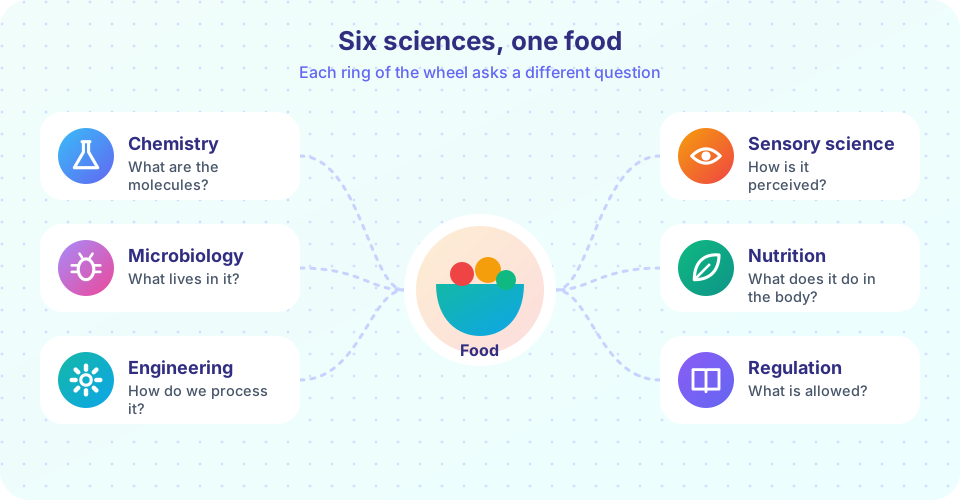
No single science can explain a slice of pizza. Its crust is a starch and protein network (chemistry), its cheese was made by bacteria and enzymes (microbiology), it was baked on a conveyor oven that moves heat (engineering), it must taste good (sensory science), it supplies energy and nutrients (nutrition) and its label must be truthful and its ingredients lawful (regulation).
| Discipline | Question it asks | Everyday example |
|---|---|---|
| Food chemistry | What are the molecules and how do they react? | Why does a cut apple brown? |
| Food microbiology | What lives in food and what does it do? | Why does yogurt thicken? Why does chicken spoil? |
| Food engineering | How do we move heat, mass and momentum at scale? | How long must a can be heated? |
| Sensory science | How do people perceive food? | Is the new recipe sweeter than the old? |
| Nutrition | What does food do inside the body? | How much protein is in a serving? |
| Regulation and quality | What is allowed, what must a label say? | Is "low fat" a legal claim here? |
A food scientist usually specializes in one or two of these rows but must be able to talk to the others. A product developer needs a feel for all six; a quality manager leans on microbiology and statistics; a process engineer lives in the engineering row.
How food science differs from its neighbors
- Cooking is the craft; food science explains the craft. A chef can make a perfect custard by touch. A food scientist can say that egg proteins set between about 70 and 85 °C depending on the ingredients, and design a custard that survives freezing.
- Nutrition studies how food affects health. Food science studies food itself, though the two overlap on topics like fortification and label claims.
- Agriculture produces raw materials. Food science starts at harvest (or slaughter) and follows food through storage, processing and distribution, though growers and food scientists increasingly work together.
A short history
Five milestones show how the field grew by solving problems.
1809: canning. In France, Nicolas Appert showed that food sealed in glass jars and heated in boiling water could be kept for months. The French government had offered a prize for a way to feed armies and sailors; Appert won it. He did not know why it worked. In 1810 the Englishman Peter Durand patented the tin can, and canned food took off.
1860s: pasteurization. Louis Pasteur investigated why wine and beer spoiled and showed that microbes were responsible. Gentle heating, later called pasteurization, killed enough of them to keep drinks stable. Pasteurization of milk spread widely in the early twentieth century and sharply reduced diseases such as tuberculosis and typhoid carried in milk.
1906: the Pure Food and Drug Act. After public outcry about adulterated and mislabeled food, the United States passed its first major federal food law, and chemist Harvey Wiley had led much of the campaign. Other countries built similar systems around the same time.
1963: Codex Alimentarius. The FAO and WHO created a commission to develop shared food standards, so that traders and consumers in different countries could rely on common definitions and limits. Codex texts are now referenced in many national laws.
1960s onward: HACCP. A system for preventing hazards in food, developed with the US space program and food companies for astronaut food, later became the standard approach to food safety worldwide. Chapter 3 teaches it in detail.
What food scientists do
Careers fall into a few families.
- Product development. Create new foods or reformulate existing ones: cut sugar, add fiber, replace an allergen, make a plant-based version. Needs chemistry, sensory testing and creativity.
- Quality assurance and food safety. Write procedures, audit suppliers, test samples, investigate complaints and manage recalls. Needs microbiology, statistics and regulation.
- Process and packaging engineering. Design and run the equipment that heats, cools, mixes, fills and seals food. Needs engineering and physics.
- Regulatory affairs. Check that ingredients, claims and labels comply with national and international law.
- Research and academia. Study mechanisms, such as why a protein gels or how a pathogen survives drying.
- Public health and inspection. Work for authorities inspecting premises and investigating outbreaks.
How a food scientist thinks: one problem, six lenses
Suppose a company wants to launch a shelf-stable, ready-to-drink iced tea. A beginner might say "brew tea, add sugar, bottle it". A food scientist asks a series of questions, one from each discipline. Chemistry: tea contains polyphenols that oxidize and darken, and some bind with proteins and minerals to make the drink cloudy when it cools, so what pH and what water will keep it clear? Microbiology: a sweet, mildly acidic liquid will happily grow yeasts and molds, so what heat treatment or preservative system gives the required shelf life? Engineering: how long must the bottle be held hot after filling, and can the line run fast enough to be economical? Sensory science: will tasters accept a slightly cooked flavor, and how sweet should it be? Nutrition: how many calories and how much sugar per serving, and could part of the sugar be replaced? Regulation: which additives are permitted in which countries, and what may the label claim?
Notice that the answers pull against each other. A lower pH helps microbial stability but makes the tea sour; more heat gives more safety but a cooked taste; fewer calories may mean a different sweetener with a different aftertaste. Food science is mostly the art of finding a workable compromise, backed by measurements. The rest of this course gives you the tools for each lens.
Common misconceptions
"Food scientists add chemicals to make food unnatural." Everything is chemicals, including water and the vitamin C in an orange. Additives are regulated and each has a purpose, such as preventing mold, replacing a lost nutrient or keeping a sauce from separating. Whether a particular additive is worthwhile is a fair debate, but the claim is about chemistry, not naturalness.
"Appert and Pasteur invented the same thing." Appert (1809) preserved food by heating in sealed containers without understanding microbes. Pasteur (1860s) explained that microbes cause spoilage and developed gentle heating for liquids. Appert's method is canning; Pasteur's is pasteurization.
"Regulation is only about safety." Laws also cover labeling, composition standards (what may be called "chocolate") and honest claims.
Try it
Press Run (or Ctrl + Enter) to see the result here.
Program input · what you'd type while the program runs
Type the answers before you press Run, one per line. Each time the program reads a line (with input()), it gets the next line from this box.
Check your understanding
Quick check · 5 questions
of 5 answered You scored / 5 · perfect!
-
1. What was Nicolas Appert's contribution?
Appert (1809) developed canning in glass jars. Pasteur later explained spoilage; Codex and food laws came afterwards. -
2. Which discipline mainly asks how to move heat and mass in a factory?
Food engineering applies physics and engineering principles to processing equipment. -
3. Codex Alimentarius is...
Codex was created in 1963 to develop shared international standards. -
4. Which job leans most on statistics, microbiology and auditing?
QA and food safety staff test samples, audit suppliers and investigate problems, so they need microbiology, statistics and regulation. -
5. Which statement about pasteurization is correct?
Pasteurization is a mild heat treatment that reduces disease-causing and spoilage microbes. It does not usually give complete sterility.
Summary
- Food science explains and improves food by combining chemistry, microbiology, engineering, sensory science, nutrition and regulation.
- Milestones: Appert's canning (1809), Pasteur's work on microbes (1860s), early food laws (1906), Codex (1963) and HACCP.
- Careers include product development, quality and safety, engineering, regulatory work, research and inspection.
- Cooking, nutrition and agriculture are neighbors, not synonyms.
Next: What food is made of
Track your progress
Create a free account to tick off lessons and pick up where you left off on any device.
of Food Science lessons completed