


















Lesson 23 of 45 · Processing Technology
Processing Technology: The Big Picture
See how food factories turn raw crops and milk into safe, stable products: the main unit operations, what each one changes, and how to plan this chapter.
A tomato in a field spoils in days. The same tomato, turned into paste, sauce or a can of whole peeled fruit, can sit on a shelf for two years. What happened in between is food processing: a planned series of physical, chemical and biological treatments that change a raw material into a food that is safe, stable, pleasant and convenient. This chapter shows you how food scientists and engineers think about that series, and then goes deep on the two ideas that matter most: heat treatment and emulsions.
What you will learn
- Define a unit operation and name the five groups used in this chapter.
- Explain what processing changes in a food: safety, shelf life, texture, flavor, nutrients and convenience.
- Do a simple mass balance on a drying step.
- Know where heat treatment and emulsification fit and which lessons cover them.
Key terms
Unit operation: one basic physical step used in many industries, such as mixing, heating, cooling, milling, drying or filtering.
Process flow diagram: a sketch of the unit operations in order, with arrows for the material flow.
Mass balance: the rule that what goes into a step must come out (or accumulate): input = output + accumulation.
Critical process parameter: a setting, such as temperature or time, that must stay within limits for the product to be safe and consistent.
Throughput: how much product a line makes per hour, for example kilograms per hour.
Why we process food
People process food for five main reasons, and most real processes serve several at once.
- Safety. Heat, acid, drying and other treatments reduce or remove disease-causing microbes and some natural toxins. Cooking dried kidney beans destroys a toxic lectin; pasteurizing milk removes pathogens such as Salmonella and Listeria.
- Shelf life. Spoilage organisms and chemical reactions such as oxidation limit how long a food lasts. Processing slows or stops them. Chapter 4 covered preservation principles; this chapter covers the machines and calculations behind several of them.
- Quality. Milling gives flour a fine, even particle size; homogenizing gives milk a smooth mouthfeel; roasting creates flavor.
- Convenience. Peeled, cut, cooked and ready-to-eat foods save time.
- Nutrition and function. Fortifying flour with iron, or removing the bitter compounds from a bean, makes a food more useful.
Processing is not automatically good or bad for nutrition. Cooking improves the digestibility of starch and removes anti-nutrients, while heat also destroys some vitamins. The chapters on nutrition later in this course look at both sides.
Five jobs of processing
More jobs
How we do it
Each is a unit operation.
Unit operations: the building blocks
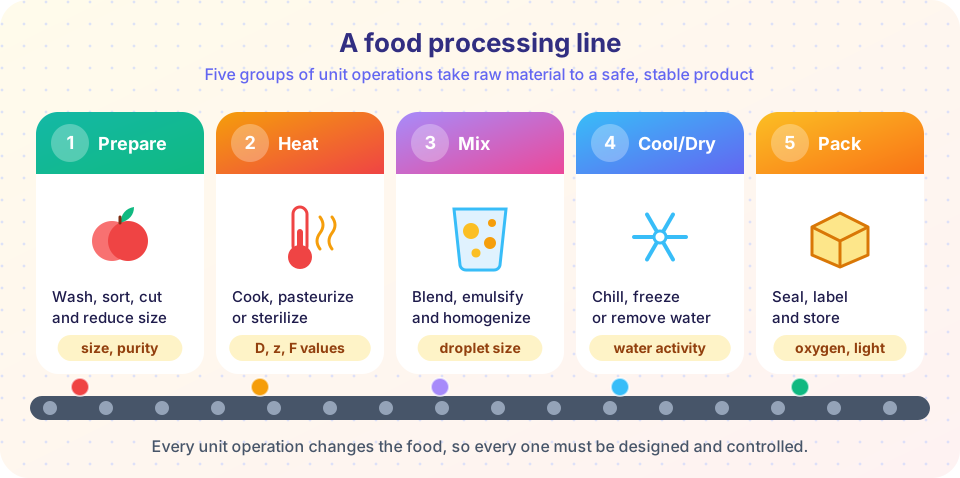
Chemical engineers noticed in the early twentieth century that factories look very different but reuse the same few steps. A unit operation is one of those steps. Learn the step once and you can analyze it in a bread plant, a dairy and a sauce factory. Five groups cover most of what you will meet.
| Group | Typical operations | What changes | Key variable |
|---|---|---|---|
| Prepare | Washing, sorting, peeling, cutting, milling | Cleanliness, size, uniformity | Particle size, purity |
| Heat | Blanching, pasteurizing, canning, baking, frying | Microbes, enzymes, texture, color, flavor | Time and temperature |
| Mix | Blending, kneading, emulsifying, homogenizing | Uniformity, droplet size, structure | Energy input, droplet size |
| Cool or dry | Chilling, freezing, evaporation, drying | Temperature, water content | Water activity, temperature |
| Pack | Filling, sealing, modified atmosphere, labeling | Protection and information | Oxygen, light, moisture barrier |
Two operations deserve a short outline here, because they appear in many products but are not given a separate lesson.
Milling breaks solid pieces into smaller ones, usually between rollers (wheat flour) or with hammers and discs (spices, corn). Smaller particles cook faster and dissolve faster, but fine powders can also form dust clouds that explode, so flour mills control dust carefully.
Extrusion pushes a dough or paste through a shaped opening, the die, with a rotating screw. In a cooking extruder the barrel is heated and the screw also shears the material, so the food is cooked, mixed and shaped in seconds. When hot, pressurized dough leaves the die, its water flashes to steam and the product puffs. Breakfast cereals, many snacks, pasta and some meat substitutes are made this way. Because the temperature is high but the time short, extrusion is a good example of the high-temperature, short-time idea that returns in the next lesson.
A first calculation: the mass balance
Every process engineer starts with a mass balance. The rule is simple: mass in = mass out + accumulation. Because dry solids do not evaporate, a drying calculation tracks the solids and works out the water from them.
Suppose 100 kg of fresh tomatoes contain 94 percent water, so 6 kg of solids. You dry them to 20 percent water. The final product is 80 percent solids, so its mass is 6 kg / 0.80 = 7.5 kg. The water removed is 100 − 7.5 = 92.5 kg. A drier that removes 92.5 kg of water for every 100 kg of fruit needs a lot of energy: that is why drying is costly, and why many factories first concentrate a liquid by evaporation or membrane filtration before the final drying step.
Common misconceptions
"Processed food is the same thing as junk food." Processing is any deliberate change to a food. Frozen peas, canned beans, yogurt, flour and pasteurized milk are all processed. Whether a product is healthy depends on its composition, not on whether it passed through a machine.
"A bigger process is always safer." More heat kills more microbes but also destroys nutrients and texture. The goal is enough treatment, calculated from the target microbe and the food, not the most treatment.
Try it
First, a quick trainer. Pick a problem and see which group of unit operations usually addresses it. This is a teaching table, not a design tool.
Now the mass balance as a small calculator for any product. Change the numbers and re-run.
Press Run (or Ctrl + Enter) to see the console output here.
No output.
In this chapter
| Lesson | What it covers |
|---|---|
| Thermal processing: D, z and F values | How much heat is enough, and how to calculate it |
| Mixing, emulsions and homogenization | How oil and water are combined and kept together |
| Chapter 5 review | Recap, one-picture summary and a 9-question quiz |
Check your understanding
Quick check · 4 questions
of 4 answered You scored / 4 · perfect!
-
1. What is a unit operation?
Unit operations are reusable steps, so learning one helps you analyze it in any food factory. -
2. 100 kg of fruit with 90 percent water is dried to 10 percent water. About how much dried product results?
Solids are 10 kg and stay constant. Product mass = 10 / 0.90 = 11.1 kg. -
3. Why is extrusion often described as high-temperature, short-time?
Residence time in a cooking extruder is short, so food is cooked while quality loss is limited. -
4. Which statement about processed food is correct?
Even washing, cutting and freezing are processing; the effect on nutrition depends on what is done.
Summary
- Food processing is a planned chain of unit operations that makes food safe, stable, pleasant and convenient.
- Five groups cover most lines: prepare, heat, mix, cool or dry, and pack.
- Each group has a key variable to control: size, time and temperature, droplet size, water activity, or oxygen and light.
- A mass balance (in = out + accumulation) is the first calculation in any process design; for drying, track the solids.
- Processing is a spectrum, not a verdict: judge a food by its composition and treatment.
Track your progress
Create a free account to tick off lessons and pick up where you left off on any device.
of Food Science lessons completed