


















Lesson 33 of 45 · Nutrition and Labeling
Energy and Macronutrients
Calculate food energy with Atwater factors and learn the science of macronutrients: carbohydrate types, protein quality (PDCAAS, DIAAS), amino acid scoring and fatty acids.
How many calories are in a granola bar? Nobody burns every bar in a laboratory. Instead, the number on the pack is calculated: measure the grams of fat, carbohydrate and protein, multiply by energy factors, and add. This lesson shows where those factors come from and what they hide, then looks at the three macronutrients as food scientists see them: the types of carbohydrate, what makes a protein good, and how fatty acids differ. The aim is understanding the numbers on the label and the science behind them, not telling you what to eat.
What you will learn
- Calculate food energy from composition with general Atwater factors, including alcohol and fiber.
- Describe the main types of carbohydrate and what glycemic index means.
- Explain protein quality, limiting amino acids, PDCAAS and DIAAS.
- Distinguish saturated, unsaturated and trans fats and name the essential fatty acids.
Key terms
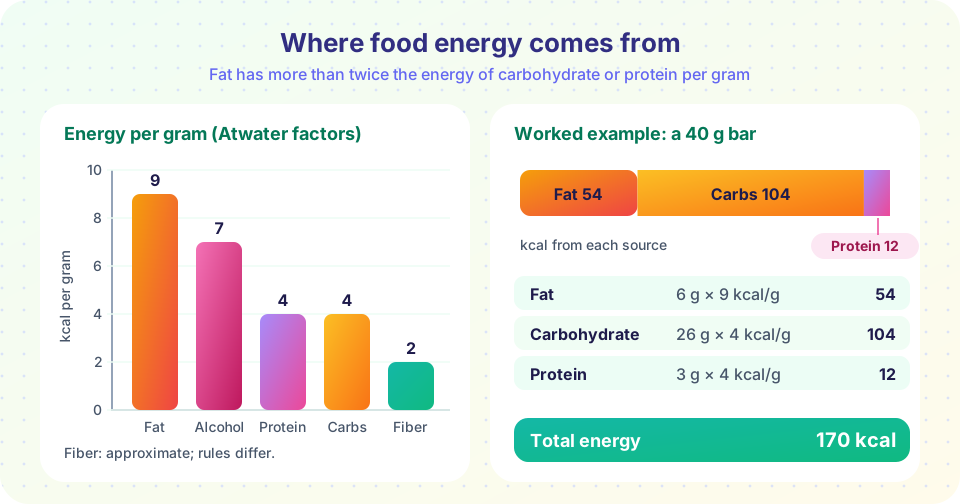
Atwater factors: average energy values per gram of protein (4 kcal), carbohydrate (4 kcal) and fat (9 kcal), used to calculate food energy.
Limiting amino acid: the essential amino acid present in the lowest amount compared with the body's needs, which limits the use of the whole protein.
PDCAAS and DIAAS: two scores of protein quality that combine amino acid pattern with digestibility.
Glycemic index (GI): a ranking from 0 to 100 of how much a carbohydrate food raises blood glucose compared with a reference food.
Triglyceride: a fat molecule made of glycerol and three fatty acids.
How food energy is calculated
The old method was a bomb calorimeter: burn a food in oxygen inside a sealed steel vessel in water and measure the temperature rise. This gives the gross energy, which is higher than what the body gets, because the body does not absorb everything (fiber and some protein pass through) and because nitrogen from protein leaves in urine as urea rather than being oxidized.
The American chemist Wilbur Atwater measured digestibility and losses in the late nineteenth century and arrived at average values for the energy the body can use. They are the general Atwater factors:
| Component | kcal per gram | kJ per gram |
|---|---|---|
| Fat | 9 | 37 |
| Alcohol | 7 | 29 |
| Protein | 4 | 17 |
| Carbohydrate (available) | 4 | 17 |
| Fiber (EU rule) | 2 | 8 |
The EU labeling rules also assign values to some other components, such as polyols (sugar alcohols, about 2.4 kcal per gram) and organic acids (about 3 kcal per gram). Other countries make other choices, for example about whether and how to count fiber, which is why the same product can show slightly different energy under different systems.
Worked example. 100 g of a cereal contains 12 g protein, 60 g total carbohydrate of which 4 g is fiber, and 8 g fat. Counting fiber separately, as in the EU system:
available carbohydrate = 60 − 4 = 56 g
energy = 12×4 + 56×4 + 4×2 + 8×9 = 48 + 224 + 8 + 72 = 352 kcal
In kilojoules that is about 352 × 4.184 = 1,473 kJ. Note that fat, at 8 g, supplies 72 of 352 kcal: 20 percent of the energy from 8 percent of the mass. Specific factors for individual foods (for example for different cereals or for eggs) can be used instead of the general ones and are slightly different.
Carbohydrates
Carbohydrates are classified by size:
- Sugars: monosaccharides (glucose, fructose, galactose) and disaccharides (sucrose, lactose, maltose).
- Oligosaccharides: short chains of 3 to 9 units, such as raffinose in beans, which humans digest poorly.
- Polysaccharides: starch (amylose and amylopectin, from plants), which is digestible, and the non-starch polysaccharides that make up dietary fiber: cellulose, pectin, beta-glucan and others.
The speed of digestion differs. Foods with rapidly digested starch and sugars raise blood glucose quickly; foods with intact cell walls, high fiber or cooled and retrograded starch raise it more slowly. The glycemic index measures this: a test food containing a fixed amount (usually 50 g) of available carbohydrate is compared with the same amount of glucose or white bread in the same people, using the area under the blood glucose curve. A GI of 55 or less is called low, 56 to 69 medium, and 70 or above high on the standard scale. GI depends on how the food is cooked and combined and varies between people, and the amount eaten matters, which is why another measure, glycemic load, multiplies GI by the carbohydrate in a portion. Nutrition authorities treat GI as one tool among several, not a complete guide to food choice.
Fiber is divided into soluble fiber (forms gels and is fermented, such as oat beta-glucan and pectin) and insoluble fiber (adds bulk, such as wheat bran). Many public health bodies recommend plenty of fiber from whole plant foods.
Proteins and protein quality
Proteins are long chains of about 20 different amino acids. Nine are indispensable (essential) for adults: histidine, isoleucine, leucine, lysine, methionine, phenylalanine, threonine, tryptophan and valine. The body can make the rest.
Food scientists measure protein through nitrogen: in the Kjeldahl method the food is digested, the nitrogen is measured, and protein is estimated as nitrogen × a factor. The default factor is 6.25 (protein is about 16 percent nitrogen), with specific factors for some foods such as 5.7 for wheat and 6.38 for dairy.
Quality differs between proteins. A complete protein supplies all essential amino acids in proportions close to human needs; animal proteins (milk, eggs, meat) usually do, while many plant proteins are short of one amino acid: lysine in cereals, and the sulfur amino acids (methionine plus cysteine) in many legumes. Because the shortfalls are different, a cereal and a legume eaten over the day complement each other, as in rice and beans or hummus and bread. Two scores rank quality:
- PDCAAS (protein digestibility-corrected amino acid score): the amino acid score is the content of the most limiting amino acid divided by the amount in a reference pattern, multiplied by true fecal digestibility and capped at 1.0.
- DIAAS (digestible indispensable amino acid score): the newer FAO recommendation. It uses digestibility of each amino acid at the end of the small intestine and does not cap at 1.0, so it can rank high-quality proteins more finely.
Scores depend on the reference pattern for the age group and on the test data, so a value from a table is an estimate.
Fats
Dietary fats are mostly triglycerides. A fatty acid is a carbon chain with an acid group at one end. If the chain has no double bonds it is saturated; one double bond makes it monounsaturated and several make it polyunsaturated. Saturated fats are usually solid at room temperature (butter, coconut oil) and unsaturated fats liquid (olive, sunflower oil), although there are exceptions.
- Essential fatty acids: linoleic acid (omega-6) and alpha-linolenic acid (omega-3) cannot be made by humans. The long-chain omega-3 fats EPA and DHA come from fish, algae, and a small conversion from alpha-linolenic acid.
- Trans fats: unsaturated fats with a particular double-bond shape. Industrial partial hydrogenation of oils created them; small amounts also occur naturally in ruminant fats. Many health authorities advise keeping trans fat intake as low as possible, and a number of countries restrict industrially produced trans fat.
- Cholesterol: a sterol found only in animal foods, not a triglyceride and a source of no energy. The body also makes it.
In foods, fats carry flavor and fat-soluble vitamins, give richness and tenderness, and are the medium for frying. Their weakness is oxidation (rancidity), which makes unsaturated oils spoil faster, a problem that packaging, antioxidants and low oxygen help to control.
Common misconceptions
"All calories are processed the same way." The Atwater factors are averages. The digestibility of a food, how finely it is ground, its fiber content and cooking all change the energy the body actually gets, and protein costs more energy to digest than fat does.
"Complete protein must be eaten at every meal." Amino acids from different foods eaten over a day can complement one another.
"Fat-free means calorie-free." Fat-free products often replace fat with sugar or starch, which still supply 4 kcal per gram.
Try it
First, an amino acid scoring demo. The reference pattern is the FAO 2013 pattern for older children, adolescents and adults for lysine and the sulfur amino acids. The values for wheat and lentil protein are rounded, illustrative figures for teaching, not precise food composition data.
Press Run (or Ctrl + Enter) to see the result here.
Program input · what you'd type while the program runs
Type the answers before you press Run, one per line. Each time the program reads a line (with input()), it gets the next line from this box.
Second, an energy calculator for a food label: enter grams per 100 g and it applies the general factors, with the fiber and alcohol options of the EU system.
Press Run (or Ctrl + Enter) to see the console output here.
No output.
Third, the Kjeldahl calculation: from the measured nitrogen to the protein value printed on a label.
Press Run (or Ctrl + Enter) to see the console output here.
No output.
Check your understanding
Quick check · 5 questions
of 5 answered You scored / 5 · perfect!
-
1. A food contains 10 g fat, 20 g carbohydrate (no fiber) and 5 g protein per serving. About how much energy does it have using the general Atwater factors?
10 × 9 + 20 × 4 + 5 × 4 = 90 + 80 + 20 = 190 kcal. -
2. Which amino acid is typically limiting in cereals?
Cereal proteins are relatively low in lysine. -
3. What does DIAAS use that PDCAAS does not?
DIAAS measures digestibility per amino acid at the ileum and does not truncate scores at 1.0. -
4. Which fatty acids are essential for humans?
Humans cannot make linoleic (omega-6) or alpha-linolenic (omega-3) acid. -
5. Why can a 'fat-free' cake still be high in energy?
Removing fat does not remove carbohydrate energy, and sugar often replaces the fat.
Summary
- Food energy is calculated with Atwater factors: fat 9, alcohol 7, protein 4, carbohydrate 4, fiber about 2 kcal per gram (EU system).
- Carbohydrates range from sugars to starch to fiber; glycemic index ranks how fast a food raises blood glucose.
- Protein is estimated as nitrogen × 6.25 (or a food-specific factor); quality depends on essential amino acids and digestibility (PDCAAS, DIAAS).
- Limiting amino acids differ between cereals and legumes, so mixtures can complement each other.
- Fats are triglycerides; saturated, mono- and polyunsaturated, essential and trans fatty acids matter for health and for oxidation stability.
Track your progress
Create a free account to tick off lessons and pick up where you left off on any device.
of Food Science lessons completed