


















Lesson 12 of 45 · Food Chemistry
Chapter review: Food Chemistry
Review Chapter 2: water activity, sugars and starch, protein denaturation and Maillard browning, lipid oxidation and emulsions, with a ten-question quiz.
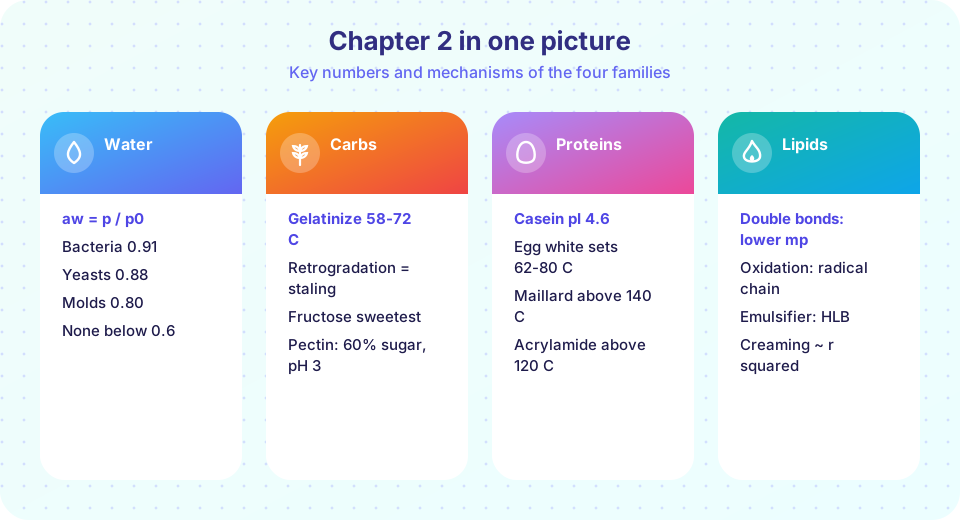
You have now met the four molecule families that make up almost every food. This review pulls them into one picture. The goal is to be able to look at any everyday food change (a brown crust, a runny sauce, a stale loaf, a rancid nut) and name the family and the mechanism behind it.
Look at the summary picture first and try to explain each panel without notes. Then use the recap table to check what you remember and what needs another read.
What you will learn
- Recall the key ideas and numbers of each Chapter 2 lesson.
- Match everyday food problems to the right chemistry.
- Practice with a mixed quiz.
Key terms
Must know: water activity, hydrogen bond, sorption isotherm, glycosidic bond, amylose, amylopectin, gelatinization, retrogradation, caramelization, denaturation, isoelectric point, Maillard reaction, acrylamide, triglyceride, cis and trans, autoxidation, emulsion, emulsifier, HLB, Stokes' law.
Recap
| Lesson | Core idea | Numbers and examples to remember |
|---|---|---|
| Water and water activity | Availability, not amount, controls growth and reactions | aw = p/p0; bacteria about 0.91, yeasts 0.88, molds 0.80, nothing below about 0.6; Norrish equation |
| Carbohydrates | Sugars dissolve and sweeten; starch swells and sets | Fructose about 1.2-1.7 and lactose about 0.2 times as sweet as sucrose; gelatinization about 58-72 °C; retrogradation causes staling; jam: about 60-65% sugar, pH about 3 |
| Proteins | Folded chains unfold and aggregate | Casein pI about 4.6; egg white sets about 62-80 °C; Maillard fast above about 140 °C; acrylamide above about 120 °C |
| Lipids | Chain shape sets melting; oxygen spoils; emulsifiers stabilize | Oleic melts about 13 °C, stearic about 69 °C; oxidation rate rises with double bonds; creaming speed grows with radius squared |
Diagnose the problem
A good habit is to treat each food change as a case file.
- Cut apple turns brown. Enzymatic browning (polyphenol oxidase, oxygen). Fix: acid, heat (blanching) or excluding oxygen. Not Maillard.
- Dry pasta stays good for years, a cooked bowl spoils in a day. Water activity (about 0.5 versus 0.97).
- A white sauce lumps. Starch granules swelled unevenly, or the flour was added to hot liquid. Disperse starch in cold liquid or fat first.
- A custard curdles. Egg proteins aggregated too fast at too high a temperature; heat gently and stir.
- Chocolate has a grey bloom. Fat crystals changed form or migrated; storage temperature swings.
- Walnut oil smells of paint. Autoxidation of polyunsaturated fatty acids.
- Cream rises in unhomogenized milk. Stokes' law: large globules rise quickly.
Water
Carbohydrates
Proteins
Lipids
Worked problems with solutions
Problem 1: water activity of a syrup. A syrup contains 40 g of sucrose in 60 g of water. Estimate aw with the Norrish equation (K = −6.47 for sucrose; molar masses 342.3 and 18.015 g/mol).
Solution. Moles of sucrose = 40 / 342.3 = 0.1169; moles of water = 60 / 18.015 = 3.331. Mole fraction of sucrose xs = 0.1169 / 3.448 = 0.0339, so xw = 0.9661. Then aw = 0.9661 × exp(−6.47 × 0.0339²) = 0.9661 × exp(−0.00744) ≈ 0.959. A 40% syrup is still easily spoiled by yeasts and molds; only much higher sugar levels, near 65%, bring aw down to jam range.
Problem 2: rate change with temperature. A browning reaction has an activation energy of 100 kJ/mol. Estimate how much faster it goes at 150 °C than at 100 °C.
Solution. Use rate ratio = exp[(Ea/R)(1/T₁ − 1/T₂)] with T in kelvin: T₁ = 373.15 K, T₂ = 423.15 K. Ea/R = 100,000 / 8.314 = 12,028 K. The bracket is (1/373.15 − 1/423.15) = 0.002680 − 0.002363 = 0.000317. So ratio = exp(12,028 × 0.000317) = exp(3.81) ≈ 45. Fifty degrees hotter makes the reaction roughly forty-five times faster, which is why searing browns while steaming does not.
Problem 3: creaming. Two milk samples differ only in fat globule diameter: 4 µm and 1 µm. How do their creaming speeds compare?
Solution. Stokes' law makes speed proportional to radius squared. The radius ratio is 4, so the speed ratio is 4² = 16. The 4 µm globules rise sixteen times faster, which is why unhomogenized milk forms a cream layer and homogenized milk does not.
Problem 4: which sugar? A cook heats plain sucrose in a dry pan and it turns amber at about 170 °C, with no protein present. Name the reaction and explain why it is not Maillard browning.
Solution. It is caramelization, the thermal breakdown of sugar. Maillard browning requires an amino group (from an amino acid or protein) and a reducing sugar; neither is present, and sucrose is not a reducing sugar until it is split.
Discuss any problem you missed with the lesson it came from: water activity (problem 1), proteins and Maillard (problems 2 and 4) or lipids and emulsions (problem 3).
Try it
Common misconceptions
"Browning is one reaction." There are three different ones: enzymatic browning, caramelization and Maillard. "Proteins and starch are both sugars." Starch is glucose polymer; proteins are amino acid chains. "More water always means faster spoilage." Availability matters more than amount.
Press Run (or Ctrl + Enter) to see the result here.
Program input · what you'd type while the program runs
Type the answers before you press Run, one per line. Each time the program reads a line (with input()), it gets the next line from this box.
Press Run (or Ctrl + Enter) to see the result here.
Program input · what you'd type while the program runs
Type the answers before you press Run, one per line. Each time the program reads a line (with input()), it gets the next line from this box.
Check your understanding
Quick check · 10 questions
of 10 answered You scored / 10 · perfect!
-
1. A food has aw 0.75. Which group is most likely to grow on it, ignoring other hurdles?
Ordinary bacteria stop near 0.91 and most molds near 0.80, but halophiles (about 0.75) and xerophiles can grow. -
2. Which sugar is NOT a reducing sugar when intact?
Sucrose's reactive groups are tied up in the glycosidic bond. -
3. Gelatinization of starch requires...
Granules swell and melt crystalline regions in hot water. -
4. Why does bread stale fastest in a refrigerator?
Retrogradation is fastest near 0 to 4 °C; freezing stops it, and warm room temperature is slower. -
5. Casein precipitates from milk at about...
pH 4.6 is casein's isoelectric point. -
6. Which oil should be most protected from oxygen?
Flaxseed oil is rich in alpha-linolenic acid, the most oxidation-prone. -
7. Halving droplet diameter in an emulsion changes creaming speed by what factor?
Speed is proportional to radius squared, so half the radius gives a quarter of the speed. -
8. Acrylamide forms mainly from...
Asparagine reacts with reducing sugars above about 120 °C. -
9. Which is a water-in-oil emulsion?
Butter has water droplets in a fat continuous phase; milk and mayonnaise are oil-in-water. -
10. Which treatment slows enzymatic browning of cut apple?
Acid lowers the pH where polyphenol oxidase works, and slows browning.
Summary
- Water activity, not water content, controls microbes and many reactions.
- Sugars sweeten and caramelize; starch gelatinizes then retrogrades; pectin gels with sugar and acid.
- Proteins unfold (denature) and set; Maillard browning needs sugar plus amino groups and heat.
- Fats differ by fatty acid shape; oxidation is a radical chain; emulsions need emulsifiers and small droplets.
Track your progress
Create a free account to tick off lessons and pick up where you left off on any device.
of Food Science lessons completed