


















Lesson 15 of 45 · Food Microbiology and Safety
Foodborne pathogens: bacteria, viruses, parasites and toxins
Meet the main foodborne pathogens, learn infection versus intoxication, typical sources and controls, and see a dose-response model for risk.
Foodborne illness is common, usually unpleasant, and sometimes deadly. Most cases are short episodes of vomiting and diarrhea that people never report, but some pathogens cause kidney failure, miscarriage, meningitis or paralysis. Public health agencies estimate that tens of millions of people fall ill from food each year even in wealthy countries, and the World Health Organization estimates roughly 600 million cases and 420,000 deaths worldwide each year (2015 estimate). Almost all of this is preventable.
This lesson introduces the pathogens a food scientist must know, how they cause illness (infection, intoxication or both), which foods they like and which control measures work against them. It is educational information only. If you suspect food poisoning, seek medical advice, especially for infants, older adults, pregnant women and people with weakened immune systems.
What you will learn
- Distinguish infection, intoxication and toxicoinfection.
- Name the main bacterial, viral and parasitic pathogens and their usual sources.
- Explain why some pathogens survive cooking or refrigeration.
- Describe how dose and susceptibility influence the risk of illness.
Key terms
Infection: illness from live organisms growing in the body. Intoxication: illness from a toxin already formed in the food. Toxicoinfection: organisms are eaten, then make toxin in the gut. Incubation period: time between eating and symptoms. Infectious dose: number of cells needed to cause illness. Cross-contamination: transfer of microbes from one food or surface to another. Spore: a dormant, heat-resistant form made by some bacteria.
How foodborne illness works
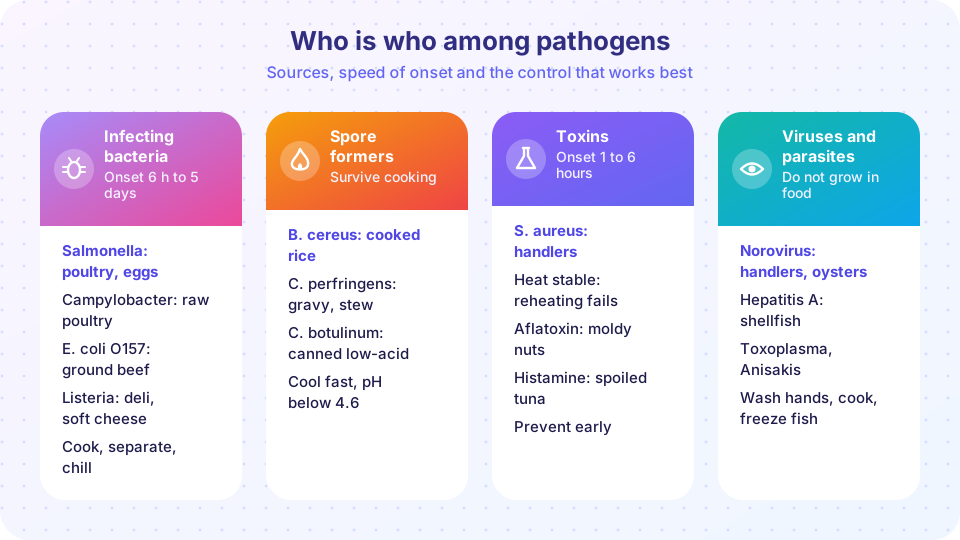
Infection. Live bacteria or viruses reach the intestine and multiply, and the body reacts. Symptoms usually start 6 hours to several days after eating. Salmonella and Campylobacter are examples.
Intoxication. The microbe grew earlier in the food and produced a toxin; swallowing the toxin makes you ill even if the bacteria are dead. Symptoms appear fast, often within 1-6 hours. Staphylococcus aureus enterotoxin and the emetic toxin of Bacillus cereus are heat-stable, so reheating does not make the food safe.
Toxicoinfection. Cells are eaten, then grow in the gut and release toxin there (Clostridium perfringens, shiga-toxin-producing E. coli, diarrheal B. cereus).
The dose matters: some pathogens (E. coli O157:H7, norovirus, Shigella) can cause illness from fewer than about a hundred cells or particles, while others (Salmonella in healthy adults) often need larger numbers, though low doses in fatty foods like chocolate have caused outbreaks. Susceptibility matters too: infants, pregnant women, older adults and people with weakened immunity are at higher risk and can become seriously ill from doses that a healthy adult tolerates.
The main bacteria
| Pathogen | Typical sources | Notes and controls |
|---|---|---|
| Salmonella | Poultry, eggs, meat, produce, low-moisture foods (nuts, spices, chocolate) | Infection; onset about 6-72 h; cook thoroughly, avoid cross-contamination; survives well in dry foods |
| Campylobacter | Raw poultry, unpasteurized milk | A leading bacterial cause of diarrhea in many countries; onset about 2-5 days; very few cells cause illness; fragile in air and dry heat but cross-contamination in kitchens is common |
| Shiga-toxin-producing E. coli (e.g. O157:H7) | Undercooked ground beef, raw milk, leafy greens, flour | Toxicoinfection; can cause hemolytic uremic syndrome (kidney failure) especially in children; cook ground beef to 71 °C (160 °F) |
| Listeria monocytogenes | Deli meats, smoked fish, soft cheeses, raw milk, pre-cut produce | Grows in the fridge; dangerous in pregnancy and for the elderly and immunocompromised; listeriosis has a high fatality rate among severe cases; control by hygiene, cold chain limits and avoiding risky foods in vulnerable groups |
| Staphylococcus aureus | Food handlers (skin, nose), cooked foods held warm, dairy, deli salads | Intoxication; toxin is heat stable; fast onset 1-6 h; hand hygiene and fast cooling |
| Bacillus cereus | Cooked rice, pasta, sauces left warm | Spores survive cooking and grow when cooled slowly; two toxin types (vomiting type, diarrheal type); cool quickly and refrigerate |
| Clostridium perfringens | Large batches of cooked meat and gravy kept warm | Toxicoinfection; spores survive cooking; fast growth near 43-47 °C; cool in small portions |
| Clostridium botulinum | Home-canned low-acid vegetables, improperly processed canned or vacuum-packed foods, fermented fish, honey (infant botulism) | Anaerobic spores make an extremely potent neurotoxin; prevented by pH below 4.6, adequate heat in canning, salt/nitrite in cured meats, cold storage for vacuum packs; toxin itself is destroyed by boiling for several minutes, but spores survive boiling |
Vibrio species (shellfish, warm seawater), Shigella (poor hygiene, produce), Yersinia enterocolitica (pork, grows in cold) and Cronobacter sakazakii (powdered infant formula) are other bacteria of importance.
Why spores matter
Spores are the survival form of Bacillus and Clostridium. They tolerate boiling, drying, and many chemicals. Normal cooking kills active cells but not spores; spores then germinate when food cools slowly or is held warm. That is why the control for these organisms is rapid cooling and cold storage after cooking, rather than just heat. In canning, heat processes are designed around spores (Chapter 4).
Viruses
Viruses cannot multiply in food; they need a living host cell. Food only carries them. Norovirus is the leading cause of acute gastroenteritis worldwide and spreads from infected handlers, contaminated shellfish (oysters from sewage-polluted waters) and berries or salads irrigated or washed with contaminated water. A very small number of virus particles causes illness, it spreads in households and care homes, and alcohol hand sanitizers are not fully effective, so thorough handwashing with soap and exclusion of sick food handlers matter. Hepatitis A also spreads through shellfish, produce and handlers, with long incubation (2-6 weeks), and is vaccine preventable.
Parasites
Parasites include Toxoplasma gondii (undercooked meat, contaminated produce), Trichinella (undercooked pork or wild game, now very rare in commercial pork), Anisakis (raw or lightly cured fish worms), Cryptosporidium and Giardia (contaminated water and produce), and Taenia tapeworms (undercooked beef or pork). Freezing at about -20 °C for 7 days or at -35 °C for 15 hours (guidance varies by authority) kills parasites in fish meant to be eaten raw; cooking to adequate core temperatures kills most others.
Toxins other than bacterial
Mycotoxins are poisons made by molds. Aflatoxins (from Aspergillus flavus) can contaminate maize, peanuts, tree nuts and spices in hot, humid conditions or poor storage; they are potent liver carcinogens and survive cooking, so prevention (drying crops quickly, storing dry, sorting, monitoring) and regulatory limits matter. Others include ochratoxin, patulin (in damaged apples) and deoxynivalenol in cereals. Marine toxins (ciguatera in tropical reef fish, shellfish poisons from algal blooms) and histamine in poorly stored scombroid fish (tuna, mackerel) cause illness that is not removed by cooking. Natural plant toxins include lectins in raw kidney beans (destroyed by proper boiling), solanine in green potatoes and cyanogenic glycosides in cassava (removed by soaking and cooking). Allergens, which cause immune reactions rather than infections, are handled under the allergen controls in the next lesson.
Where do pathogens come from?
- Animals and their intestines (poultry, cattle, pigs), so raw meat, eggs and milk carry some pathogens at times.
- Soil, manure and water, so produce can carry E. coli, Salmonella and parasites.
- People, especially hands, skin and nose (Staphylococcus) and gut (norovirus).
- The environment of food plants, such as drains and wet equipment where Listeria can form biofilms, layers of cells on surfaces that resist cleaning.
Cross-contamination moves pathogens from a raw food to a ready-to-eat one, via hands, boards, knives, cloths or drips from the refrigerator shelf. Typical home controls: separate boards and knives for raw meat, store raw meat below other foods, wash hands for at least 20 seconds with soap after handling raw food, cook to the right core temperature, chill leftovers promptly.
Risk and dose-response
How likely is a given dose to cause illness? Quantitative microbial risk assessment uses dose-response models. One widely used form for infection is the beta-Poisson model: P_ill = 1 − (1 + dose / β)^(−α), where α and β depend on the organism and host. The curve rises steeply and then flattens; at low doses the risk is small but never exactly zero, which is why standards aim to keep pathogen numbers as low as possible, and some, such as Listeria in ready-to-eat foods, have strict numerical limits.
Common misconceptions
"Food poisoning always starts within a few hours." Onset ranges from an hour (toxins) to weeks (hepatitis A, some parasites). The "last meal" is often not the culprit. "Reheating makes everything safe." Heat-stable toxins (Staphylococcus, B. cereus emetic toxin) survive. "Hot water kills norovirus on hands." Mechanical washing with soap matters most. "Raw chicken should be washed." Washing splashes bacteria onto surfaces; cooking, not rinsing, makes it safe. "Organic or farm-fresh means pathogen-free." Origin does not remove the need for safe handling.
Try it
Press Run (or Ctrl + Enter) to see the result here.
Program input · what you'd type while the program runs
Type the answers before you press Run, one per line. Each time the program reads a line (with input()), it gets the next line from this box.
Press Run (or Ctrl + Enter) to see the result here.
Program input · what you'd type while the program runs
Type the answers before you press Run, one per line. Each time the program reads a line (with input()), it gets the next line from this box.
Press Run (or Ctrl + Enter) to see the result here.
Program input · what you'd type while the program runs
Type the answers before you press Run, one per line. Each time the program reads a line (with input()), it gets the next line from this box.
Check your understanding
Quick check · 6 questions
of 6 answered You scored / 6 · perfect!
-
1. Which pathogen produces a heat-stable toxin in food, so reheating does not help?
S. aureus enterotoxin is heat stable. Campylobacter and Salmonella are killed by cooking; norovirus is a virus. -
2. Why is cooling cooked rice quickly important?
Spores survive cooking; slow cooling in the danger zone lets them germinate and grow. -
3. Viruses in food...
Viruses need host cells. Food only carries them. -
4. Which food is a classic risk for Listeria?
Listeria grows in the fridge, so ready-to-eat chilled foods are the main concern. -
5. Aflatoxins are best described as...
Aflatoxins are mycotoxins from Aspergillus molds and persist through cooking. -
6. Cross-contamination is...
It is the movement of pathogens, for example from raw chicken to a salad via a board or hands.
Summary
- Illness can come from infection, intoxication (toxin already in food) or toxicoinfection; timing hints at the cause.
- Key bacteria: Salmonella, Campylobacter, STEC, Listeria, Staphylococcus, B. cereus, C. perfringens, C. botulinum; spores survive cooking.
- Viruses (norovirus, hepatitis A) are carried by food and need hygiene; parasites need cooking or freezing; mycotoxins and other toxins survive cooking.
- Dose, host susceptibility and cross-contamination shape risk; dose-response models estimate it.
Next: HACCP and hygiene
Track your progress
Create a free account to tick off lessons and pick up where you left off on any device.
of Food Science lessons completed