


















Lesson 36 of 45 · Nutrition and Labeling
Chapter 7 Review: Nutrition and Labeling
Review chapter 7: Atwater energy factors, macronutrient quality, vitamin and mineral losses, fortification, Nutrition Facts, %DV and claims, with flashcards and a 9-question quiz.
You have followed a food's nutrients from the laboratory to the label: how energy is calculated, what happens to vitamins in processing and storage, and how the numbers are rounded, scaled and described in claims. This review gathers the key points. Remember that the chapter taught how nutrition science and labels work; it did not give personal dietary advice.
What you will learn
- Recall the Atwater factors and the key formulas of the chapter.
- Link each idea to the lesson where it was explained.
- Practice with flashcards, a label calculator and a 9-question quiz.
Key terms
Atwater factors: 4, 4 and 9 kcal per gram for protein, carbohydrate and fat.
Bioavailability: the fraction of a nutrient that the body absorbs and uses.
Overage: extra nutrient added to cover storage losses.
%DV: amount per serving divided by the Daily Value, times 100.
Per 100 g: a common basis for comparing products.
Recap table
| Topic | Key facts | Lesson |
|---|---|---|
| Nutrient classes | Carbohydrate, protein, fat, vitamins, minerals, water; fiber | Overview |
| Energy units | 1 kcal = 4.184 kJ | Overview |
| Atwater | Fat 9, alcohol 7, protein 4, carbohydrate 4, fiber about 2 kcal/g | Energy |
| Protein | N × 6.25; limiting amino acids; PDCAAS and DIAAS | Energy |
| Carbohydrate | Sugars, starch, fiber; glycemic index | Energy |
| Vitamin loss | Heat, oxygen, light, water, pH, enzymes | Micronutrients |
| Kinetics | C = C₀ e^(−kt), t½ = ln 2 / k, Arrhenius |
Micronutrients |
| Fortification | Overage = claim ÷ retention | Micronutrients |
| %DV | Amount ÷ DV × 100; 5% low, 20% high | Labels |
| Label from recipe | Sum, adjust for moisture loss, divide, round | Labels |
Common misconceptions
"Atwater factors are exact." They are averages; real digestibility varies with the food and its preparation.
"Minerals can be cooked away." They are elements; they can be removed or made less available, not destroyed.
"Labels give personal recommendations." %DV and serving sizes are references, not individual advice.
Try it
Flashcards for the chapter. Try to answer before you flip.
Now a combined calculator: from grams of fat, carbohydrate (with fiber) and protein per serving, it gives the energy in kcal and kJ and the percentage of energy from each macronutrient.
Press Run (or Ctrl + Enter) to see the console output here.
No output.
The granola bar shows 166 kcal here, not the 170 kcal of the earlier lessons, because this calculator counts its 2 g of fiber at 2 kcal per gram instead of 4. Different counting rules give slightly different totals, which is why labels follow one stated rule.
Check your understanding
Quick check · 9 questions
of 9 answered You scored / 9 · perfect!
-
1. A food has 20 g carbohydrate, 10 g protein and 5 g fat per serving. How much energy by the general Atwater factors?
20 × 4 + 10 × 4 + 5 × 9 = 80 + 40 + 45 = 165 kcal. -
2. 300 kcal is about how many kilojoules?
300 × 4.184 = 1,255 kJ. -
3. A vitamin has a half-life of 40 days. What fraction remains after 80 days?
80 days is two half-lives, so (1/2)² = 1/4 remains. -
4. Which vitamin is most sensitive to light?
Riboflavin is photosensitive; this is one reason milk is packed in opaque containers. -
5. To reach a label claim of 60 units after losing 25 percent in storage, how much must be added?
Retention is 0.75, so add 60 / 0.75 = 80 units. -
6. A serving has 14 g added sugars; the Daily Value is 50 g. What is the %DV?
14 / 50 × 100 = 28 percent. -
7. Which is NOT a source of loss for minerals?
Minerals are elements; oxidation does not destroy them. -
8. Per 100 g a food has 8 g fiber. A claim 'high in fibre' in the EU needs at least:
'High in fibre' needs at least 6 g per 100 g (3 g for 'source of fibre'), so 8 g qualifies. -
9. Why can two limiting amino acids in different foods be useful?
A cereal short of lysine plus a legume rich in lysine gives a more balanced mix.
Summary
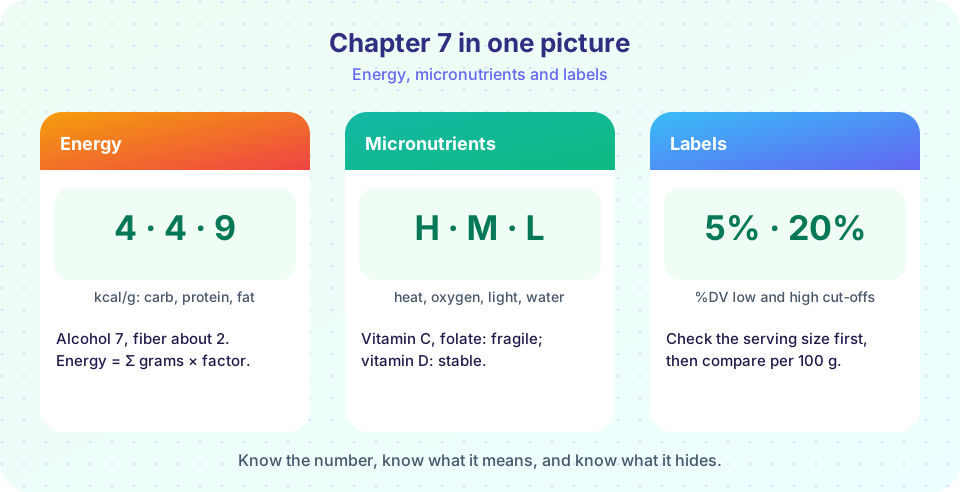
- Energy is the sum of grams × factor: fat 9, alcohol 7, protein 4, carbohydrate 4, fiber about 2 kcal/g.
- Vitamins are lost mainly through heat, oxygen, light and water; minerals are removed or made unavailable, not destroyed.
- First-order kinetics and Arrhenius predict vitamin loss; overage and bioavailability matter for fortification.
- %DV compares a serving with a daily reference; 5 percent is low, 20 percent is high; per-100 g values allow fair comparison.
- Labels combine regulation, calculation and rounding; claims and front-of-pack systems simplify but do not replace the full panel.
- Chapter 8 turns to innovation and regulation: how new foods reach the market safely.
Track your progress
Create a free account to tick off lessons and pick up where you left off on any device.
of Food Science lessons completed