


















Lesson 40 of 45 · Food Innovation and Regulation
Chapter 8 Review: Food Innovation and Regulation
Review chapter 8: the stage-gate pipeline, scale-up and cost of goods, food law and Codex, the seven HACCP principles, and novel food safety assessment, with a game and a 9-question quiz.
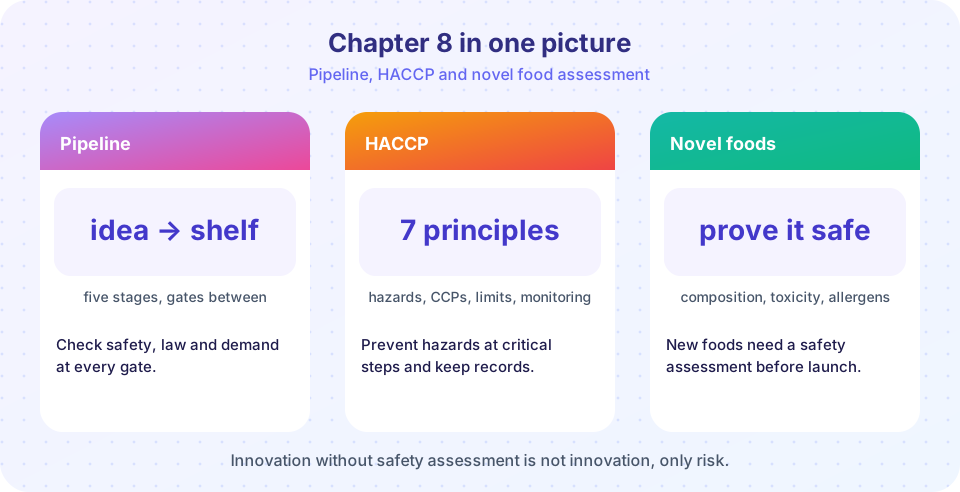
New foods have to be wanted, makeable, safe and legal. This chapter followed an idea through its gates, looked at how safety is built into a process with HACCP, and examined the science and assessment of novel foods and alternative proteins. Use this review to consolidate: the picture, the recap table, a sorting game and the quiz.
What you will learn
- Recall the stages of NPD, the seven HACCP principles and the elements of a novel food assessment.
- Apply mass balance and cost calculations to yield and extrusion.
- Check your understanding with a classification game and a mixed 9-question quiz.
Key terms
Gate: a decision point in the stage-gate process.
CCP and critical limit: the control step and its measurable limit.
Codex Alimentarius: international food standards from FAO and WHO.
Novel food: a food without a significant history of consumption, or made by a new source or process, needing authorization.
GRAS: generally recognized as safe, a US route for ingredients.
Recap table
| Topic | Key facts | Lesson |
|---|---|---|
| Stage-gate | Idea, concept, prototype, scale-up, launch; gates check demand, feasibility, safety, law | Overview |
| Scale-up | Surface area per volume falls; heat transfer and mixing change | Overview |
| Cost and yield | COGS per kg = costs ÷ finished kg | Overview |
| Risk analysis | Assessment, management, communication | Law and HACCP |
| Hazards | Biological, chemical, physical | Law and HACCP |
| HACCP | 7 principles; prerequisites first | Law and HACCP |
| Standards | Codex; GFSI-benchmarked schemes | Law and HACCP |
| Novel foods | EU: not eaten significantly before 15 May 1997; US: GRAS or additive | Novel foods |
| Alternative proteins | Plant, fermentation, cultivated, insects | Novel foods |
Common misconceptions
"HACCP is paperwork." Records are only the proof; the core is a scientific analysis of hazards and measurable control.
"Novel foods are unregulated." They face premarket assessment in many countries.
"Scale-up is just multiplying the recipe." Physical processes change with size.
Try it
A sorting game. Decide which HACCP principle each example matches, then check. It is a revision tool.
A calculator that links the yield and cost ideas: how much does a one-point change in yield change the cost per kilogram?
Press Run (or Ctrl + Enter) to see the console output here.
No output.
Check your understanding
Quick check · 9 questions
of 9 answered You scored / 9 · perfect!
-
1. Why are the early gates in stage-gate valuable?
Costs grow with each stage, so stopping weak ideas early saves the most. -
2. Which is a physical hazard?
Metal, glass and stones are physical hazards. -
3. A critical limit is:
For example, 72 °C for 15 seconds at the pasteurization CCP. -
4. Who sets international food standards used as a reference in trade?
Codex, created by FAO and WHO, is the international reference. -
5. A raw ingredient batch of 100 kg costs 500 and yields 80 kg. Ingredient cost per kg of product is:
500 / 80 = 6.25 per kg. -
6. Which is a typical element of a novel food safety assessment?
Assessments cover composition, process, intake, toxicology and allergenicity. -
7. Which alternative protein is made by growing animal cells in bioreactors?
Cultivated meat grows animal cells in a medium inside a bioreactor. -
8. Why does scale-up affect heating time?
Large volumes have less surface area per unit volume, so heat enters more slowly. -
9. Prerequisite programs are:
GMP and GHP create the basic conditions; HACCP controls the process-specific hazards.
Summary
- Stage-gate pipelines turn ideas into products; gates check demand, feasibility, safety and law.
- Scale-up changes heat transfer and mixing; yield strongly affects cost of goods.
- Risk analysis and Codex underpin food law; businesses are responsible for safety.
- HACCP: hazard analysis, CCPs, critical limits, monitoring, corrective action, verification, records, on top of prerequisite programs.
- Novel foods need authorization or a safety conclusion based on composition, process, toxicology and allergenicity.
- Chapter 9 puts it all together in a shelf-life project, practice problems and a glossary.
Track your progress
Create a free account to tick off lessons and pick up where you left off on any device.
of Food Science lessons completed