


















Lesson 9 of 45 · Food Chemistry
Carbohydrates: sugars, starch, gelatinization and gels
Learn how sugars and starch behave in food: sweetness, caramelization, amylose and amylopectin, gelatinization, retrogradation and pectin gels.
Carbohydrates are the most abundant food component on Earth. They are the sweetness in fruit, the thickness of gravy, the crumb of bread, the chew of pasta and the fiber in vegetables. They are also the substances that turn gold when you toast sugar and go hard when bread goes stale. Despite this variety, they are all built from the same small units, and knowing the building blocks makes the behavior easy to predict.
This lesson walks from single sugars to long starch chains. You will learn what makes one sugar sweeter than another, what happens to starch granules when you heat them in water, why bread stales, and how pectin forms the gel in jam. Each story comes down to how the molecules interact with water, with heat and with each other.
What you will learn
- Name the main sugars and the bonds that join them into disaccharides and starch.
- Compare sweetness and explain caramelization.
- Describe gelatinization and retrogradation and relate them to sauces, bread and rice.
- Explain how pectin, sugar and acid form a jam gel.
Key terms
Monosaccharide: a single sugar (glucose, fructose, galactose). Disaccharide: two sugars joined (sucrose, lactose, maltose). Amylose and amylopectin: the linear and branched polymers of glucose in starch. Gelatinization: irreversible swelling of starch granules in hot water. Retrogradation: re-association of starch chains on cooling, causing firming and staling. Reducing sugar: a sugar that can donate electrons and take part in Maillard browning.
From single sugars to chains
Monosaccharides are single sugar units with the formula (CH₂O)ₙ. The three that matter most in food are glucose (the body's main fuel and the unit of starch), fructose (in fruit, honey and high-fructose syrups) and galactose (part of milk sugar). All are six-carbon sugars with the formula C₆H₁₂O₆ but with different arrangements of atoms, which gives different sweetness and behavior.
Joining two sugars through a glycosidic bond, with the loss of one water molecule, forms a disaccharide:
- Sucrose (table sugar) = glucose + fructose. Not a reducing sugar, because the bond ties up the reactive groups of both units.
- Lactose (milk sugar) = galactose + glucose. About one-fifth as sweet as sucrose; some adults lack the enzyme lactase to digest it (lactose intolerance).
- Maltose = glucose + glucose. Appears when enzymes break down starch, for example in malting grain and in a chewed bread crust.
Long chains of sugar units are polysaccharides: starch and glycogen (digestible), cellulose, pectin and many gums (fiber).
Sweetness
Sweetness is measured by comparison with sucrose, set to 1.0. The numbers vary with concentration, temperature and the panel, but typical values are:
| Sweetener | Sweetness (sucrose = 1) |
|---|---|
| Lactose | about 0.2 |
| Maltose | about 0.4 |
| Glucose | about 0.7 |
| Sucrose | 1.0 |
| Fructose | about 1.2-1.7 |
| Aspartame | about 200 |
| Sucralose | about 600 |
Fructose tastes sweetest cold and less sweet when hot. Intense sweeteners such as aspartame and sucralose are used in tiny quantities, which saves energy but removes the bulk, browning and water-binding that sugar supplies, so recipes using them need other ingredients to make up the texture. Sugars do far more than sweeten: they lower water activity, tenderize cakes by delaying gluten and starch setting, feed yeast, brown and caramelize.
Caramelization
When sugar is heated well above its melting point without water, its molecules break apart and recombine into hundreds of colored and aromatic compounds. This is caramelization. It begins at different temperatures for different sugars: fructose around 110 °C, glucose, galactose and sucrose around 160 °C and maltose around 180 °C. Unlike the Maillard reaction (next lesson), it does not need amino acids. Caramel color (the additive) is made industrially in several grades for soft drinks and sauces.
Starch
Starch is how plants store glucose, in microscopic granules 1-100 µm across (potato granules are large, rice granules small). Each granule is made of two polymers:
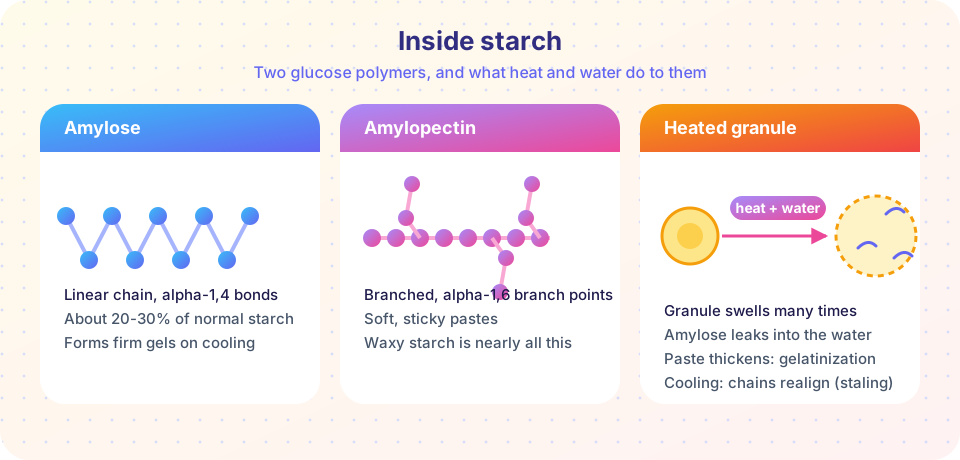
- Amylose: a long, mostly linear chain of glucose units joined by α-1,4 bonds. It tends to form helices and, when it cools, tight, ordered structures. Normal starches are roughly 20-30% amylose; high-amylose varieties exist; waxy starches (waxy maize, glutinous rice) contain almost none.
- Amylopectin: a large branched molecule with α-1,4 chains and α-1,6 branches roughly every 20-30 units. Its bulky shape gives soft, sticky pastes.
Gelatinization
Raw starch granules are semi-crystalline and do not dissolve in cold water. Heat them in excess water and a series of changes unfolds. First the granules absorb water and swell a little. At a characteristic range of temperatures the crystalline regions melt, the granules swell dramatically (many times their original volume) and amylose leaks out into the water. This is gelatinization. The mixture turns from cloudy to translucent and becomes much more viscous. Typical gelatinization ranges are roughly 58-64 °C for wheat, 62-72 °C for maize and 56-66 °C for potato, depending on the variety and the conditions. Sugar and fat delay it by competing for water, while acid at high levels breaks chains and thins the paste.
Continued heating and stirring burst the swollen granules; the paste thins (this is why over-cooked cornstarch sauces go runny), but cooling then lets the leached amylose chains join into a gel, giving puddings, custards and the firm set of a cooled starch sauce.
Retrogradation and staling
On cooling and storage, starch chains slowly realign and crystallize again. This is retrogradation. In bread it is a main cause of staling: the crumb becomes firm and crumbly, though not because it loses water to the air (stale bread is not drier than fresh bread). Warming bread above about 60 °C reverses the effect temporarily, which is why toasted stale bread tastes better. Freezing stops it, and refrigerator temperatures (around 4 °C) accelerate retrogradation, which is why bread is better kept at room temperature for a few days or frozen. Enzymes, emulsifiers such as mono- and diglycerides, and waxy flours slow retrogradation.
Pectin and jam
Pectin is a polysaccharide in fruit cell walls that helps hold plant tissue together. In jam, high-methoxyl pectin forms a gel when three conditions meet: enough dissolved sugar (about 60-65% soluble solids, which draws water away from the pectin), a low pH (about 2.8-3.5, which reduces the repelling charges on pectin chains) and heat to dissolve and then set. Underripe fruit has more pectin; apple and citrus peel are rich sources. Low-methoxyl pectin gels with calcium instead and needs little or no sugar, so it is used for low-sugar jams. Other food gels use agar and carrageenan (from seaweed), locust bean gum and guar gum (from seeds) and xanthan gum (made by bacterial fermentation), each with its own texture.
Common misconceptions
"Stale bread has lost water." Mostly it has not; starch retrogradation firms the crumb. "All sugars are equally sweet." Fructose is sweeter and lactose far less sweet than sucrose. "Caramelization and Maillard browning are the same." Caramelization is sugar alone at high temperature; Maillard needs amino groups. "Raw starch dissolves in water." It does not until heated; cornstarch in cold water settles as a suspension.
Try it
Press Run (or Ctrl + Enter) to see the result here.
Program input · what you'd type while the program runs
Type the answers before you press Run, one per line. Each time the program reads a line (with input()), it gets the next line from this box.
Press Run (or Ctrl + Enter) to see the result here.
Program input · what you'd type while the program runs
Type the answers before you press Run, one per line. Each time the program reads a line (with input()), it gets the next line from this box.
Press Run (or Ctrl + Enter) to see the result here.
Program input · what you'd type while the program runs
Type the answers before you press Run, one per line. Each time the program reads a line (with input()), it gets the next line from this box.
Check your understanding
Quick check · 6 questions
of 6 answered You scored / 6 · perfect!
-
1. Sucrose is formed from...
Sucrose is glucose plus fructose; maltose is glucose plus glucose, and lactose is galactose plus glucose. -
2. Which describes amylopectin?
Amylopectin has α-1,4 chains with α-1,6 branch points; it is highly branched. -
3. What best explains why bread goes stale?
Starch chains realign and crystallize, firming the crumb. Water loss is a minor factor. -
4. Gelatinization is...
Gelatinization is the heat-and-water transition of starch; it has nothing to do with gelatin. -
5. Which conditions favor a high-methoxyl pectin jam gel?
High sugar and low pH let pectin chains associate into a gel network. -
6. Which sugar caramelizes at the lowest temperature?
Fructose begins to caramelize around 110 °C, lower than glucose or sucrose.
Summary
- Sugars are single units (glucose, fructose, galactose) or pairs (sucrose, lactose, maltose); sweetness differs widely.
- Caramelization is sugar-only browning at about 110-180 °C, depending on the sugar.
- Starch is amylose plus amylopectin; heating in water gelatinizes granules, cooling lets chains re-associate (retrogradation, staling).
- Pectin gels need sugar, low pH and heat (or calcium for low-methoxyl pectin).
Track your progress
Create a free account to tick off lessons and pick up where you left off on any device.
of Food Science lessons completed