


















Lesson 14 of 45 · Food Microbiology and Safety
The growth of microbes in food: curves, temperature, pH and oxygen
Learn the bacterial growth curve, generation time, cardinal temperatures, pH and oxygen limits, and a square-root model of how temperature changes growth.
A single bacterial cell in a bowl of cooked rice looks harmless. Left on a counter for a few hours, its descendants can number in the millions. That is the central problem of food microbiology: small, invisible populations can become dangerous quickly if conditions allow, and the same food kept cold or acidic or dry can hold the same cell almost unchanged for weeks. Understanding growth lets you predict which is which.
This lesson describes how microbial populations grow over time, how fast they can double, and how temperature, acidity and oxygen shape that growth. You will also see how food scientists turn these observations into simple predictive models, which is the basis of shelf-life and safety calculations.
What you will learn
- Describe the four phases of the microbial growth curve.
- Calculate generation time and population size from growth data.
- Explain how temperature, pH, oxygen and water activity limit growth.
- Use a square-root model to estimate how growth slows as temperature falls.
Key terms
Generation (doubling) time: the time for a population to double. Lag phase: the period of adjustment before growth starts. Log phase: the period of fastest, exponential growth. Psychrotroph, mesophile, thermophile: organisms that grow best in the cold, at moderate temperatures and in heat. Aerobe, anaerobe, facultative: needs oxygen, is harmed by oxygen, or can use either. CFU: colony-forming unit, the usual count of living cells.
The growth curve
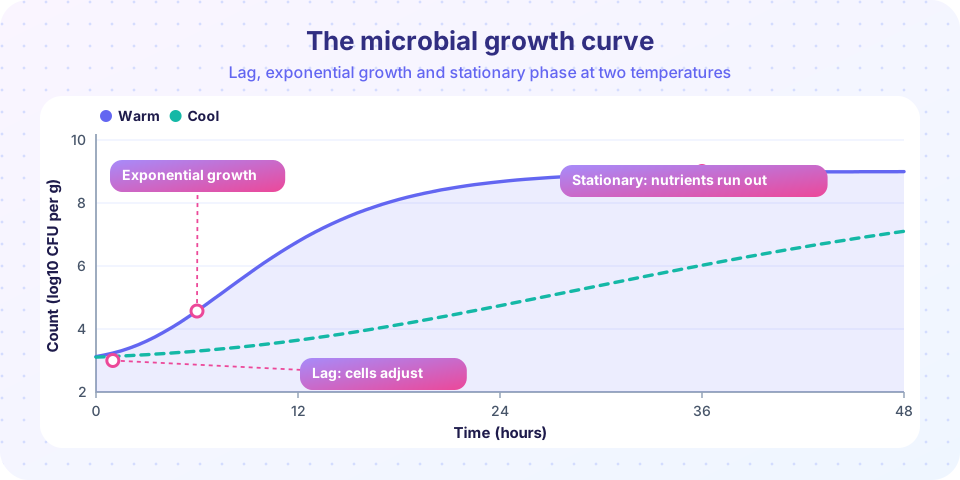
Put a small number of bacteria into a nutrient-rich food and count them over time. Plotting the logarithm of the count against time gives a characteristic S-shaped curve with four phases.
- Lag phase. The cells have arrived in a new environment. They are not dividing yet but are making enzymes, repairing damage and adjusting. The lag may last minutes to days. It is longer when the cells are stressed (dried, cold, acidified, previously heated) and shorter when they come from a similar, warm, rich food.
- Log (exponential) phase. Cells divide at a constant, maximum rate. On a log scale the count rises along a straight line.
- Stationary phase. Nutrients run low or waste products (acids) accumulate. Cell division balances cell death and the count levels off.
- Death (decline) phase. The population falls as cells die.
During the log phase, population size follows N = N₀ × 2^(t/g), where N₀ is the starting count, t the time and g the generation time. Taking log base 10 gives a straight line log₁₀ N = log₁₀ N₀ + 0.301 × t/g. The slope tells you the growth rate.
Typical generation times under ideal conditions: Escherichia coli about 20 minutes at 37 °C, Salmonella about 20-30 minutes, Staphylococcus aureus about 30 minutes, Clostridium perfringens as short as about 10 minutes at 43-47 °C. Yeasts are slower (1.5-3 hours) and molds slower still, though they grow as filaments rather than dividing cells.
Temperature
Each organism has three cardinal temperatures: a minimum below which it cannot grow, an optimum where it grows fastest and a maximum above which it dies. Microbes are grouped by where they sit.
| Group | Typical range | Food examples |
|---|---|---|
| Psychrophiles / psychrotrophs | grow at 0-7 °C or below; optimum 20-30 °C | Pseudomonas on chilled meat; Listeria monocytogenes in a fridge |
| Mesophiles | about 10-45 °C; optimum 30-40 °C | Most pathogens: Salmonella, E. coli |
| Thermophiles | about 45-70 °C; optimum 50-60 °C | Bacillus and Geobacillus spores in canned goods, C. perfringens |
The temperature band in which pathogens grow fastest is called the danger zone. Guidance differs a little by country: the US recommends keeping cold food at or below 41 °F (5 °C) and hot food at or above 135 °F (57 °C); the UK and EU commonly use 8 °C and 63 °C. A short rule is that growth is possible from about 5 °C to about 60 °C, and food should spend as little time as possible in between.
Listeria is a special case. Listeria monocytogenes can grow slowly at refrigerator temperatures, and even around 0 °C, so a long fridge life is not a guarantee of safety for ready-to-eat foods. That is why shelf-life limits matter for foods such as smoked fish, deli meats and soft cheeses.
A square-root model
Predictive microbiology describes growth rate in terms of temperature. A well-known empirical model is the Ratkowsky square-root model: √μ = b (T − T_min), where μ is the specific growth rate (per hour), T the temperature, T_min a notional minimum temperature for growth and b a constant. For a mesophile, T_min is often a few degrees above zero. The model shows growth falling quickly, but not linearly, as temperature drops. The numbers below are illustrative, not published parameters for a particular strain.
pH
Most food bacteria grow best near neutral pH (6.5-7.5) and are slowed below about pH 5 (roughly pH 4.0-4.5 for many pathogens). Their approximate limits are: most bacteria 4.5-9, yeasts 1.5-8.5 (they tolerate acid well), molds 1.5-11 (the broadest). Clostridium botulinum does not grow or make toxin below about pH 4.6, which is the reason food law divides foods into low-acid foods (pH above 4.6) and acid foods (pH 4.6 or lower). Acid foods can be processed at boiling-water temperatures; low-acid canned foods need pressure cooking. Organic acids such as acetic, lactic and propionic inhibit growth more than their pH alone would predict because the uncharged form crosses the cell membrane (more in Chapter 4).
Oxygen
Microbes differ in their oxygen needs. Strict aerobes (many molds, Pseudomonas) need oxygen. Strict anaerobes (Clostridium) cannot grow with oxygen. Facultative anaerobes (E. coli, Salmonella, Staphylococcus, yeasts) grow with or without it. Microaerophiles (Campylobacter) need a little oxygen, about 5%. This is why vacuum packing prevents mold but can favor anaerobes such as C. botulinum (non-proteolytic type B/E can grow at 3 °C), a reason why vacuum-packed chilled fish need strict temperature control.
Water activity, nutrients and competition
We met water activity in Chapter 2: most bacteria need above 0.91. Microbes also need nutrients (carbon, nitrogen, minerals, vitamins). Meat, milk and eggs are nutrient rich; sugar syrups are not. Finally, competition matters. Foods carry mixed populations. A fast-growing spoilage organism can crowd out a pathogen, a reason why a slightly spoiled food is sometimes less dangerous than a sterilized one that was later contaminated with a single pathogen and has no competitors.
Common misconceptions
"Bacteria multiply at constant speed." Only in the log phase; lag and stationary phases differ. "The fridge stops growth." It slows most species; psychrotrophs including Listeria still grow. "Acid foods can't spoil." Yeasts and molds thrive in acid; it is bacteria that are limited. "Hot holding kills bacteria." Holding at 60 °C or above prevents growth but does not necessarily kill everything, and spores survive.
Try it
Press Run (or Ctrl + Enter) to see the result here.
Program input · what you'd type while the program runs
Type the answers before you press Run, one per line. Each time the program reads a line (with input()), it gets the next line from this box.
Press Run (or Ctrl + Enter) to see the result here.
Program input · what you'd type while the program runs
Type the answers before you press Run, one per line. Each time the program reads a line (with input()), it gets the next line from this box.
Press Run (or Ctrl + Enter) to see the result here.
Program input · what you'd type while the program runs
Type the answers before you press Run, one per line. Each time the program reads a line (with input()), it gets the next line from this box.
Press Run (or Ctrl + Enter) to see the result here.
Program input · what you'd type while the program runs
Type the answers before you press Run, one per line. Each time the program reads a line (with input()), it gets the next line from this box.
Check your understanding
Quick check · 5 questions
of 5 answered You scored / 5 · perfect!
-
1. In which phase do cells divide at a constant, maximum rate?
During the log phase, growth is exponential, a straight line on a log plot. -
2. A culture starts at 100 cells and doubles every 30 minutes with no lag. How many cells after 3 hours?
6 doublings multiply by 64, so 100 × 64 = 6,400. -
3. Why can Listeria monocytogenes be a problem in refrigerated ready-to-eat foods?
Listeria is a psychrotroph and can multiply at 0-4 °C. -
4. What does pH 4.6 divide in food law?
Clostridium botulinum does not grow below about pH 4.6, so this is the threshold between acid and low-acid foods. -
5. Which organism needs a little oxygen but not a full atmosphere?
Campylobacter is microaerophilic, favoring about 5 percent oxygen.
Summary
- Batch growth has lag, log, stationary and death phases; log growth follows
N = N₀ × 2^(t/g). - Temperature sets growth speed; the danger zone is roughly 5-60 °C; psychrotrophs such as Listeria grow in the fridge.
- pH 4.6 separates acid from low-acid foods; oxygen needs differ by species; water activity and competition matter.
- Predictive models such as the square-root model estimate how growth rate depends on temperature.
Next: Foodborne pathogens
Track your progress
Create a free account to tick off lessons and pick up where you left off on any device.
of Food Science lessons completed