


















Lesson 42 of 45 · Projects and Practice
Practice Problems: Chapters 5 to 8
Fifteen practice problems with full solutions on thermal processing, emulsions, sensory statistics, rheology, energy, labels, vitamin loss, cost of goods and shelf-life Q10.
The surest way to learn a calculation is to do it with a pencil before you check. This lesson gives fifteen problems from chapters 5 to 8, in the order of the chapters, followed by worked solutions. Try each one first, then compare. Two tools help: a random problem generator that checks your answers, and a short program that solves the whole set so you can see how the code mirrors the algebra.
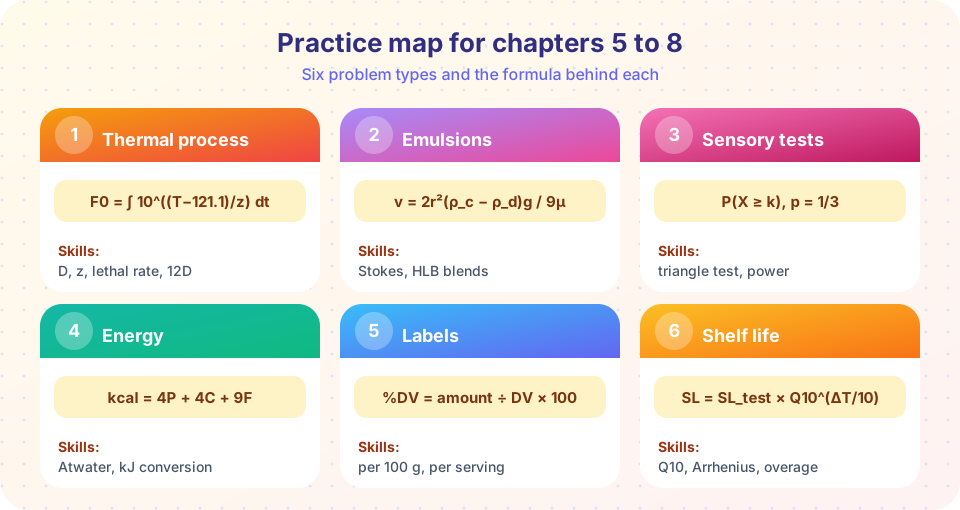
What you will learn
- Apply the formulas of chapters 5 to 8 to numerical problems.
- Check answers for size and units before trusting them.
- Use a short program to verify hand calculations.
Key terms
Lethal rate L: 10^((T − 121.1)/z), minutes at 121.1 °C per minute at T.
Stokes ratio: the ratio of creaming speeds, proportional to the ratio of radii squared.
Critical count: the smallest number of correct answers that is significant at the chosen level.
%DV: amount per serving divided by the Daily Value times 100.
Q10 rule: SL(T) = SL_test × Q10^((T_test − T)/10).
How to work a problem
- Write what is given and what is asked, with units.
- Choose the formula and check that its assumptions hold (for example, first-order kinetics, or p = 1/3).
- Substitute and calculate, keeping extra digits until the end.
- Check: Is the answer the right size? Does it have the right unit? Would doubling the input do what you expect?
The problems
Processing (chapter 5)
- A spore has D = 0.25 min at 121.1 °C. A can contains 10⁴ spores. How long at 121.1 °C reduces the expected count to 10⁻⁶ spores per can?
- With z = 10 °C, how many minutes at 111.1 °C deliver the same lethality as 3 minutes at 121.1 °C?
- A cream droplet of radius 5 µm and another of radius 1.25 µm rise in the same milk. By what factor is the larger droplet faster?
- An oil needs an emulsifier blend with HLB 12. You have emulsifier A (HLB 4.3) and B (HLB 15.0). What weight fraction of B do you need?
Sensory science (chapter 6)
- A drink contains 8 percent sugar. If the Weber fraction for sweetness is 0.15, what increase is just noticeable?
- A triangle test with 24 panelists has 14 correct answers. The critical count at α = 0.05 is 13. Is the difference significant? What is the p-value?
- A sauce shows a shear stress of 12 Pa at a shear rate of 40 s⁻¹. What is its apparent viscosity?
- In a TPA test the area under the first compression is 18 N·s and under the second 12.6 N·s. What is the cohesiveness?
Nutrition and labels (chapter 7)
- A food has, per 100 g, 20 g fat, 50 g carbohydrate of which 5 g is fiber, and 15 g protein. Using EU factors (fiber 2 kcal per gram), how much energy is that in kcal and kJ?
- A serving contains 690 mg sodium and the Daily Value is 2,300 mg. What is the %DV, and is it low, medium or high?
- A vitamin degrades with k = 0.01 per day. What fraction is left after 90 days, what is its half-life, and how much must be added at manufacture (as a percentage of the label claim) for the claim to hold at 90 days?
- A product contains 8.5 g sugars per 100 g. A serving is 35 g. How many grams of sugar are in a serving?
Innovation and shelf life (chapters 8 and 9)
- 100 kg of raw ingredients cost 300. The yield is 88 percent. Packaging and processing cost 0.60 per kg of product. What is the cost of goods per kg?
- In a pasteurization plan, which HACCP principle does each of these belong to: (a) 72 °C for 15 s; (b) a chart of hold-tube temperature; (c) diverting milk when the temperature falls?
- A cereal fails after 20 days at 45 °C. If Q10 = 2.5, what is its predicted shelf life at 25 °C?
Solutions
- Needed reduction: from 10⁴ to 10⁻⁶ is 10 log units.
t = 10 × 0.25 = 2.5 min. L(111.1) = 10^((111.1 − 121.1)/10) = 0.1. Equivalent time= 3 / 0.1 = 30 min.- Stokes: speed ∝ r².
(5 / 1.25)² = 4² = 16times faster. 15.0x + 4.3(1 − x) = 12, so10.7x = 7.7andx = 0.72. About 72 percent B and 28 percent A.- JND = k × I = 0.15 × 8 = 1.2 percentage points (to about 9.2 percent).
- 14 is at least 13, so yes, significant at α = 0.05. The p-value is the tail probability
P(X ≥ 14)for n = 24, p = 1/3, which the program below computes: about 0.010, well below 0.05. η = τ / γ̇ = 12 / 40 = 0.30 Pa·s.- Cohesiveness
= A₂ / A₁ = 12.6 / 18 = 0.70. - Available carbohydrate
= 50 − 5 = 45 g. Energy= 20 × 9 + 45 × 4 + 5 × 2 + 15 × 4 = 180 + 180 + 10 + 60 = 430 kcal. In kJ:430 × 4.184 ≈ 1,799 kJ. 690 / 2300 × 100 = 30 percent: high (20 percent or more).- Fraction left
= e^(−0.01 × 90) = e^(−0.9) = 0.407(41 percent). Half-life= ln 2 / 0.01 = 69.3 days. To meet the claim, add1 / 0.407 = 2.46times the claim: 246 percent of the label amount. 8.5 × 35 / 100 = 2.975 g, about 3.0 g.- Ingredients per kg of product
= 300 / 88 = 3.41. Total= 3.41 + 0.60 = 4.01per kg. - (a) Principle 3, critical limits. (b) Principle 4, monitoring. (c) Principle 5, corrective action.
SL = 20 × 2.5^((45 − 25)/10) = 20 × 2.5² = 20 × 6.25 = 125 days.
Common misconceptions
"Plug in the numbers and trust the result." Always check the size: a lethal rate below 1 at a temperature under 121.1 °C, a Stokes ratio above 1 for a bigger droplet, a shelf life that grows when the temperature rises, are all sanity checks.
"The p-value is the chance the hypothesis is true." It is the probability of data at least this extreme if the null hypothesis were true.
"Percent means percentage points." A rise from 8 to 9.2 percent sugar is 1.2 percentage points, which is a 15 percent relative increase.
Try it
First, a problem generator. It makes a random problem of the type you select, and you type the answer. The accepted tolerance is 2 percent. It is a practice tool, and the numbers are random.
Second, the whole set solved in code. The p-value for problem 6 comes from the binomial distribution.
Press Run (or Ctrl + Enter) to see the result here.
Program input · what you'd type while the program runs
Type the answers before you press Run, one per line. Each time the program reads a line (with input()), it gets the next line from this box.
Check your understanding
Quick check · 4 questions
of 4 answered You scored / 4 · perfect!
-
1. 10 minutes at 131.1 °C (z = 10 °C) equals how many minutes at 121.1 °C?
L = 10^((131.1 − 121.1)/10) = 10, so 10 minutes gives 100 equivalent minutes. -
2. A serving has 3.9 g saturated fat. The Daily Value is 20 g. What is the %DV?
3.9 / 20 × 100 = 19.5 percent, which a label would round to 20 percent. -
3. A shelf life is 60 days at 40 °C. With Q10 = 3, what is it at 30 °C?
60 × 3^((40 − 30)/10) = 60 × 3 = 180 days. -
4. Which is the correct unit of viscosity?
Viscosity = stress (Pa) / shear rate (1/s), so Pa·s.
Summary
- Work every problem in four steps: given and asked, formula, calculation, check.
- Lethality, Stokes, Weber, binomial tests, Atwater factors, %DV, first-order loss, yield cost and Q10 cover the numerical core of chapters 5 to 8.
- A short program can verify hand calculations, but a size and unit check catches many mistakes first.
- Percentage points and percent are different; p-values are not probabilities that a hypothesis is true.
Track your progress
Create a free account to tick off lessons and pick up where you left off on any device.
of Food Science lessons completed