


















Lesson 38 of 45 · Food Innovation and Regulation
Food Law, HACCP and Standards
Understand how food safety is regulated: risk analysis, Codex and national law, the seven HACCP principles with a pasteurization example, prerequisites and certification standards.
When a food causes illness, people ask who was responsible and how it could have been prevented. Modern food safety is built on a simple answer: the company that makes the food is responsible for its safety, and it must show how it controls the hazards, with a documented system rather than a final inspection. This lesson explains the legal framework that surrounds that idea, then takes apart the system used almost everywhere: HACCP, Hazard Analysis and Critical Control Points. You will see the seven principles in order, work through a real example, and learn what certification standards add.
What you will learn
- Explain the roles of national food law, Codex Alimentarius and risk analysis.
- Name the three hazard types and give examples.
- Describe the seven HACCP principles and apply them to pasteurization.
- Distinguish prerequisite programs, HACCP plans and certification standards.
Key terms
Hazard: a biological, chemical or physical agent in food that can cause harm.
Critical control point (CCP): a step at which control is essential to prevent, eliminate or reduce a hazard to an acceptable level.
Critical limit: the maximum or minimum value a control measure must meet at a CCP, such as a temperature and time.
Codex Alimentarius: the collection of international food standards, guidelines and codes of practice set up by FAO and WHO.
Traceability: the ability to follow a food and its ingredients one step back and one step forward through the supply chain.
The legal framework
Food law differs between countries, but the main ideas are common.
- The business is responsible. In the EU, the General Food Law (Regulation 178/2002) states that food business operators must ensure food is safe and that they can identify their suppliers and customers (traceability). In the US the Federal Food, Drug, and Cosmetic Act and the Food Safety Modernization Act (FSMA, 2011) move the system toward preventing problems, with mandatory preventive controls for most facilities, rather than reacting after illness occurs.
- Risk analysis is the scientific backbone. It has three parts: risk assessment (a scientific estimate of how likely harm is and how severe), risk management (a regulatory decision about what to do) and risk communication (explaining it openly). Independent bodies such as the European Food Safety Authority (EFSA), and for international work the joint expert committees of FAO and WHO (JECFA for additives and contaminants, JMPR for pesticide residues, JEMRA for microbiological risk), supply the scientific advice.
- Codex Alimentarius, established in 1963 by FAO and WHO, produces international standards, such as maximum residue limits, additive rules, labeling guidelines and the HACCP guidelines. Under the World Trade Organization's agreement on sanitary and phytosanitary measures, Codex standards are the reference for settling trade disputes, which is why most national rules are similar.
- Recalls and traceability: when a problem is found, the company must be able to find the affected lots quickly and withdraw them.
The three kinds of hazard
HACCP starts with identifying hazards at each step of the process.
| Type | Examples | Typical control |
|---|---|---|
| Biological | Salmonella, Listeria monocytogenes, E. coli O157, norovirus, parasites, mold toxins | Heat treatment, cold chain, hygiene, supplier control |
| Chemical | Allergens, cleaning chemicals, pesticide residues, heavy metals, mycotoxins, unauthorized additives | Supplier specifications, allergen controls, testing, correct dosing |
| Physical | Glass, metal fragments, stones, bone, plastic | Sieves, magnets, metal detectors, X-ray, maintenance |
Biological hazards cause most illness from food, which is why heat treatments, such as those in the thermal processing lesson, and refrigeration feature so often as control measures.
HACCP: where it came from
HACCP was developed in the 1960s by the Pillsbury Company, together with NASA and the US Army, to make food for astronauts. They could not afford a single case of food poisoning in space, and testing the finished product could not guarantee safety, because testing destroys the sample and cannot find rare contamination. The idea was to control the process so that hazards were prevented. Codex adopted HACCP guidelines in 1993 and they were updated since; the approach is now required or expected in most developed food industries.
Getting ready: preliminary steps
Before the seven principles, a HACCP team (people from production, quality, engineering and microbiology) describes the product and its intended use, who will eat it (for example, babies and vulnerable people need stricter control), draws a process flow diagram and confirms it on the factory floor.
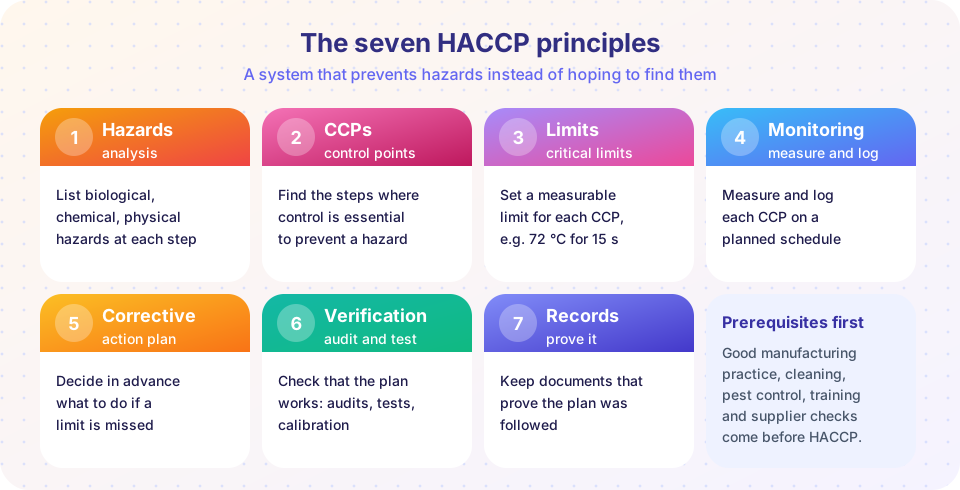
The seven principles, with an example
The example below follows a dairy making pasteurized milk.
- Conduct a hazard analysis. List the hazards at each step and decide which are significant. Raw milk may carry pathogens such as Salmonella and Listeria, and chemical hazards include antibiotic residues and cleaning agents. Significant hazard: pathogens that survive.
- Determine the critical control points. Use a decision tree or expert judgement. Pasteurization is the step where pathogens are destroyed, and nothing downstream could remove them, so it is a CCP.
- Establish critical limits. For HTST milk: at least 72 °C held for at least 15 seconds. Limits must be measurable and based on science, such as the thermal death data from the previous chapter.
- Establish monitoring procedures. A continuous temperature recorder at the end of the holding tube, a flow-diversion valve, and a regular check of the holding time.
- Establish corrective actions. If the temperature falls below the limit, the flow-diversion valve sends the milk back for re-pasteurization, the cause is investigated, and affected product is held and evaluated.
- Establish verification procedures. Calibration of the thermometers, review of records, an enzyme test such as alkaline phosphatase on the finished milk (which should be negative if pasteurization worked), audits and periodic review of the plan.
- Establish documentation and record keeping. Charts, calibration certificates, corrective action reports, and the HACCP plan itself, ready for an inspector.
Note that a CCP is not just any important step. It is a point where control is essential and a measurable limit exists. Other controls that are less critical may be handled as operational prerequisite programs or ordinary good practice.
Prerequisite programs
HACCP cannot work on top of a dirty, disorganized factory. Prerequisite programs (also called good manufacturing practice, good hygiene practice, or GMP and GHP) are the basic conditions: building design, sanitation and cleaning, pest control, personal hygiene, training, water quality, waste handling, maintenance, supplier approval, allergen control, labeling control and recall procedures. The HACCP plan then concentrates on the few steps where control must be exact. As a rule of thumb, the prerequisites control the general environment; HACCP controls the specific, process-related hazards.
Standards and certification
Many retailers will not buy from a company that is not certified to a recognized standard. The Global Food Safety Initiative (GFSI) benchmarks private schemes, and the common ones include FSSC 22000 (built on the ISO 22000 food safety management standard), BRCGS, SQF and IFS. Auditors check that the HACCP plan, prerequisite programs, management commitment, traceability and food defense are in place and working. Certification does not replace legal compliance; it demonstrates it to customers.
Beyond safety: composition and labeling law
Food law also covers what a food may contain and how it may be described: lists of permitted additives (with E-numbers in the EU and numbers assigned by Codex), maximum limits for contaminants and pesticide residues, standards of identity that define products such as chocolate or mayonnaise, and rules for geographical indications that protect names such as Parma ham. These rules link back to the labeling lesson.
Common misconceptions
"Testing the final product keeps food safe." Testing samples cannot find rare contamination in all units. Process control (HACCP) gives much stronger assurance.
"Every step is a CCP." Too many CCPs dilute attention. CCPs are the few steps where control is essential and measurable.
"A certificate means no risk." Certification shows a system is in place and audited; it does not remove all risk, and the plan must be kept up to date.
"Regulations are the same everywhere." Codex helps harmonize them, but permitted additives, limits and labeling still differ between countries.
Try it
First, a HACCP-style worksheet. Pick a step in a food process and see typical hazards and controls. This is a teaching example, not a complete hazard analysis for any real factory.
Second, monitoring a CCP. The code simulates temperature readings at the end of a holding tube, with measurement noise and one brief dip. It marks readings below the critical limit of 72 °C, the moments when the flow-diversion valve would divert milk. The data are randomly generated for the exercise.
Press Run (or Ctrl + Enter) to see the result here.
Program input · what you'd type while the program runs
Type the answers before you press Run, one per line. Each time the program reads a line (with input()), it gets the next line from this box.
Third, a holding-tube calculation: how long must the tube be for a required holding time? It uses the mean velocity, so it gives the minimum length; real designs use the fastest-moving fluid.
Press Run (or Ctrl + Enter) to see the console output here.
No output.
Check your understanding
Quick check · 5 questions
of 5 answered You scored / 5 · perfect!
-
1. Which is a biological hazard?
Salmonella is a pathogenic bacterium: a biological hazard. Glass and metal are physical; cleaning chemicals are chemical. -
2. What is a critical limit?
For example, 72 °C for 15 seconds for HTST pasteurization. -
3. A pasteurizer's temperature falls below the limit. What should the HACCP plan say happens?
Principle 5 requires corrective actions to be planned in advance. -
4. Which belongs to prerequisite programs rather than a specific CCP?
Pest control and hygiene are general conditions; CCPs control specific process hazards. -
5. What is Codex Alimentarius?
Codex is the international reference for food standards and is used in trade disputes.
Summary
- The food business is responsible for safety; law demands traceability, preventive controls and recalls.
- Risk analysis (assessment, management, communication) and Codex Alimentarius shape national rules.
- Hazards are biological, chemical or physical; biological hazards cause most illness.
- HACCP has seven principles: hazard analysis, CCPs, critical limits, monitoring, corrective actions, verification, records.
- Prerequisite programs (GMP, hygiene, pest control, supplier control) come first; certification schemes such as FSSC 22000 or BRCGS show compliance to customers.
Track your progress
Create a free account to tick off lessons and pick up where you left off on any device.
of Food Science lessons completed