


















Lesson 6 of 45 · Getting Started
Chapter review: Getting Started
Review Chapter 1 of Food Science: the disciplines, history, food components, proximate analysis, energy calculations and measurement skills, with a 9-question quiz.
You have now seen the map of the field, the main ingredients of every food and the basic measuring skills. Before moving on to the chemistry of water, sugars, proteins and fats, take a moment to pull the threads together. A good review does not repeat every sentence; it rebuilds the main structure from memory so that later chapters have something to attach to.
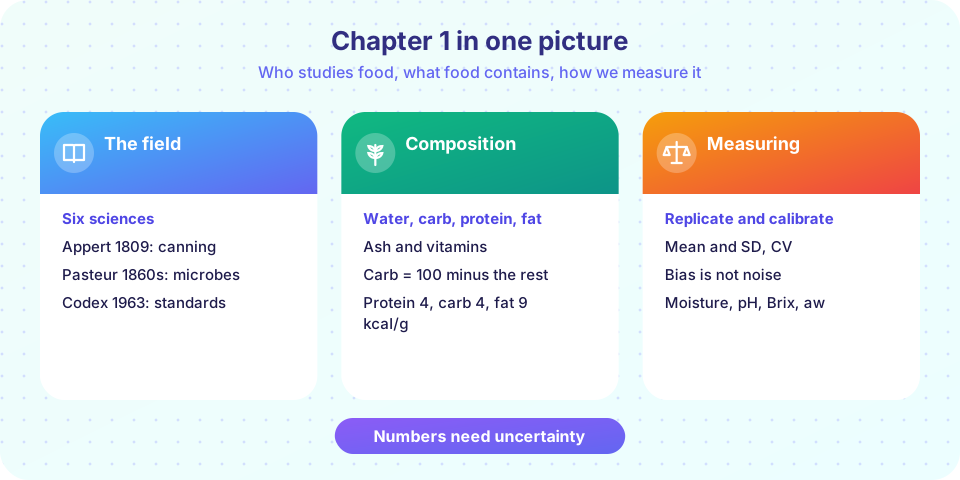
Start with the picture below. Try to explain every part of it aloud before reading the recap table. If you get stuck on a part, that is the lesson to reread.
What you will learn
- Recall the disciplines, milestones and careers from lesson 1.
- Recall the components, proximate analysis steps and energy factors from lesson 2.
- Recall measurement concepts from lesson 3 and apply them to a mixed set of questions.
Recap
| Lesson | Big idea | Must remember |
|---|---|---|
| What is food science? | Several sciences act on the same food | Chemistry, microbiology, engineering, sensory science, nutrition, regulation; Appert 1809, Pasteur 1860s, Codex 1963 |
| What food is made of | Foods are mixtures of a few components | Water, carbohydrate, protein, fat, minerals, vitamins; carbohydrate by difference; Atwater 4-4-9 |
| Lab basics | Numbers need uncertainty | Sampling, replicates, mean and SD, bias versus random error, calibration; moisture, pH, Brix, water activity |
Key terms to know cold. Food science; shelf life; macronutrient; proximate analysis; crude protein (N × 6.25); ash; Atwater factors; accuracy; precision; bias; calibration; titratable acidity; °Brix; water activity.
Connections to the rest of the course
Each idea in Chapter 1 returns later with more depth.
- Composition returns in Chapter 2, where each component gets a lesson and you see why water, starch, protein and fat behave as they do.
- Water activity, only mentioned here, becomes a central tool for predicting microbial growth in Chapters 3 and 4.
- pH reappears in Chapter 3 (growth limits) and Chapter 4 (acid preservation, acid versus low-acid foods).
- Energy calculations return in Chapter 7 when you read and design nutrition labels.
- Replicates and spread return in Chapter 6, because sensory and consumer tests need statistics too.
Worked problems with solutions
Work each problem on paper first, then check against the solution.
Problem 1: composition and energy. A cracker has, per 100 g: moisture 4.0 g, ash 2.5 g, protein 9.0 g and fat 14.0 g. (a) Find carbohydrate by difference. (b) Find the energy in kcal and kJ per 100 g.
Solution. (a) Carbohydrate = 100 − (4.0 + 2.5 + 9.0 + 14.0) = 70.5 g. (b) Energy = 9.0 × 4 + 70.5 × 4 + 14.0 × 9 = 36 + 282 + 126 = 444 kcal. In kilojoules, 444 × 4.184 ≈ 1,858 kJ. Notice that fat, at only 14% of the mass, supplies 126 of the 444 kcal, about 28% of the energy.
Problem 2: crude protein. A Kjeldahl test finds 2.4% nitrogen in a flour sample. Estimate crude protein with the general factor of 6.25, then with a factor of 5.7 for wheat.
Solution. With 6.25: 2.4 × 6.25 = 15.0%. With 5.7: 2.4 × 5.7 = 13.7%. The two answers differ by more than a percentage point, which shows why the factor must be stated whenever a protein value is reported.
Problem 3: bias or noise? A student weighs a certified 100.00 g reference weight five times and reads 100.52, 100.49, 100.51, 100.50 and 100.53 g. Is the balance precise? Is it accurate?
Solution. The readings agree within about 0.04 g, so the balance is precise. But the mean, 100.51 g, is 0.51 g above the true value, so it is not accurate: it has a systematic error of about +0.5 g. The fix is calibration or applying a correction, not more replicates.
Problem 4: pH ratios. Orange juice has pH 3.5 and milk has pH 6.5. How many times higher is the hydrogen ion concentration in the juice?
Solution. The difference is 3 pH units, so the ratio is 10³ = 1,000. The juice has about a thousand times more free hydrogen ions than the milk.
If you got these right, you have the quantitative skills of Chapter 1. If not, return to the lesson on food composition or lab basics and retry the matching calculation.
Try it
Press Run (or Ctrl + Enter) to see the result here.
Program input · what you'd type while the program runs
Type the answers before you press Run, one per line. Each time the program reads a line (with input()), it gets the next line from this box.
Press Run (or Ctrl + Enter) to see the result here.
Program input · what you'd type while the program runs
Type the answers before you press Run, one per line. Each time the program reads a line (with input()), it gets the next line from this box.
Check your understanding
Quick check · 10 questions
of 10 answered You scored / 10 · perfect!
-
1. Which pair correctly matches person and contribution?
Appert developed canning in 1809. Pasteur explained microbial spoilage; Durand patented the tin can in 1810; Codex was created in 1963 by FAO and WHO. -
2. Which component provides the most energy per gram?
Fat gives 9 kcal per gram versus 4 for protein and carbohydrate. Water provides none. -
3. A sample has 1.8 percent nitrogen. Using the factor 6.25, its crude protein is about...
1.8 × 6.25 = 11.25 percent. -
4. Moisture 10, ash 2, protein 12, fat 8 (all percent). What is the carbohydrate by difference?
100 − (10 + 2 + 12 + 8) = 68 percent. -
5. Replicate readings all agree closely but a calibration check shows the balance is 1 g high. The problem is...
Agreement among readings is precision; a constant offset from the true value is bias. -
6. Why does pH alone fail to describe how sour a food is?
pH is about free hydrogen ions; titratable acidity measures the total acid available to neutralize. -
7. Which statement about 'carbohydrate by difference' is true?
Because it is calculated as the remainder, any error in moisture, ash, protein or fat ends up in the carbohydrate value, and fiber is included unless measured separately. -
8. A refractometer reads 15 degrees Brix on a clear juice. This means roughly...
Brix is the sucrose-equivalent mass per 100 g of solution. -
9. Which is the best sampling practice for a large batch?
Representative sampling captures variation across the batch. -
10. Which discipline mainly designs the heating step for cans so that the center reaches a safe temperature?
Engineering computes heat transfer; microbiology defines the target lethality.
Summary
- Food science combines chemistry, microbiology, engineering, sensory science, nutrition and regulation.
- Food is mostly water, carbohydrate, protein, fat, minerals and vitamins, which proximate analysis separates by measuring and by difference.
- Energy comes from Atwater factors: 4, 4 and 9 kcal per gram.
- Accurate measurements need representative samples, calibration, replicates and an honest statement of spread.
Track your progress
Create a free account to tick off lessons and pick up where you left off on any device.
of Food Science lessons completed