


















Lesson 20 of 45 · Preservation
Cold and drying: refrigeration, freezing and dehydration
Learn how refrigeration and freezing slow spoilage, what ice crystals do to texture, how drying and freeze-drying work and how to model a drying curve.
Heat kills microbes; cold and dryness starve them. Both methods are older than recorded history. People stored meat in caves and ice houses and dried fish, grain, fruit and meat in the sun and wind long before anyone understood why it worked. Today refrigeration and freezing are the backbone of the global food supply chain (the "cold chain"), and drying turns perishable ingredients into stable powders, flakes and snacks.
Both families are based on slowing change rather than destroying microbes, so their success depends on maintaining conditions. This lesson explains how low temperature and low moisture protect food, what happens inside the food during freezing and drying, and how engineers describe and speed up these processes.
What you will learn
- Explain how temperature affects reaction and growth rates (Q₁₀).
- Describe what happens to food during freezing and why freezing rate affects texture.
- Distinguish drying methods, including freeze-drying, and describe the drying curve.
- State storage guidance and the main quality problems of cold and dried foods.
Key terms
Cold chain: unbroken refrigerated storage and transport from producer to consumer. Q₁₀: factor by which a rate increases for a 10 °C rise. Initial freezing point: temperature where ice begins to form in a food. Freezer burn: dry, discolored surface patches on frozen food. Sublimation: solid ice turning directly into vapor. Equilibrium moisture: the moisture content a food reaches in air of a given humidity.
Why cold works
Almost every reaction and biological process speeds up with temperature. The ratio of rates for a 10 °C rise is the Q₁₀; for many microbial growth and chemical spoilage processes it is about 2 to 3, so cooling from 20 °C to 5 °C slows them by a factor of roughly 3 to 5 or more (with a Q₁₀ of 2.5, 2.5^1.5 ≈ 3.9). Cooling thus extends the shelf life of fresh meat from hours to days, fresh milk from hours to a week or two and some produce to weeks. Cold does not kill most microbes and does not stop all growth: psychrotrophs such as Pseudomonas (spoilage) and Listeria (a pathogen) continue to grow slowly in a refrigerator, which is why refrigerated shelf life is always limited.
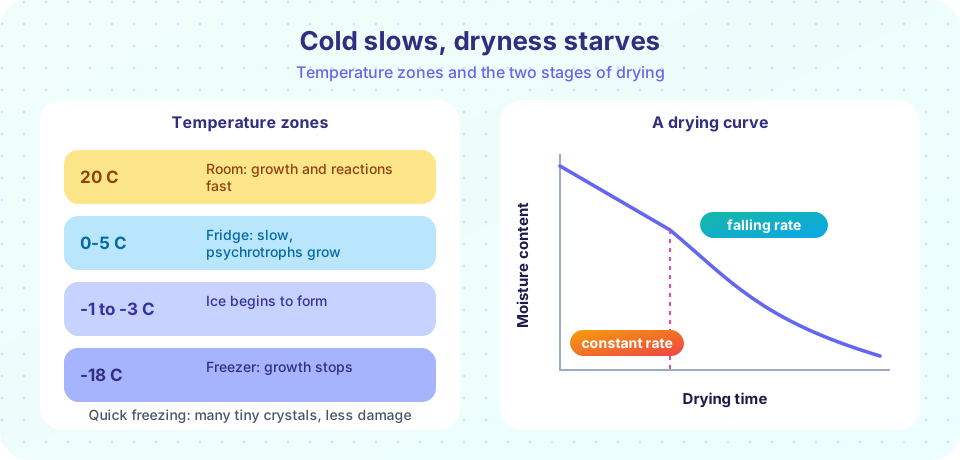
Refrigeration temperatures are typically 0 to 5 °C (about 4 °C is common domestic advice; many authorities recommend 5 °C or below). Many tropical fruits and vegetables suffer chilling injury below about 10-13 °C: bananas blacken, tomatoes lose flavor and cucumbers pit, so they are stored warmer. Other foods are best stored just above freezing: meat at about 0 to 2 °C, leafy greens near 0 °C with high humidity.
Freezing
Freezing preserves food in two ways: it lowers temperature far below where microbes can grow (growth stops below about -10 °C, and nothing grows in a standard -18 °C freezer) and it turns liquid water into ice, which removes the water from reactions. The internationally used storage standard is -18 °C (0 °F) or colder; chemical and enzymatic changes continue slowly at that temperature, so quality still declines over months (the practical storage life is weeks for some fish and fatty foods and a year or more for many vegetables and lean meats).
How food freezes
Pure water freezes at 0 °C, but foods contain dissolved sugars, salts and acids that depress the freezing point: most foods begin to freeze between about -0.5 and -3 °C. Water turns to ice first, so the remaining unfrozen solution gets more concentrated, and its freezing point falls. This is freeze concentration. Foods therefore freeze progressively over a range of temperatures, and even at -18 °C some water stays unfrozen. At very low temperatures the concentrated solution may turn into a glassy, amorphous solid, and below this glass transition temperature chemical reactions become extremely slow, one reason why ice cream is best stored at the coldest possible temperature.
Ice crystals and texture
The size of ice crystals determines damage. Slow freezing (hours, as in a domestic freezer for a big item) gives few, large crystals that form between cells, pulling water out of them and puncturing walls; on thawing, plant tissues turn mushy and meats drip. Quick freezing (minutes, in a blast freezer, plate freezer or liquid nitrogen tunnel) gives many tiny crystals inside and between cells, causing far less damage. Clarence Birdseye developed the plate-freezing process in the 1920s after observing how Inuit people froze fish rapidly in Arctic air. Vegetables are blanched (briefly heated) before freezing to destroy enzymes that would otherwise cause off-flavors and color loss over months.
Problems in frozen storage
- Freezer burn: ice sublimes from the surface of unwrapped food, leaving dry, pale, leathery patches. Airtight packaging prevents it.
- Recrystallization: temperature fluctuations melt small crystals, which refreeze as larger ones, making ice cream gritty.
- Lipid oxidation continues in frozen fatty fish and meat.
- Drip loss on thawing and protein damage.
- Temperature abuse in transport. A thawed and refrozen food has often spent time in the danger zone, so refreezing raw foods is discouraged unless cooked.
Drying
Drying (dehydration) lowers water activity by removing water, so that microbes cannot grow and enzymes and chemical reactions slow. A dried food with aw below about 0.6 is microbiologically stable. Typical products: grains, pasta, dried fruit and vegetables, powdered milk, instant coffee, herbs, spices, jerky and dried fish. Drying also cuts weight and volume, lowering transport and storage costs.
Methods
- Sun and air drying: simple and cheap but slow, weather-dependent, and open to contamination and pests; solar dryers help.
- Hot-air (tray, tunnel, belt) drying: warm air at about 50-90 °C blows over the food.
- Spray drying: a liquid (milk, coffee extract, egg) is sprayed as fine droplets into hot air; droplets dry in seconds into a powder, with the particle staying cool through evaporation.
- Drum drying: a thin film dries on a heated rotating drum (infant cereals, mashed potato flakes).
- Vacuum drying: lower pressure lowers the boiling point for heat-sensitive foods.
- Freeze-drying (lyophilization): the food is frozen, then placed under vacuum and gently warmed so the ice sublimates (turns straight to vapor) without melting. Below the triple-point pressure of water (about 611 Pa, or 6.1 mbar) liquid water cannot exist, which is why vacuum is used. The result is a light, porous product that rehydrates quickly and keeps shape, flavor and nutrients well, at the cost of a slow, energy-hungry process: instant coffee, fruit pieces, camping meals and some pharmaceuticals.
- Osmotic dehydration: soaking in concentrated sugar or salt solution removes part of the water and is often a pre-treatment.
The drying curve
Plot moisture content against time and most air-dried foods show phases.
- Warm-up: the surface heats.
- Constant-rate period: free water at the surface evaporates, like a wet towel, and the rate depends on the air (temperature, humidity, velocity). The surface stays near the wet-bulb temperature.
- Falling-rate period: the surface dries and water must move from the interior by diffusion and capillary action; the rate falls steadily, and this stage takes most of the time.
If the surface dries too fast, it hardens into a crust (case hardening) that traps moisture inside. Dried food shrinks, may lose volatile flavors and nutrients such as vitamin C, and can brown (Maillard reaction at intermediate aw, plus enzymatic browning if not blanched or treated with sulfite or ascorbic acid).
A simple model for the falling-rate period is the Lewis (Newton) equation: MR = (M − Mₑ)/(M₀ − Mₑ) = exp(−k t), where MR is the moisture ratio, M₀ the initial moisture, Mₑ the equilibrium moisture and k a drying constant that increases with temperature.
Storing dried foods
Dried foods are hygroscopic: they absorb water from humid air and can cake, go sticky, become moldy or soften. Packaging must be a good moisture barrier (foil laminates, sealed jars, desiccant sachets). Quality losses to watch: oxidation of fats (nuts, whole-grain flour), Maillard browning, loss of color and aroma and insect infestation. Rehydration restores some, but not all, properties. A low-moisture food is not immune to pathogens. Salmonella survives for months in dry foods (nuts, spices, flour, infant formula, chocolate), and low aw can even make bacteria more heat-resistant, which is why low-moisture foods need validated kill steps.
Common misconceptions
"Freezing kills bacteria." It stops growth; many survive and resume when thawed. "Frozen food lasts forever." It remains safe indefinitely at -18 °C, but quality declines (freezer burn, rancidity). "Dried food cannot make you sick." Dried foods can carry spores, Salmonella or mycotoxins. "Freeze-drying and drying are the same." Freeze-drying removes ice by sublimation and preserves structure; hot-air drying removes liquid water and shrinks the food.
Try it
Press Run (or Ctrl + Enter) to see the result here.
Program input · what you'd type while the program runs
Type the answers before you press Run, one per line. Each time the program reads a line (with input()), it gets the next line from this box.
Press Run (or Ctrl + Enter) to see the result here.
Program input · what you'd type while the program runs
Type the answers before you press Run, one per line. Each time the program reads a line (with input()), it gets the next line from this box.
Press Run (or Ctrl + Enter) to see the result here.
Program input · what you'd type while the program runs
Type the answers before you press Run, one per line. Each time the program reads a line (with input()), it gets the next line from this box.
Press Run (or Ctrl + Enter) to see the result here.
Program input · what you'd type while the program runs
Type the answers before you press Run, one per line. Each time the program reads a line (with input()), it gets the next line from this box.
Check your understanding
Quick check · 6 questions
of 6 answered You scored / 6 · perfect!
-
1. With a Q10 of 2, how much slower is a reaction at 5 °C than at 25 °C?
20 °C is two 10 °C steps, so 2 squared is 4 times slower. -
2. Why does quick freezing usually preserve texture better than slow freezing?
Rapid freezing forms many tiny ice crystals, avoiding large crystals that rupture cells. -
3. What is sublimation in freeze-drying?
Under vacuum and gentle heat, ice goes straight to vapor, leaving a porous structure. -
4. In the falling-rate period of drying...
Once surface water is gone, internal diffusion limits the rate. -
5. Freezer burn is caused by...
Ice sublimes from exposed surfaces, leaving dry, pale patches. -
6. Why is Salmonella a concern in dried foods such as nuts?
Survival, not growth, is the concern, so low-moisture foods need validated kill steps.
Summary
- Cold slows reactions and growth (Q₁₀ about 2-3) but does not kill; psychrotrophs still grow in the fridge.
- Freezing at -18 °C or colder halts growth; quick freezing gives small crystals; freezer burn, recrystallization and oxidation limit quality.
- Drying lowers water activity; freeze-drying sublimes ice under vacuum; drying curves have constant-rate and falling-rate periods.
- Dry foods need moisture barriers and can still carry survivors such as Salmonella.
Track your progress
Create a free account to tick off lessons and pick up where you left off on any device.
of Food Science lessons completed