


















Lesson 17 of 45 · Food Microbiology and Safety
Chapter review: Food Microbiology and Safety
Review Chapter 3: microbial growth and FAT TOM, the main foodborne pathogens, HACCP principles and time-temperature rules, with a ten-question quiz.
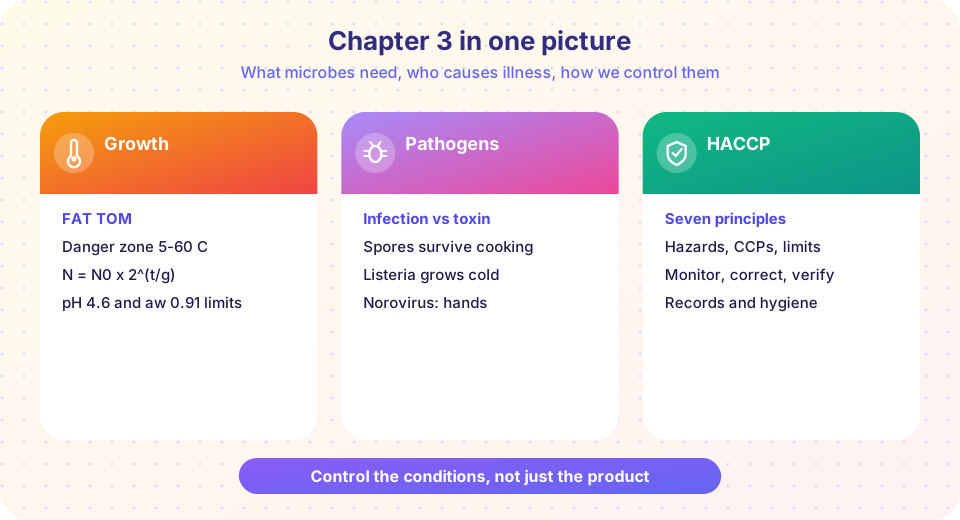
Chapter 3 covered the living side of food: how microbes grow, which ones cause illness and how systems such as HACCP keep food safe. This review compresses it into one picture and one table, then gives you practice questions that mix the three lessons. If any part feels shaky, go back to that lesson before starting Chapter 4, because preservation builds directly on these ideas.
Try to explain the picture out loud first: what does a microbe need, which organisms to watch, and where do you put controls?
What you will learn
- Recall growth phases, FAT TOM and temperature, pH and oxygen limits.
- Recall pathogen types and typical sources.
- Recall the seven principles of HACCP and key time-temperature rules.
Key terms
Must know: lag and log phase, generation time, FAT TOM, danger zone, psychrotroph, pH 4.6 boundary, infection versus intoxication, spore, norovirus, mycotoxin, cross-contamination, HACCP, CCP, critical limit, corrective action, verification, prerequisite program, allergen.
Recap
| Lesson | Core idea | Key numbers and facts |
|---|---|---|
| The growth of microbes | Populations grow exponentially if conditions allow | N = N₀ × 2^(t/g); danger zone about 5-60 °C; most bacteria need aw above about 0.91; pH 4.6 boundary for botulinum; Listeria grows in the fridge |
| Foodborne pathogens | Infection, intoxication, toxicoinfection | Spores survive cooking; S. aureus and B. cereus (emetic) toxins are heat stable; norovirus spreads by handlers; aflatoxins survive cooking; WHO: about 600 million cases and 420,000 deaths a year |
| HACCP and hygiene | Prevent hazards at critical points | Seven principles; cook poultry to 74 °C; cooling in two stages; 20 seconds handwashing; US 9 and EU 14 allergens |
Connect the dots
- A low pH or low aw food needs fewer controls for bacteria (Chapter 4 builds on this).
- A cooked, then slowly cooled food is a classic spore problem, so the CCP is cooling.
- A ready-to-eat chilled food can still carry Listeria, so hygiene and shelf-life limits matter.
- A toxin already made cannot be cooked away; prevention must come earlier.
Grow
Who causes illness
Control
Worked problems with solutions
Problem 1: growth. A pathogen starts at 50 cells per gram on a food left on a counter. Its generation time under those conditions is 25 minutes, with no lag. How many cells per gram after 3 hours?
Solution. 3 hours is 180 minutes, so 180 / 25 = 7.2 generations. Growth factor = 2^7.2 ≈ 147. Cells = 50 × 147 ≈ 7,400 per gram. Real growth would include a lag and could be slower, so this is a worst-case idealization.
Problem 2: classify the food. Salsa has pH 4.2 and aw 0.97; cooked pasta has pH 6.5 and aw 0.99; jerky has pH 5.6 and aw 0.80. Which are acid foods, which low-acid? Which is protected by low water activity?
Solution. Salsa has pH below 4.6, so it is an acid food (botulinum cannot grow). Cooked pasta and jerky are above 4.6, so low-acid foods. Jerky's aw of 0.80 is below the limit for most bacteria (about 0.91), so it is protected by dryness; pasta at 0.99 needs cold storage and short holding times.
Problem 3: toxin or infection? Several guests feel sick about three hours after eating a potato salad left out all afternoon. Which kind of illness is most likely, and why does reheating the leftovers not make them safe?
Solution. The short onset points to a preformed toxin, most likely from Staphylococcus aureus introduced by hands and then grown in the warm salad. The staphylococcal enterotoxin is heat stable, so heating kills the bacteria but leaves the toxin. Prevention is hygiene and keeping the salad cold.
Problem 4: a HACCP step. A kitchen cools a large pot of chili by leaving it on the stove overnight. Name the hazard, the control that is missing and a critical limit.
Solution. The hazard is germination and growth of Clostridium perfringens and Bacillus cereus spores that survived cooking. The missing control is rapid cooling. A typical critical limit is from 57 °C to 21 °C within 2 hours and to 5 °C within a total of 6 hours, achieved by dividing the chili into shallow containers or using an ice bath. Monitoring is a probe thermometer with time records, and the corrective action is to discard food that missed the limit.
Use the explanations to decide which lesson to reread: problem 1 relates to growth, problem 3 to pathogens, and problems 2 and 4 to growth factors and HACCP.
Try it
Common misconceptions
"Cooking removes all risk." Not if the food is recontaminated or if toxins or spores are involved. "A clean-looking kitchen is a safe kitchen." Pathogens are invisible; controls and records show safety. "Safe limits are the same everywhere." Limits vary by authority; learn the principle and apply local rules.
Press Run (or Ctrl + Enter) to see the result here.
Program input · what you'd type while the program runs
Type the answers before you press Run, one per line. Each time the program reads a line (with input()), it gets the next line from this box.
Press Run (or Ctrl + Enter) to see the result here.
Program input · what you'd type while the program runs
Type the answers before you press Run, one per line. Each time the program reads a line (with input()), it gets the next line from this box.
Check your understanding
Quick check · 10 questions
of 10 answered You scored / 10 · perfect!
-
1. A pathogen has a 20-minute generation time and no lag. Starting from 10 cells, how many are there after 2 hours?
2 hours is 6 generations, 2 to the 6 is 64, and 10 × 64 = 640. -
2. Which pathogen can grow at refrigerator temperatures?
Listeria is a psychrotroph. Campylobacter does not grow below about 30 °C, a virus does not grow in food, and aflatoxin is a toxin. -
3. Illness within 1-6 hours after eating is most likely due to...
Preformed toxins act quickly; viruses and parasites take longer. -
4. pH 4.6 is important because...
It separates acid and low-acid foods in canning rules. -
5. Which is NOT one of the seven HACCP principles?
Advertising is not part of HACCP. -
6. Spores are important in food safety because...
Spore-formers such as Bacillus and Clostridium survive cooking. -
7. Which is a correct statement about cross-contamination?
Shared surfaces and hands move microbes from raw to ready-to-eat foods. -
8. A CCP for cooked chicken is...
Cooking is the step that eliminates pathogens and has a measurable critical limit. -
9. Aflatoxins are controlled mainly by...
Aflatoxins survive cooking, so prevention in crops and storage is key. -
10. Which is true of norovirus?
Norovirus does not grow in food but spreads easily; handwashing with soap is important.
Summary
- Growth depends on FAT TOM; cold, acid, dryness and hygiene are the main brakes.
- Pathogens cause infection, intoxication or toxicoinfection; spores, toxins and viruses need special controls.
- HACCP places measurable controls at critical points, supported by hygiene and allergen programs.
- Time-temperature rules and cooling limits are applications of growth science.
Track your progress
Create a free account to tick off lessons and pick up where you left off on any device.
of Food Science lessons completed