


















Lesson 44 of 45 · Projects and Practice
Cheat Sheet: Food Science Formulas and Numbers
One-page food science cheat sheet: thermal processing, emulsions, sensory statistics, rheology, energy and nutrition, labels, HACCP, Q10 shelf life, with unit converters and examples.
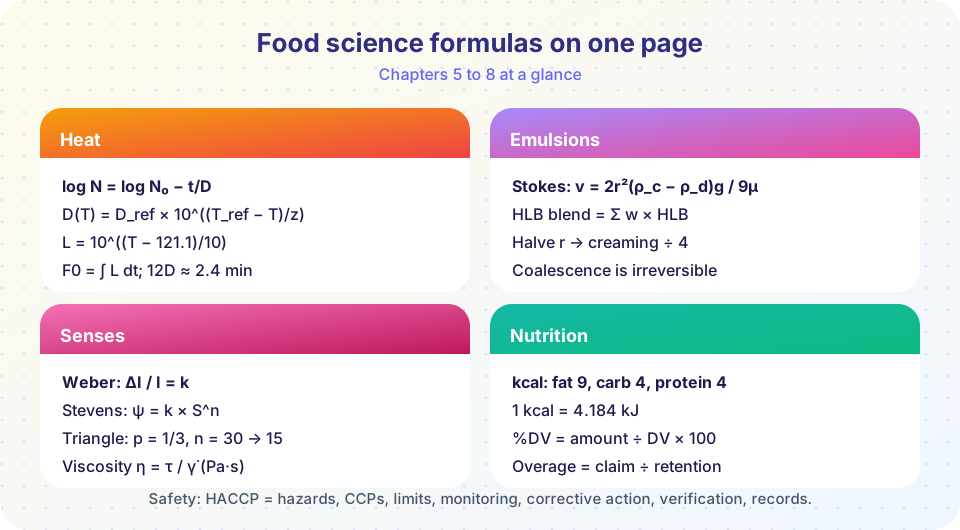
When you are revising, working a problem or standing in a pilot plant, you want the key formulas and numbers on one page. This cheat sheet collects them from chapters 5 to 9, with the symbols defined and the common traps flagged. Print it, but remember: a formula is only useful if you know when it applies, so each block below says what the formula assumes.
What you will learn
- Find any key formula or number of the second half of the course in seconds.
- See the conditions under which each formula is valid.
- Convert units and run the main calculations with the tools below.
Key terms
Formula: a rule that links quantities, valid only under stated assumptions.
Assumption: a condition that must be true for the formula to work, such as first-order kinetics or constant temperature.
Unit check: confirming that both sides of an equation have the same units.
Heat processing
| Quantity | Formula | Notes |
|---|---|---|
| Log kill | log N = log N₀ − t / D |
First-order death at a constant temperature |
| D at another temperature | D(T) = D_ref × 10^((T_ref − T) / z) |
z of spores about 10 °C |
| Lethal rate | L = 10^((T − 121.1) / z) |
1 min at T equals L min at 121.1 °C |
| Process lethality | F0 = ∫ L dt |
Integrate the cold-spot history, including cooling |
| 12D botulinum cook | F = 12 × D121.1 |
About 2.4 min if D = 0.2 min; real processes add margin |
| Conduction time | t ∝ L² / α |
Double the size, about four times slower |
| Mass balance (drying) | product = solids / (1 − final moisture) |
Solids stay constant |
Emulsions and texture
| Quantity | Formula | Notes |
|---|---|---|
| Stokes velocity | v = 2 r² (ρ_c − ρ_d) g / (9 μ) |
Single small sphere, slow flow |
| HLB of a blend | HLB = Σ wᵢ × HLBᵢ |
Weight fractions add to 1 |
| Viscosity | η = τ / γ̇ |
Pa·s; Newtonian if constant |
| Power law | τ = K × γ̇^n |
n < 1 shear-thinning, n > 1 thickening |
| Herschel-Bulkley | τ = τ₀ + K × γ̇^n |
Yield stress τ₀ |
| TPA cohesiveness | A₂ / A₁ |
Areas under bites 2 and 1 |
Senses and statistics
| Quantity | Formula or rule | Notes |
|---|---|---|
| Weber's law | ΔI / I = k |
JND is a constant fraction of intensity |
| Stevens' law | ψ = k × S^n |
n above 1 expansive, below 1 compressive |
| Triangle test | p = P(X ≥ k), X ~ Binomial(n, 1/3) |
n = 12 needs 8, 24 needs 13, 30 needs 15, 60 needs 27 (α = 0.05) |
| Paired / duo-trio | Binomial with p = 1/2 | Preference tests are two-sided |
| Power | 1 − β |
Rises with panel size and effect size |
Nutrition and labels
| Quantity | Formula | Notes |
|---|---|---|
| Energy | kcal = 9 × fat + 4 × protein + 4 × carbohydrate (+ 7 × alcohol, + 2 × fiber) |
Atwater averages |
| Energy units | 1 kcal = 4.184 kJ |
|
| Protein from nitrogen | protein = N × 6.25 |
5.7 for wheat, 6.38 for dairy |
| %DV | amount ÷ DV × 100 |
5% or less low, 20% or more high (US) |
| Per serving | per 100 g × serving g ÷ 100 |
|
| First-order loss | C = C₀ e^(−kt), t½ = ln 2 / k |
k rises with T by Arrhenius |
| Overage | add = claim ÷ retention |
Retention = fraction left at end of shelf life |
Safety, innovation and shelf life
| Topic | Key point |
|---|---|
| HACCP principles | 1 hazard analysis, 2 CCPs, 3 critical limits, 4 monitoring, 5 corrective actions, 6 verification, 7 records |
| Hazards | Biological, chemical, physical |
| Prerequisite programs | GMP, hygiene, pest control, training, supplier control |
| Cost of goods | ingredient cost ÷ finished kg + packaging + processing |
| Q10 | SL(T) = SL_test × Q10^((T_test − T) / 10) |
| Arrhenius | ln k = ln A − (Ea / R)(1 / T), R = 8.314 J/(mol·K) |
| Q10 from Ea | Q10 = exp[Ea × 10 / (R T (T + 10))]; 50 kJ/mol gives about 2, 80 kJ/mol about 3 |
Numbers worth remembering
- pH 4.6: the divide between acid and low-acid foods for C. botulinum.
- 121.1 °C (250 °F): the reference temperature for F0.
- 72 °C for 15 s: HTST pasteurization of milk; 63 °C for 30 min for the low-temperature version.
- 4, 4, 9 kcal per gram for carbohydrate, protein and fat; 7 for alcohol; about 2 for fiber.
- 2,000 kcal: the reference diet behind the US Daily Values.
- 12 log reductions: the botulinum cook.
Common misconceptions
"A formula always works." Each one has assumptions. Stokes' law is for dilute single droplets, Q10 for a constant mechanism, Atwater factors for averages.
"Units are optional." Many mistakes come from mixing minutes and seconds, kJ and kcal, grams and milligrams.
"Memorize and forget." Rework one problem from each block each week and you will keep them.
Try it
First, a unit helper for the conversions used in this course.
Second, one calculator that runs the main formulas of the cheat sheet on example values. Change the inputs at the top and re-run.
Press Run (or Ctrl + Enter) to see the console output here.
No output.
Check your understanding
Quick check · 4 questions
of 4 answered You scored / 4 · perfect!
-
1. Which formula gives the lethal rate?
L compares the killing rate at T with that at 121.1 °C using z. -
2. A low-acid food needs a botulinum cook of 12D. If D = 0.2 min at 121.1 °C, F is:
12 × 0.2 = 2.4 min. -
3. Which unit pair is correct?
One kilocalorie equals 4.184 kilojoules. -
4. Which value is the typical minimum correct answers for a triangle test with 30 panelists (α = 0.05)?
30 panelists need 15 correct answers at α = 0.05.
Summary
- Heat: log kill, D, z, lethal rate, F0 and the 12D cook; conduction time grows with size squared.
- Emulsions and texture: Stokes, HLB blend, viscosity, power-law and Herschel-Bulkley models, TPA.
- Senses: Weber, Stevens and binomial tests with p = 1/3 or 1/2.
- Nutrition and labels: Atwater factors, kcal to kJ, %DV, first-order loss, overage.
- Safety and shelf life: seven HACCP principles, cost of goods, Q10 and Arrhenius.
- Every formula comes with assumptions: check them before you trust the answer.
Track your progress
Create a free account to tick off lessons and pick up where you left off on any device.
of Food Science lessons completed