


















Lesson 37 of 45 · Food Innovation and Regulation
Food Innovation and Regulation: The Big Picture
See how a new food goes from idea to shelf: the stage-gate process, scale-up, cost of goods, reformulation and the safety and legal gates that every product must pass.
Every product on a supermarket shelf began as an idea in someone's notebook. Most food ideas never get there. Some fail because people do not want them, others because the recipe cannot be made at scale, and a few because they cannot be proved safe or legal. Food innovation is the work of turning the right ideas into products, and food regulation is the framework that decides whether a product may be sold. This chapter treats them together, because in practice a food scientist thinks about both from the first day: can we make it, will people buy it, and may we sell it?
What you will learn
- Describe the stages of new product development and what a gate checks.
- Explain why scale-up is difficult for food and give examples.
- Calculate a simple cost of goods and see how yield changes it.
- Preview the regulatory and safety questions covered in this chapter.
Key terms
New product development (NPD): the process of taking a food from idea to market.
Stage-gate process: an NPD method with stages of work and gates where managers decide whether to continue, revise or stop.
Scale-up: moving a recipe from the kitchen or laboratory, through a pilot plant, to full factory production.
Cost of goods (COGS): the direct cost of ingredients, packaging and processing per unit sold.
Reformulation: changing an existing recipe, for example to cut sugar, salt or cost, while keeping its quality.
Why foods change
Several forces drive innovation in food:
- Health and nutrition: reducing sugar, salt and saturated fat, adding fiber or protein.
- Sustainability: lower greenhouse gas emissions, less waste and less water.
- Convenience: ready meals, snack formats, single-serve packs, longer shelf life.
- Taste and culture: global flavors, premium foods, local specialties.
- Cost and supply: crop failures, prices and new ingredients that can replace scarce ones.
A good idea sits where these forces meet a real consumer need. The phrase clean label is popular with consumers and manufacturers for ingredient lists with few and familiar names, but it has no legal definition, so companies use it differently. Remember from the labeling lesson that an ingredient list tells you what is in a product, not how nutritious it is.
The stage-gate process
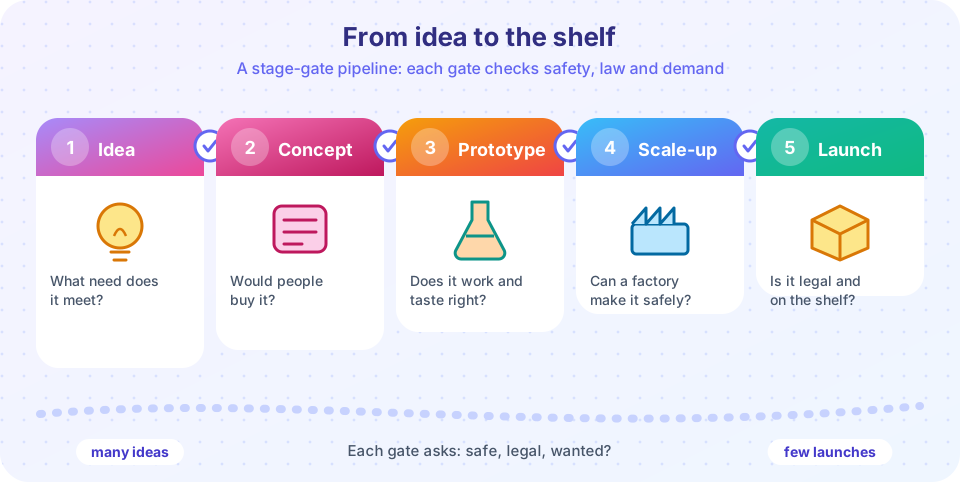
Many companies follow a variant of the stage-gate approach, described by Robert Cooper in the 1980s. Work is divided into stages, and each stage ends with a gate: a decision based on evidence about whether to go on. Costs rise sharply at each stage, so the early gates aim to stop weak ideas cheaply.
| Stage | Main work | Typical gate question |
|---|---|---|
| 1. Idea | Gather ideas from trends, consumers, suppliers and science | Does it meet a real need and fit the company's strategy? |
| 2. Concept | Describe the product and test it with consumers; first costing | Would people buy it, at what price? |
| 3. Prototype | Make samples in the kitchen or lab; sensory tests; first shelf-life tests | Does it work, taste right and meet the nutrition target? |
| 4. Scale-up | Pilot plant trials, process design, packaging, HACCP plan | Can a factory make it safely, consistently and at the target cost? |
| 5. Launch | Final regulatory checks, labels, production, marketing | Is it legal, safe and ready for the shelf? |
The gates are also safety and legal checks: an ingredient that is not authorized in your market, a health claim that cannot be justified, or an allergen that is not controlled in the factory can stop a launch at any stage.
Why foods change
How they get made
What stops a product?
Gates catch each early.
Scale-up: why the kitchen is not the factory
A recipe that works in a 1 kg batch can fail in a 1,000 kg batch, because physical processes do not scale evenly. Heat transfer is the classic example, as in the thermal processing lesson: a large vessel has far less surface area per unit volume, so heating and cooling take longer, and the cold spot lags. Mixing also changes: a whisk in a bowl provides strong, even shear; a big tank needs a designed agitator. Time matters: batches that wait for an hour in a hot hold tank may brown or lose vitamins. Ingredients behave differently in bulk, with different particle size, moisture and variability. Engineers use a pilot plant (a small production line) to find these problems before building or changing the factory.
Cost of goods and yield
A product has to be profitable, so every prototype gets a cost. Cost of goods per kilogram of finished product is the sum of ingredient costs divided by the finished weight:
COGS per kg = (Σ ingredient kg × price per kg + packaging + processing) / finished kg
Yield is the ratio of finished weight to raw weight, and it matters a lot: if you buy 100 kg of ingredients and 8 kg are lost as trim and evaporation, you must pay for 100 kg but sell only 92 kg. Improving yield is often worth more than cutting the price of an ingredient.
Regulation is part of design
Rules differ between countries, but they ask similar questions: Is the ingredient permitted? Is the process safe (HACCP)? Is the label truthful and complete? Are the claims allowed? Is a novel food or process safe? The next lesson explains the safety system and the international standards; the lesson after it covers novel foods and alternative proteins.
Common misconceptions
"A great taste guarantees success." A product also needs the right price, availability, safety documentation and packaging, and consumers often resist unfamiliar foods.
"Regulation just slows innovation." Safety rules prevent harm and protect trust; one outbreak can damage a whole category. Good regulation also gives clear criteria that companies can plan for.
"If it works in the lab, it will work in the plant." Scale changes heat and mass transfer, mixing and timing.
Try it
First, a funnel simulator. Set the share of ideas that survive each gate and see how many remain from a starting number. The pass rates are only for the exercise, not statistics about real companies.
Second, a cost-of-goods calculator for a recipe, including the effect of yield. The prices are invented for practice.
Press Run (or Ctrl + Enter) to see the console output here.
No output.
In this chapter
| Lesson | What it covers |
|---|---|
| Food law, HACCP and standards | Hazard analysis, Codex, GFSI and how safety is regulated |
| Novel foods and alternative proteins | Plant-based, fermentation, cultivated and insect proteins; safety assessment |
| Chapter 8 review | Recap, one-picture summary, 9-question quiz |
Check your understanding
Quick check · 4 questions
of 4 answered You scored / 4 · perfect!
-
1. What is a gate in the stage-gate process?
Gates are decision points where evidence is reviewed before more money is spent. -
2. Why are early gates cheap and useful?
Costs rise with each stage, so stopping weak ideas early saves most. -
3. Which change makes a scaled-up batch heat slower than a small one?
Large volumes have less surface area per unit volume, so heat transfer is slower. -
4. A recipe uses 100 kg of ingredients costing 450 in total and yields 90 kg of product. What is the ingredient cost per kg of product?
450 / 90 = 5.00 per kg, higher than 4.50 because of yield loss.
Summary
- Food innovation turns ideas into products through stages and gates; each gate checks demand, feasibility, safety and law.
- Scale-up is hard because heat transfer, mixing, time and ingredient variability change with size; pilot plants reveal problems.
- Cost of goods depends strongly on yield; improving yield can matter more than ingredient price.
- Regulation is part of design, not an afterthought; the next lessons cover HACCP, standards and novel foods.
Track your progress
Create a free account to tick off lessons and pick up where you left off on any device.
of Food Science lessons completed