


















Lesson 35 of 45 · Nutrition and Labeling
Nutrition Labels and Claims
Learn how food labels are built: ingredient lists, allergens, Nutrition Facts and %Daily Value, serving size and rounding, nutrient claims, and front-of-pack systems.
A food label is a small legal document, a scientific summary and an advertisement, all in a few square centimeters. Every number on it comes from somewhere: a laboratory analysis, a calculation from a recipe, a regulation that says how to round and how to describe it. This lesson takes a label apart. You will see which parts are mandatory, how the numbers are made and expressed as a percentage of a daily reference, what words like "low," "high" and "light" may legally mean, and how front-of-pack schemes try to make the information faster to read.
What you will learn
- List the mandatory elements of a food label and how ingredients and allergens are shown.
- Calculate %Daily Value, convert between per-100 g and per-serving values, and read the 5 / 20 percent rule.
- Explain how a label is calculated from a recipe, including moisture loss and rounding.
- Interpret common claims and front-of-pack systems, and their limits.
Key terms
Daily Value (DV): a reference amount of a nutrient for labeling, based on a 2,000 kcal reference diet in the US; %DV is the share of it that one serving provides.
Reference Intake (RI): the corresponding EU labeling reference values.
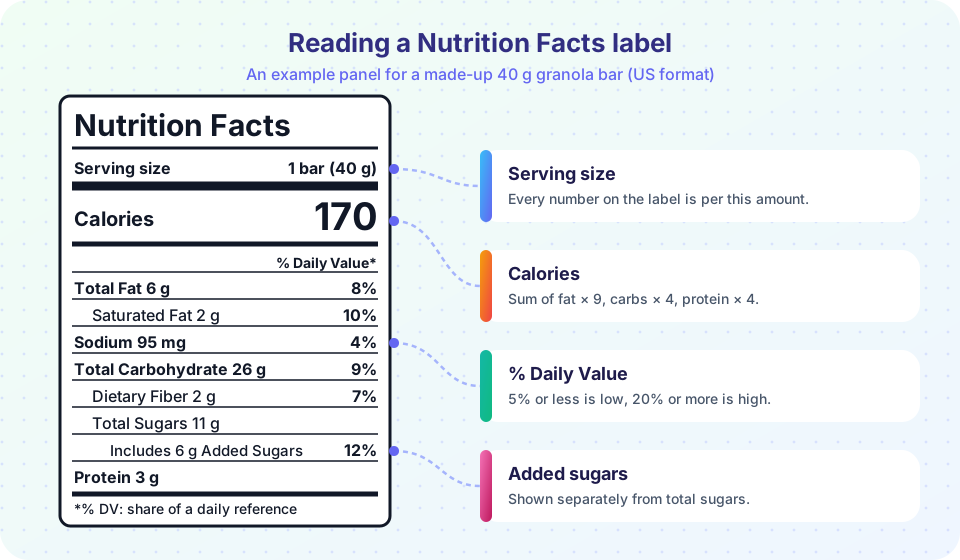
Serving size: in the US, an amount that people customarily eat, not a recommendation.
Nutrient content claim: a statement such as "low fat" or "high in fiber" that must meet legal criteria.
Front-of-pack labeling (FOPL): a simple graphic or color code on the front of the pack that summarizes nutrition quality.
What every label must show
Details differ by country, but nearly all systems require:
- the name of the food and the net quantity;
- the ingredient list, in descending order by weight at the time of manufacture, so the first ingredient is the largest;
- allergens, highlighted (in bold, or in a "Contains" statement). The EU lists 14 allergens: cereals containing gluten, crustaceans, eggs, fish, peanuts, soybeans, milk, tree nuts, celery, mustard, sesame, sulphites, lupin and molluscs. The US names nine (milk, eggs, fish, crustacean shellfish, tree nuts, peanuts, wheat, soybeans and sesame);
- a date mark: "use by" for foods that are microbiologically unsafe after the date, and "best before" for quality;
- the name and address of the manufacturer or importer, storage conditions, and the country of origin where required;
- the nutrition declaration.
In the EU the nutrition declaration gives energy (kJ and kcal), fat, saturates, carbohydrate, sugars, protein and salt per 100 g or 100 ml, and optionally per portion. The US Nutrition Facts panel gives calories per serving in large type, then total fat, saturated fat, trans fat, cholesterol, sodium, total carbohydrate, fiber, total sugars, added sugars, protein, and vitamin D, calcium, iron and potassium, with %DV for most.
%Daily Value and the 5 / 20 rule
The %Daily Value puts a number in context:
%DV = (amount in one serving ÷ Daily Value) × 100
For the US 2,000 kcal reference, some of the Daily Values are:
| Nutrient | Daily Value |
|---|---|
| Total fat | 78 g |
| Saturated fat | 20 g |
| Sodium | 2,300 mg |
| Total carbohydrate | 275 g |
| Dietary fiber | 28 g |
| Added sugars | 50 g |
| Protein | 50 g |
| Potassium | 4,700 mg |
Worked example from the bar in the picture: 6 g fat gives 6 / 78 × 100 = 7.7, which is rounded to 8 percent; 95 mg sodium gives 95 / 2300 × 100 = 4.1, which is 4 percent; 6 g added sugars give 6 / 50 × 100 = 12 percent. The label guidance says 5 percent DV or less per serving is low in a nutrient and 20 percent DV or more is high. That helps a shopper judge quickly whether a food is a lot or a little of something, but whether more or less is better depends on the nutrient and the person. The EU uses Reference Intakes in a similar way: 8,400 kJ (2,000 kcal) of energy, 70 g fat, 20 g saturates, 260 g carbohydrate, 90 g sugars, 50 g protein and 6 g salt.
Serving size and per-100 g values
Per-100 g values let you compare different products fairly. Per serving values show what a typical portion supplies, and are the basis of the US panel. The serving size is set by the regulator from surveys of how much people customarily eat (the reference amounts customarily consumed), so it is not a recommendation. Manufacturers can make a product look lower in calories by using a small serving, so check how many servings the pack contains. Scaling is a ratio:
per serving = (per 100 g) × (serving in grams) ÷ 100
How a label is built from a recipe
Small companies often do not analyze every batch in a laboratory. They calculate the label from the recipe and a food composition database. The method:
- Take the grams of each ingredient and its composition per 100 g.
- Sum each nutrient over all ingredients (grams of nutrient = grams of ingredient × composition ÷ 100).
- Adjust for processing yield: baking or cooking evaporates water, so the finished weight is lower than the raw total, and the nutrient content per 100 g of the finished product goes up. Nutrient losses (such as vitamin loss on heating) are applied where they are known.
- Divide by the finished weight to get per-100 g values, and scale to the serving.
- Calculate energy from the Atwater factors and round according to the regulation.
The US rules for rounding are simple in principle: calories are reported as 0 if below 5, to the nearest 5 up to 50, and to the nearest 10 above 50; fat is reported to the nearest 0.5 g below 5 g and to the nearest gram above; sodium to the nearest 5 mg up to 140 mg and to the nearest 10 mg above. These details change, so manufacturers check the current regulation. Rounding explains why a food can say "0 g trans fat" when a serving contains a little under 0.5 g: the number is rounded down.
Labels should also be verified: a sample is analyzed in a laboratory, and the regulator allows a tolerance. For some nutrients the label must not be below the true amount (vitamins and fiber, which are "good" nutrients), and for others it must not be above (calories, sugar, fat, sodium, which are the "limit" ones).
Claims on the front of the pack
A nutrient content claim describes the level of a nutrient. In the US, "free" means a trivially small amount (for example less than 0.5 g of fat or sugar per serving), "low" has defined limits, "reduced" means at least 25 percent less than the reference product, and "high" or "excellent source" means 20 percent DV or more per serving while "good source" means 10 to 19 percent. The EU has its own list of defined claims, for example "source of fibre" requires at least 3 g of fiber per 100 g, "high in fibre" at least 6 g, "low fat" at most 3 g of fat per 100 g in solids and "sugar-free" at most 0.5 g sugars per 100 g. Health claims link a food or nutrient to a health effect; in the EU only authorized claims on a published register may be used, while in the US some health claims are authorized and others are structure-function statements. "Natural" has no strict general legal definition in many countries, so it tells you little.
Front-of-pack systems
Because a full table is slow to read, many countries use a summary on the front.
- Nutri-Score (France and several European countries) ranks products from A (green) to E (red) using an algorithm that counts energy, sugars, saturated fat and salt against fiber, protein, and fruit and vegetable content.
- Traffic lights (UK, voluntary) show red, amber and green for fat, saturates, sugars and salt, with per-portion figures.
- Warning labels (Chile and other Latin American countries) use black octagons such as "high in sugars" on products above set thresholds.
Researchers compare these schemes by whether shoppers choose more healthful products and whether manufacturers reformulate to avoid warnings. Each simplifies information, so none replaces the full panel, and each has critics, for example for how it rates oils or cheeses.
Common misconceptions
"The serving size is what I should eat." It is the amount people typically eat. It is not a recommended portion.
"0 g trans fat means none." It means under 0.5 g per serving after rounding. The ingredient list ("partially hydrogenated oil") reveals more.
"If a product is 'low fat' it is healthy." Reduced-fat foods may be high in sugar or salt. The label should be read as a whole.
"%DV tells me whether I eat well." It is for comparing foods against a reference diet, but individual needs differ. This lesson is about reading labels, not personal advice.
Try it
First, a %DV checker for a serving. The Daily Values are the US values from the table above. Enter amounts and see the percentage and the low / high flag.
Second, build a label from a recipe. The composition values are rounded typical figures per 100 g from public tables, and the baking loss is an assumption. Change the numbers to see how moisture loss concentrates the nutrients.
Press Run (or Ctrl + Enter) to see the console output here.
No output.
Check your understanding
Quick check · 5 questions
of 5 answered You scored / 5 · perfect!
-
1. A serving contains 460 mg sodium and the Daily Value is 2,300 mg. What is the %DV?
460 / 2300 × 100 = 20 percent, which counts as high under the 5 / 20 rule. -
2. How are ingredients listed on a label?
The largest ingredient by weight comes first. -
3. A product has 12 g sugars per 100 g. A serving is 30 g. How much sugar is in a serving?
12 × 30 / 100 = 3.6 g. -
4. Why can a label say 0 g trans fat when the product contains a small amount?
Labeling rules round very small amounts to zero. -
5. What is the main purpose of per-100 g values?
A common basis lets you compare products whatever their serving sizes.
Summary
- Labels must show the name, quantity, ingredients (descending by weight), allergens, a date mark, the producer and a nutrition declaration.
- %DV = amount ÷ Daily Value × 100; 5 percent or less is low and 20 percent or more is high in the US system; the EU uses Reference Intakes.
- Serving size reflects typical eating, not a recommendation; per-100 g values allow fair comparison.
- A label can be calculated from a recipe: sum ingredients, adjust for moisture loss, divide by finished weight, apply Atwater factors and round.
- Content claims have legal definitions, health claims are regulated, and front-of-pack systems summarize but cannot replace the full panel.
Next: Chapter 7 review
Track your progress
Create a free account to tick off lessons and pick up where you left off on any device.
of Food Science lessons completed