


















Lesson 2 of 45 · Getting Started
Chapter overview: Getting Started with Food Science
Preview Chapter 1: what food science is, what foods are made of, and the measuring skills (moisture, pH, sampling) every food scientist uses.
Before you study how a loaf of bread rises or why milk goes sour, you need three things: a sense of what the field covers, a vocabulary for what food is made of, and a handful of measurement skills. This chapter gives you all three. It is short on purpose. Think of it as learning the layout of a kitchen before you cook in it.
The central idea is that food is a chemical system that is also alive, or recently alive. A tomato is mostly water with sugars, acids, pigments and cell walls; it also carries enzymes that keep working after harvest and microbes that arrive on its skin. When you cook, cool, dry or package it, you are changing that system. Food scientists predict the changes and steer them toward foods that are safe, nutritious and pleasant.
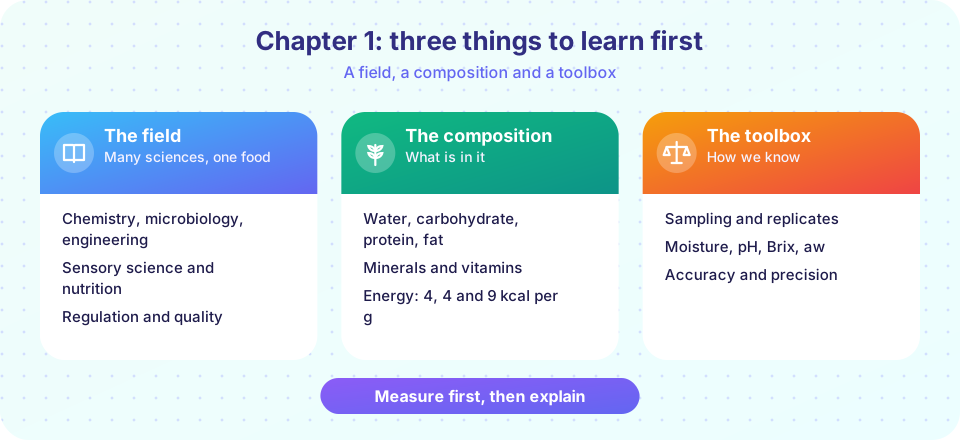
What you will learn
- Why food science needs several sciences at once.
- The six components that make up almost every food.
- Which quick measurements tell you the most about a food.
- How the lessons in this chapter connect.
Key terms
Component: a major class of substances in food (water, carbohydrate, protein, fat, minerals, vitamins). Proximate analysis: the standard set of tests that splits a food into water, ash, protein, fat and carbohydrate. Accuracy: closeness to the true value. Precision: closeness of repeated measurements to each other.
The big picture
Food scientists ask four questions, again and again.
- What is it made of? Composition decides nutrition, texture and how a food behaves when heated.
- How does it change? Reactions (browning, oxidation, enzyme action) and growth (microbes) happen all the time. Some are wanted (ripening cheese), some are not (rancid oil).
- How do we control it? Heat, cold, drying, acid, salt, packaging and hygiene.
- Is it good and safe for people? Taste, texture, nutrition and law.
Chapter 1 touches the first question and gives you the skills to measure the answer. Chapters 2 to 4 take it much further.
Food is a system
Four questions
Skills for measuring
What each lesson covers
- What is food science?: the disciplines, a short history from Appert to Codex, and what food scientists do for a living.
- What food is made of: the components, proximate analysis and how to turn a composition into energy.
- Lab basics: measuring food: units, sampling, accuracy and precision, moisture, pH and water activity.
- Chapter review: a one-picture summary and a longer quiz.
Why start with measurement?
Opinions about food are cheap: "this tastes fresher", "that is too dry". Food science replaces opinions with numbers wherever it can. A moisture content of 12% in flour, a pH of 4.2 in yogurt and a core temperature of 74 °C in cooked chicken are statements anyone can check. Numbers let different people in different countries make the same product and judge it the same way. They also let you see risks: a food with a pH below 4.6 and a low water activity needs very different handling than a moist, neutral one.
A second reason is honesty about uncertainty. Every measurement has error. A scientist who reports "moisture 12.1%" without saying how repeatable it is has told you only half of what you need. Lesson 3 teaches you to report a mean and a spread.
A quick sample calculation
The calculation below previews the rest of the chapter. It takes three invented replicate measurements of a flour's moisture and reports the mean and the spread.
Common misconceptions
"A dry-looking food has little water." Bread feels dry yet is about 35-40% water. Water content (how much) and water activity (how available) are different ideas, and Chapter 2 separates them.
"Precise means correct." A scale that always reads 2 g too high is precise but not accurate. Lesson 3 shows how to detect each problem.
Try it
Press Run (or Ctrl + Enter) to see the result here.
Program input · what you'd type while the program runs
Type the answers before you press Run, one per line. Each time the program reads a line (with input()), it gets the next line from this box.
Press Run (or Ctrl + Enter) to see the result here.
Program input · what you'd type while the program runs
Type the answers before you press Run, one per line. Each time the program reads a line (with input()), it gets the next line from this box.
Check your understanding
Quick check · 4 questions
of 4 answered You scored / 4 · perfect!
-
1. Which is NOT one of the four questions food scientists keep asking?
Branding matters commercially but is not part of the core science questions: composition, change, control and safety and quality. -
2. Why do food scientists prefer numbers to opinions where possible?
Measurements are repeatable and comparable, though they still carry error. -
3. A balance always reads 2 g too high but gives the same reading each time. It is...
Repeatable readings mean high precision; a constant offset from the true value means poor accuracy. -
4. Which statement is correct?
Bread is roughly 35-40% water. How available that water is (water activity) matters for microbes, not just how much there is.
Summary
- Food is a chemical system that is also (or was recently) alive, so it keeps changing.
- Four questions drive the field: what is it, how does it change, how do we control it, and is it good and safe?
- Measurements turn opinions into comparable numbers, and every number needs an estimate of its uncertainty.
- This chapter covers the field, composition and lab basics before a review.
Next: What is food science?
Track your progress
Create a free account to tick off lessons and pick up where you left off on any device.
of Food Science lessons completed