


















Lesson 1 of 45 · Getting Started
Course map: how this Food Science course works
Start here: who this Food Science course is for, what you need to know first, how the nine chapters fit together and how to study them.
Every meal you eat is the end of a long chain of decisions. Someone chose the crop, someone decided how to store it, someone heated, cooled, dried, fermented or packaged it, and someone checked that it would not make you ill. Food science is the study of all those decisions: what food is made of, how it changes, why it spoils, how to keep it safe and how to make it taste, look and feel the way people expect.
This course explains that chain from the molecule to the supermarket shelf. It is written for curious people aged about 14 and up, for students of biology, chemistry or nutrition who want a food-focused view, for home cooks who keep asking "but why does that happen?", and for anyone thinking about a career in the food industry. You do not need a laboratory. Every calculation runs in your browser, and every laboratory method is described, never presented as a result we measured ourselves.
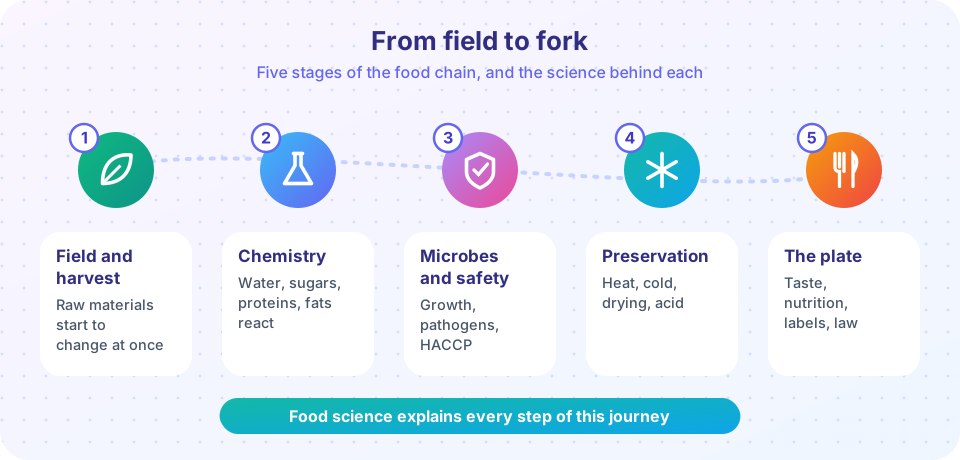
What you will learn
- Who the course is for and what background helps (and what does not matter).
- How the nine chapters build on each other, from chemistry to regulation.
- A study routine that mixes reading, calculating and quizzing.
- Which tools you will use: worked examples, Python simulations, interactive widgets and illustrated posters.
Key terms
Food science: the science of the nature, deterioration, safe processing and improvement of food. Food technology: applying that science to produce food at scale. Shelf life: how long a product stays safe and acceptable under stated storage conditions. Hazard: a biological, chemical or physical agent that can make food harmful.
Who this course is for
The course follows an international curriculum: it overlaps with the food chemistry, microbiology, nutrition and technology content in Cambridge IGCSE and A Level Food Studies and Biology, IB Chemistry and Biology options, and US introductory food science courses. We use SI units (grams, kilograms, degrees Celsius, pascals) and give US customary values such as degrees Fahrenheit only where a regulation uses them.
You will get the most from it if you can already do school arithmetic and read a graph. When a chapter needs a bit of chemistry (molecules, pH) or a bit of mathematics (logarithms, exponentials), the lesson explains it in two or three sentences first. If a term is new, the Key terms box near the top of each lesson defines it.
An educational note. This course explains how food works. It is not medical, dietary or legal advice. If you have a food allergy, a medical condition or run a food business, follow the guidance of your doctor, dietitian or national food authority.
How the nine chapters fit together
Think of the course as three layers. The first four chapters give you the science of food: what it contains, how those components behave and what lives in it. The next two chapters cover making and judging food: how processing changes it and how people perceive it. The last three connect food to people and society: nutrition, labels, laws and your own projects.
- Getting Started
- Food Chemistry
- Microbiology and Safety
- Preservation
5-6. Processing and Senses
7-9. People and Practice
Each chapter starts with an overview lesson (the map of that chapter), then three or four content lessons, and ends with a review lesson that has a one-picture summary, a recap table and a longer quiz.
How to study
- Read a lesson in two passes. First skim the headings, the illustration and the key terms. Then read the body slowly with a pencil.
- Run every example. The Python and widget examples are small on purpose. Change a number, predict what will happen, then run it. Prediction followed by surprise is how understanding forms.
- Do the quiz without looking back. The explanations are part of the teaching, so read them even for questions you got right.
- Use the review lessons. Come back to a chapter review after a week; retrieving facts from memory beats rereading.
- Keep a kitchen notebook. Food science is one of the few sciences you can test with ingredients you already own. Note what you saw, then read the lesson that explains it.
The Python examples use a pre-loaded set of libraries (numpy, matplotlib and sometimes scipy). Press Run; the first run can take a few seconds while the Python runtime loads. Several examples draw a styled chart. Where an example uses invented numbers to show a method, it says so; real-world values are quoted only when they are widely published, and they are rounded.
A first taste of a calculation
Almost every chapter has a small calculation like this. The first one converts a food label into energy using the standard Atwater factors (4 kcal per gram of protein and carbohydrate, 9 kcal per gram of fat). It will return in Chapter 7.
What you will be able to do afterwards
By the end of the course you should be able to read an ingredient list and a nutrition panel with understanding, explain why a recipe works in terms of chemistry, and predict which of two foods will spoil first and why. You will be able to calculate a shelf-life estimate, a sterilization time and a label energy value, and to say which controls (temperature, acidity, water activity, packaging) a given product relies on. You will know how a sensory panel is run and what its statistics mean, how processing steps such as milling, extrusion and fermentation change a food, and how laws and standards shape what appears on a shelf.
None of this requires memorizing hundreds of facts. A small number of ideas recur everywhere: composition decides behavior, temperature and water control rates, microbes need conditions to grow, measurements need uncertainty, and every protection has a cost. When you meet a new food or a new problem, ask which of those ideas applies. That habit is the real skill the course is trying to build, and it is what separates a person who follows recipes from one who can design them.
Common misconceptions
"Food science is just cooking." Cooking is applied food science, but the field also covers microbiology, chemistry, engineering, sensory analysis, nutrition and law.
"Processed food is always bad and fresh food is always good." Processing includes pasteurizing milk and canning tomatoes, which prevent illness and waste. Whether a food is healthy depends on its composition, not on whether a factory touched it. Chapters 5 and 7 return to this.
"Natural means safe." Many natural substances are toxic, from raw kidney beans to aflatoxins made by molds. Safety comes from knowledge and control.
Try it
Press Run (or Ctrl + Enter) to see the result here.
Program input · what you'd type while the program runs
Type the answers before you press Run, one per line. Each time the program reads a line (with input()), it gets the next line from this box.
Press Run (or Ctrl + Enter) to see the result here.
Program input · what you'd type while the program runs
Type the answers before you press Run, one per line. Each time the program reads a line (with input()), it gets the next line from this box.
Check your understanding
Quick check · 4 questions
of 4 answered You scored / 4 · perfect!
-
1. Which description fits food science best?
Food science combines chemistry, microbiology, engineering, sensory science and nutrition to understand and improve food. Recipes and farming are related but narrower. -
2. In this course, what do we do with laboratory methods?
Methods are explained so you can understand them. Example data used in calculations is labelled as invented or illustrative. -
3. Which chapter group covers the science of what food contains and what lives in it?
Chapters 1 to 4 build the science base: orientation, chemistry, microbiology and preservation. -
4. Which is a good study habit for the calculation examples?
Predicting and then testing builds intuition. Changing inputs shows how each variable matters.
Summary
- Food science studies the whole chain from molecule to meal, using chemistry, microbiology, engineering, sensory science and nutrition.
- The nine chapters move from science (1-4) to making and judging food (5-6) to people and society (7-9).
- Each chapter has an overview, content lessons and a review with a longer quiz.
- Run and modify every example, and treat the course as educational information, not medical advice.
Track your progress
Create a free account to tick off lessons and pick up where you left off on any device.
of Food Science lessons completed