


















Lesson 7 of 45 · Food Chemistry
Chapter overview: Food Chemistry
Preview Chapter 2: how water, carbohydrates, proteins and lipids behave in food, why foods brown, thicken, gel and go rancid, and what each lesson covers.
Why does bread go stale, an avocado brown, a custard set and a bottle of oil turn rancid? Each answer is a piece of chemistry, and each piece belongs to one of four families: water, carbohydrates, proteins and lipids. This chapter treats each family in its own lesson, then you see how they interact when you cook.
A useful way to think about food chemistry is to ask what a molecule can do. Some molecules dissolve (sugar), some form networks (protein, starch), some repel water (fat), and some react with each other when heated (sugar and amino acids). Foods are mixtures where these behaviors compete and cooperate.
What you will learn
- The big role of each of the four molecule families in food.
- Which everyday phenomena each family explains.
- How the lessons of this chapter fit together.
Key terms
Water activity (aw): a measure of how available water is for reactions and microbes. Gelatinization: swelling and softening of starch granules when heated in water. Denaturation: loss of a protein's folded shape. Maillard reaction: browning between reducing sugars and amino groups. Autoxidation: the free-radical reaction between oxygen and unsaturated fats that causes rancidity. Emulsion: a mixture of two immiscible liquids, with one dispersed as droplets.
The big picture
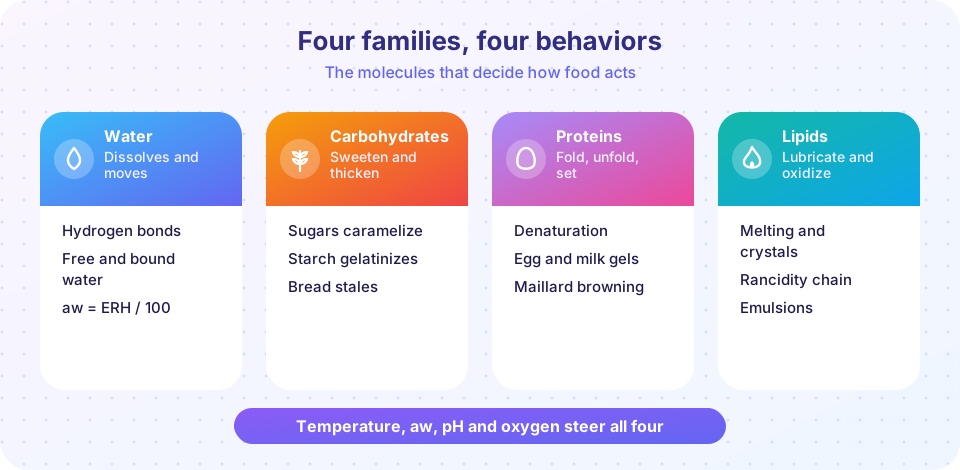
Water is more than a filler. It is the medium of food, it forms hydrogen bonds that link molecules together, and it exists in forms with different availability. Free water evaporates and feeds microbes; bound water is held by solutes and surfaces. Water activity condenses this into one number. Lesson 2 shows how sugar, salt and drying all work by lowering it.
Carbohydrates supply sweetness, bulk and thickening. Small sugars dissolve and caramelize; starch, a polymer of glucose, swells in hot water and gels as it cools. The ratio of two starch forms, amylose and amylopectin, decides whether a sauce is smooth or a bread crumb stays soft.
Proteins are chains that fold into precise shapes. Heat, acid and mechanical force unfold them (denaturation) and they tangle into new networks: the set of an egg, the curd of cheese, the stretch of dough. Proteins also supply amino groups for the Maillard reaction, which gives the brown crust and savory aroma of roasted foods.
Lipids carry flavor, give texture and store energy. Their chemistry hinges on fatty acid structure: double bonds lower the melting point and raise the oxidation rate. Fats also form emulsions with water, from milk to mayonnaise, which need emulsifiers to stay mixed.
Water
Carbohydrates
Proteins
Lipids
What each lesson covers
- Water and water activity: hydrogen bonds, free and bound water,
aw, sorption isotherms and why sugar and salt preserve. - Carbohydrates: sugars and starch: sweetness, caramelization, gelatinization, retrogradation and pectin gels.
- Proteins: structure, gels and browning: denaturation, egg and milk proteins, gluten and the Maillard reaction.
- Lipids: fats, oxidation and emulsions: fatty acids, melting, rancidity and emulsifiers.
- Chapter review: a recap picture and a ten-question quiz.
Why chemistry predicts so much
Chemical changes in food are governed by a small set of factors that you will keep meeting: temperature (most reaction rates rise with it), water availability, pH, oxygen, light and catalysts such as enzymes and traces of metals. A food scientist who learns to ask "what is the temperature, water activity, pH and oxygen level here?" can usually predict how a food will change and what to do about it. The same questions also predict microbial growth in Chapter 3, so the habit pays twice.
Common misconceptions
"Water is inert." In food, water takes part in reactions (hydrolysis), carries heat and dissolves everything else. "Starch and sugar are the same." Sugars are small and dissolve; starch is a large polymer that swells. "Cooking destroys protein." It changes the shape (denatures) but does not remove it; cooked egg still has the same amino acids.
Try it
Press Run (or Ctrl + Enter) to see the result here.
Program input · what you'd type while the program runs
Type the answers before you press Run, one per line. Each time the program reads a line (with input()), it gets the next line from this box.
Press Run (or Ctrl + Enter) to see the result here.
Program input · what you'd type while the program runs
Type the answers before you press Run, one per line. Each time the program reads a line (with input()), it gets the next line from this box.
Check your understanding
Quick check · 4 questions
of 4 answered You scored / 4 · perfect!
-
1. Which pair of molecule families react together to give a browned crust?
The Maillard reaction joins reducing sugars with amino groups from proteins and amino acids. -
2. Which factor is NOT usually one of the main controls on chemical change in food?
Temperature, oxygen, water activity, pH, light and catalysts matter; the calendar does not. -
3. Denaturation means...
Denaturation unfolds the protein; the amino acid sequence stays. -
4. Which lesson explains rancidity?
Rancidity is lipid oxidation, covered in the lipids lesson.
Summary
- Food chemistry rests on four molecule families: water, carbohydrates, proteins and lipids.
- Each family has a signature behavior: dissolving and bonding, thickening and sweetening, folding and gelling, lubricating and oxidizing.
- Temperature, water activity, pH, oxygen, light and catalysts are the recurring controls.
- Lessons 2 to 5 take the families in turn, and the review ties them together.
Next: Water and water activity
Track your progress
Create a free account to tick off lessons and pick up where you left off on any device.
of Food Science lessons completed