


















Lesson 24 of 45 · Processing Technology
Thermal Processing: D, z and F Values
Learn how food scientists calculate heat treatments: D and z values, the 12D botulinum cook, F0, lethal rate, heat penetration and why HTST protects quality.
Heating is the most important preservation process in the food industry, and also the one most easily done badly. Too little heat and spores survive, which in a sealed can can mean botulism. Too much and the food turns gray, soft and flavorless. Food scientists solve this with a small set of numbers, D, z and F, that turn "cook it until it is safe" into a calculation you can check. This lesson builds those numbers from first principles and then shows why the speed at which heat reaches the middle of a food is just as important as the temperature of the oven.
What you will learn
- Use the D value to predict how many log reductions a hold time gives.
- Use the z value to convert between times at different temperatures, and compute a lethal rate.
- Explain the 12D botulinum cook and calculate F0 from a temperature history.
- Explain why heating time depends on the shape and size of the food, and why HTST and aseptic processing keep more quality.
Key terms
D value (decimal reduction time): the time at a fixed temperature that reduces the population of a microbe by 90 percent, one log10 unit.
z value: the temperature increase that makes D ten times smaller (a 90 percent shorter time for the same kill).
F value: the total heating time at a reference temperature that gives a stated lethal effect; F0 uses 121.1 °C (250 °F) and z = 10 °C.
Commercial sterility: a state where the food contains no viable organisms that can grow under normal storage, and no harmful toxin; it is not the same as having zero microbes.
Cold spot: the slowest-heating point of a container, which decides the process time.
Microbes die logarithmically
If you heat a population of cells or spores at a constant temperature, a fixed fraction dies each minute, not a fixed number. The kill is a first-order process: the curve of the logarithm of survivors against time is a straight line.
log10(N) = log10(N0) − t / D
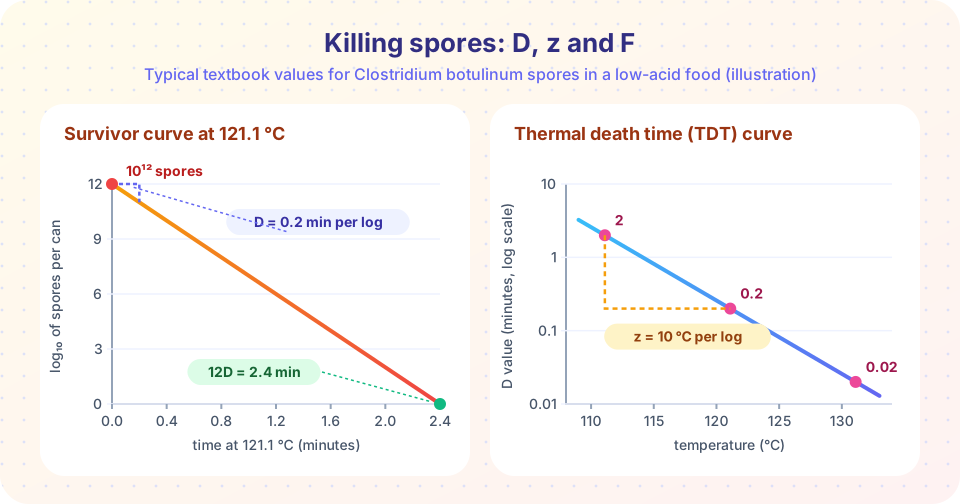
N0 is the starting count, N the survivors after time t, and D the time needed for one tenfold drop. Because the scale is logarithmic, you can never reach exactly zero; you can only make survival very improbable. That is why safety is stated as a probability: after 12 log reductions of a population of 10¹² spores, you expect one survivor, and for a population of one spore the chance that it survives is 10⁻¹².
Worked example. A food contains 1,000 spores of a heat-resistant organism per can. Its D value at 121.1 °C is 0.2 min. How long to bring the count to one spore in a million cans (10⁻⁶ per can)? The needed drop is from 10³ to 10⁻⁶, which is 9 log units, so t = 9 × 0.2 = 1.8 min.
The 12D concept and the pH 4.6 divide
The spore-forming bacterium Clostridium botulinum grows without oxygen and makes the deadliest known food poison. It cannot grow below about pH 4.6, so food is split into two classes.
- Acid foods (pH ≤ 4.6, such as most fruit, pickles, tomatoes with added acid) only need a mild pasteurization to kill vegetative cells and spoilage yeasts and molds.
- Low-acid foods (pH > 4.6 and water activity above 0.85, such as vegetables, meat, fish, soups) must be given a botulinum cook: enough heat to reduce C. botulinum spores by 12 log units. This is the "12D process."
With a typical D121.1 of about 0.2 min for these spores, a 12D process needs 12 × 0.2 = 2.4 min at 121.1 °C, measured at the cold spot. In practice commercial canned foods are given more than this, because other spoilage spores (such as some thermophilic bacilli) are even more heat-resistant than C. botulinum. Values differ between strains and foods, so real processes are set from published thermal-death data and challenge tests by a qualified "process authority."
The z value: trading time for temperature
A hotter process kills faster. The z value says exactly how much faster:
D(T) = D_ref × 10^((T_ref − T) / z)
For spores z is about 10 °C. So D falls from 2 min at 111.1 °C to 0.2 min at 121.1 °C and to 0.02 min at 131.1 °C, which are the three dots in the right-hand chart above.
The lethal rate L turns this into a convenient number: how many minutes at the reference temperature one minute at temperature T is worth.
L = 10^((T − 121.1) / 10)
| Temperature (°C) | Lethal rate L | Time to deliver F0 = 2.4 min |
|---|---|---|
| 111.1 | 0.1 | 24 min |
| 121.1 | 1 | 2.4 min |
| 131.1 | 10 | 0.24 min (about 14 s) |
If the temperature changes during the process, as it always does, you add up the lethality as it accumulates:
F0 = ∫ L dt (sum over the whole heating, holding and cooling history)
This is the general method of Bigelow. Measure the temperature at the cold spot with a thermocouple, compute L at each moment, and integrate. Cooling counts too: while the can is still hot it is still killing spores.
Why quality prefers high temperature and short time
Heat also destroys vitamins, color and texture. These quality reactions have their own D and z values, but their z values are larger (often 20 to 40 °C, depending on the attribute) than the z of spores. A larger z means quality is less sensitive to temperature than spores are. Raising the temperature by 10 °C therefore multiplies spore kill by 10 but quality loss by only about 2 (for z = 33 °C).
So the best strategy is the high-temperature, short-time (HTST) one: heat fast to a high temperature, hold briefly, cool fast. Milk shows the same idea at a lower temperature: low-temperature long-time pasteurization uses 63 °C for 30 min; HTST pasteurization uses 72 °C for 15 s; and UHT milk, heated to roughly 135 to 150 °C for a few seconds and filled into sterile packages (aseptic processing), keeps more of its fresh character than milk sterilized in the bottle.
The catch is heat transfer. A liquid can be pumped through a heat exchanger and heated in seconds. A solid food in a can cannot.
Heat penetration: the cold spot decides
Heat travels into a container in two ways. In a liquid with free movement, convection stirs the contents, and the cold spot is low in the can. In a solid or very thick material, only conduction moves heat, and the cold spot is at the geometric center. Conduction is slow because it works by diffusion: the time needed scales with the square of the distance,
t ∝ L² / α
where L is the characteristic size and α the thermal diffusivity, about 1.4 × 10⁻⁷ m²/s for a food that is mostly water. Doubling the thickness makes heating about four times slower. That is why cream-style corn and pumpkin purée take far longer to sterilize than clear soup in the same can, why small cans are processed faster than large ones, and why flat pouches that are thin in one direction heat quickly.
Sterilization of a canned food is designed for the slowest-heating point. Everything else in the can is overprocessed; the aim is to make that overprocessing as small as possible by choosing the container shape, agitating the retort, or pumping and sterilizing a liquid before filling.
Common misconceptions
"Sterile means zero microbes." Industrial sterility is a probability. A 12D process makes survival of the target spore extremely unlikely, and the sealed package prevents re-contamination, but the food is not guaranteed to contain nothing.
"More heat is always safer." Beyond the required lethality extra heat only costs quality. The safe process is the one with the calculated F0 at the cold spot.
"The oven temperature is the food temperature." The retort or oven temperature is where the heat comes from. The food at the cold spot lags behind, and the lag grows with the square of the size.
Try it
The first run computes F0 from a made-up temperature history of a can's cold spot: heating for 15 minutes, holding near 121 °C, then cooling. It integrates the lethal rate with the trapezoid rule.
Press Run (or Ctrl + Enter) to see the result here.
Program input · what you'd type while the program runs
Type the answers before you press Run, one per line. Each time the program reads a line (with input()), it gets the next line from this box.
The next simulation is a finite-difference model of conduction in a flat slab of food, heated from both faces in a retort at 121.1 °C. It shows how the time for the center to reach 100 °C changes with thickness. It is a simplified model (constant properties, perfect surface contact), not a design tool.
Press Run (or Ctrl + Enter) to see the result here.
Program input · what you'd type while the program runs
Type the answers before you press Run, one per line. Each time the program reads a line (with input()), it gets the next line from this box.
Last, a calculator of the speed-versus-quality trade-off. It compares a process that delivers F0 = 2.4 min at different temperatures, and estimates the quality loss with an assumed quality z of 33 °C (the number is typical of the order of magnitude, not a property of any one food).
Check your understanding
Quick check · 5 questions
of 5 answered You scored / 5 · perfect!
-
1. A microbe has D = 0.5 min at a given temperature. After 3 minutes at that temperature, by how many log units does the population fall?
Log reductions = t / D = 3 / 0.5 = 6. -
2. With z = 10 °C and D = 2 min at 111.1 °C, what is D at 121.1 °C?
A 10 °C rise equals one z, so D becomes ten times smaller: 0.2 min. -
3. Which foods need a 12D botulinum cook?
Clostridium botulinum spores can grow in sealed, low-acid, moist food, so a 12-log reduction is needed there. -
4. Why does HTST processing retain more quality than a long, cooler process of equal sterility?
Spore kill rises about tenfold per 10 °C while quality loss rises only about twofold, so hotter and shorter is better. -
5. A can of thick purée is twice as thick as another. About how much longer does the thicker one take to heat by conduction?
Conduction time scales with size squared, so doubling the size makes it about four times slower.
Summary
- Microbial death is logarithmic:
log N = log N0 − t/D, so survival can be made small but never exactly zero. - The z value links time and temperature: D falls tenfold for each z °C; the lethal rate is
L = 10^((T − 121.1)/10). - Low-acid canned food needs a 12D botulinum cook, about 2.4 min at 121.1 °C at the cold spot, and real processes add a safety margin.
- F0 is the integral of the lethal rate over the whole temperature history, including cooling.
- Conduction heating time scales with size squared, so the cold spot sets the process.
- Quality loss is less temperature-sensitive than spore kill, so HTST and aseptic processing preserve more quality.
Track your progress
Create a free account to tick off lessons and pick up where you left off on any device.
of Food Science lessons completed