


















Lesson 21 of 45 · Preservation
Salt, sugar, acid, fermentation and hurdle technology
Learn how salt, sugar, acid, preservatives, nitrite, smoking and fermentation protect food, why undissociated acid matters, and how hurdle technology combines barriers.
Before refrigerators and retorts, people preserved food with what they could find: salt from the sea, sugar from cane or honey, vinegar from wine, smoke from fires and the microbes in fermenting cabbage and milk. These methods are still common, and for good reason. They work at room temperature, use cheap materials and often improve flavor. Ham, kimchi, pickles, jam, yogurt, salami and soy sauce are all preservation by chemistry.
This lesson explains how each method works at the molecular level, why the acidity of a food decides which preservative to choose, how fermentation both preserves and creates flavor, and how modern food scientists combine several mild barriers, the idea of hurdle technology, to get safe, high-quality, shelf-stable foods.
What you will learn
- Explain how salt and sugar lower water activity and what else they do.
- Describe why weak-acid preservatives depend on pH (the undissociated fraction).
- Describe curing with nitrite and the main uses of smoking and fermentation.
- Apply the hurdle concept, including modified atmosphere packaging, to design a stable food.
Key terms
Curing: preserving meat with salt (and nitrite or nitrate). Weak acid preservative: an organic acid such as sorbic, benzoic or propionic acid that works mainly in its undissociated form. pKa: the pH at which an acid is half dissociated. Fermentation: microbial conversion of sugars into acids, alcohol or gases. Bacteriocin: a protein made by bacteria that inhibits related bacteria (nisin). Hurdle technology: combining several preservation factors, each at a mild level. Modified atmosphere packaging (MAP): replacing the air in a pack with a chosen gas mixture.
Salt and sugar
Both work by osmosis and by lowering water activity (Chapter 2). Dissolved salt or sugar pulls water out of microbial cells, which shrink and stop growing; the food's own aw drops too. Salt does more: sodium and chloride ions are directly inhibitory to many bacteria, and salt alters protein structure. The numbers are striking: a saturated salt solution (about 26% NaCl) has aw near 0.75, while a 10% brine sits around 0.94, and a sucrose solution reaches about 0.90 at 60% and about 0.87 at 65%, close to saturation (jams go lower because fruit solutes add to the sugar).
- Dry salting and brining are used for fish, ham, cheese and vegetables. Because salt is a small molecule and ionizes into two ions, it lowers
awmore efficiently per gram than sugar. - Sugar preserves jam, candied fruit, syrups and condensed milk. In jam it also supports pectin gels and, with acid, gives a double barrier.
- Side effects: high salt intake raises blood pressure risk in many people, so health agencies aim to cut sodium; salt also changes texture and taste. Sugar adds energy and affects the glycemic response. Reducing either requires replacing some of the preservative effect with something else, such as acid, cold or packaging.
Halophilic bacteria and osmophilic yeasts can still grow in salty or sugary foods (pink salted fish, honey fermenting, syrup), which is why moisture and storage conditions still matter.
Acid and weak-acid preservatives
Low pH inhibits microbes by disturbing cell membranes, enzymes and internal pH. Foods are acidified naturally (fruit, fermentation) or by adding vinegar (acetic acid, about 4-8% in vinegar), lemon juice (citric acid), or lactic, malic or phosphoric acid. Many foods that look harmless have pH below 4.6, so they never support C. botulinum.
Weak-acid preservatives: sorbic acid and its salts (sorbates; cheese, baked goods, beverages, wine), benzoic acid and benzoates (soft drinks, pickles, jams) and propionic acid and propionates (bread, to stop mold) are used in small amounts (typically hundredths of a percent, limited by law). They are called "weak" because they only partly dissociate in water:
HA ⇌ H⁺ + A⁻
The undissociated form HA is uncharged and slips through the microbe's membrane; inside, where the pH is near neutral, it releases H⁺ and acidifies the cell, and the anion builds up, so the cell wastes energy pumping protons out. The charged anion A⁻ cannot cross the membrane, so it is far less effective. The fraction in the active form depends on the pH and the acid's pKa:
fraction undissociated = 1 / (1 + 10^(pH − pKa))
Approximate pKa values: acetic 4.76, sorbic 4.76, benzoic 4.20, propionic 4.87, lactic 3.86. At pH = pKa half of the acid is undissociated. So sorbate works up to about pH 6 to 6.5, propionate in mildly acid foods and benzoate best below about pH 4.5. In neutral foods (pH 7) such as milk or meat, these preservatives are almost useless, which is why you find them in acidic foods like soft drinks, pickles and dressings, and why acidifying a product often works better than raising the preservative level. Acetic acid is the most inhibitory of the common food acids at a given pH because its undissociated fraction is higher (compared with lactic or citric) at pH 4-5.
Curing, nitrite and smoke
Curing applies salt, and usually nitrite (from sodium nitrite or from natural sources such as celery powder, which contains nitrate converted by bacteria), plus sometimes sugar and spices, to meat. Nitrite does several jobs: it reacts with myoglobin to give the stable pink color of ham and bacon (nitrosylmyoglobin), contributes the characteristic cured flavor, retards fat oxidation and, most importantly for safety, inhibits Clostridium botulinum growth and toxin production in products that are not sterilized. Ingoing nitrite levels are limited by regulation, commonly on the order of 100-150 mg per kg of meat. A concern is that nitrite can form nitrosamines, some carcinogenic, under high-heat frying conditions or in the stomach; ascorbate or erythorbate added to cure mixes reduces this, and monitoring keeps residues low. The debate about processed meat and cancer risk is real: the WHO's cancer agency classifies processed meat as carcinogenic to humans (Group 1) based on epidemiological evidence, meaning there is strong evidence it can cause cancer but not how strong the effect is relative to other agents; amounts and overall diet matter.
Smoking exposes food to smoke from burning hardwood. Smoke contains phenols, aldehydes and organic acids with antimicrobial and antioxidant action, plus flavor and color; surface drying also helps. Cold smoking (below about 30 °C) flavors and partly dries; hot smoking (about 50-80 °C or more) cooks the food. Smoke can contain polycyclic aromatic hydrocarbons (PAHs), such as benzo[a]pyrene, which are carcinogens, so modern producers control temperature, use filtered or liquid smoke and monitor levels.
Fermentation
In fermentation, microbes convert sugars into other compounds. In food preservation the key products are acids and alcohol:
- Lactic acid fermentation: lactic acid bacteria (Lactobacillus, Leuconostoc, Lactococcus, Streptococcus thermophilus) convert sugars to lactic acid, lowering pH to about 3.5-4.5 and out-competing spoilage organisms. Examples: yogurt (typical final pH about 4.2-4.6), cheese, sauerkraut and kimchi (about 2-2.5% salt for sauerkraut, which favors the lactic bacteria), pickles, sourdough and fermented sausages. In sauerkraut, Leuconostoc mesenteroides starts the process and Lactiplantibacillus plantarum finishes it.
- Alcoholic fermentation: yeasts (Saccharomyces cerevisiae) convert glucose to ethanol and carbon dioxide:
C₆H₁₂O₆ → 2 C₂H₅OH + 2 CO₂. Beer, wine, cider and bread rising. Alcohol at 10-15% is a strong preservative on its own. - Acetic fermentation: Acetobacter oxidizes ethanol to acetic acid, giving vinegar.
- Mold fermentation: Aspergillus oryzae (koji) in soy sauce, miso and sake; Penicillium in blue and white-rind cheeses.
Fermentation also yields bacteriocins such as nisin, a peptide from Lactococcus lactis approved as a preservative in many countries (processed cheese, canned foods), and flavor compounds (diacetyl, esters). Safety still depends on control: the starter culture, salt level and temperature must favor the right organisms, and some fermented foods have caused outbreaks when contaminated or made incorrectly. Chapter 5 covers fermentation processes in industry.
Hurdle technology
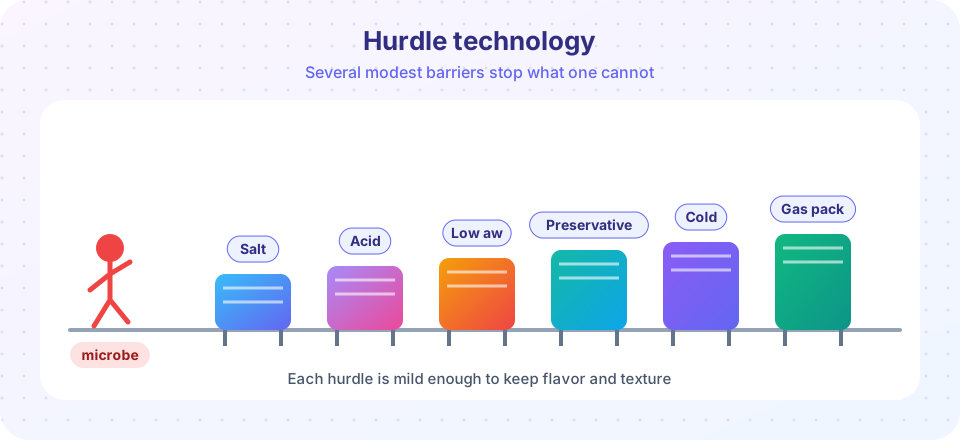
In 1978 the German food scientist Lothar Leistner proposed the hurdle concept: instead of one severe treatment, use several mild "hurdles", and a microorganism that can clear one may fail at the combination. Each hurdle can be: temperature, water activity, pH, redox potential, preservatives (nitrite, sorbate), competitive flora (fermentation), packaging atmosphere, or physical treatments (heat, high pressure). Hurdles can act together in different ways: stressing the same cell mechanism (energy for repair, homeostasis) so that its reserves run out.
Many shelf-stable foods are hurdle designs that no one calls by that name. Dry sausage uses low aw, low pH, salt, nitrite and competitive flora; jam uses low aw, low pH and heat; intermediate-moisture foods use aw about 0.7-0.85, a humectant, a preservative and a barrier pack. The advantage is quality: each hurdle is modest, so the food keeps flavor and texture. The risk is complexity: all hurdles must be validated together, and quality assurance must monitor each one.
Modified atmosphere packaging
MAP flushes the pack with a gas mixture of oxygen, carbon dioxide and nitrogen before sealing. Carbon dioxide inhibits many spoilage aerobes (about 20-60% in meat and fish packs; it dissolves in food and may collapse the pack), nitrogen is an inert filler that prevents pack collapse and prevents oxidation, and oxygen is added only when needed: high oxygen (about 70-80%) keeps red meat bright red (oxymyoglobin) but accelerates fat oxidation, and low oxygen (about 2-5%) slows the respiration of fresh produce. Vacuum packing removes air entirely. Remember the anaerobe warning from Chapter 3: C. botulinum type E and non-proteolytic type B can grow at refrigerator temperatures in oxygen-free fish and cooked meat packs, so low storage temperature, short shelf life or an extra hurdle is essential.
Other physical hurdles. High-pressure processing (HPP) applies about 400-600 MPa for a few minutes at chilled temperature, inactivating vegetative bacteria without cooking (juices, guacamole, deli meats); it does not reliably kill spores. Irradiation with gamma rays, electron beams or X-rays at doses of about 0.1 to 10 kGy depending on the purpose reduces spoilage organisms, insects and pathogens in spices, meat and produce, and is approved in many countries but needs clear labeling and public trust. Chapter 5 covers both in more detail.
Common misconceptions
"Preservatives are all synthetic." Salt, sugar, vinegar, alcohol and smoke are traditional preservatives; many weak acids also occur naturally in fruit. "Preservatives work in any food." Weak-acid preservatives depend on pH; they are weak in neutral foods. "Fermented food is automatically safe." Safety depends on the right organisms, salt, temperature and hygiene. "Vacuum packing makes food last forever." It excludes oxygen, which stops molds but can favor anaerobes unless cold storage is also used. "Nitrite is only added to make meat pink." It is a key safeguard against botulinum in cured meats.
Try it
Press Run (or Ctrl + Enter) to see the result here.
Program input · what you'd type while the program runs
Type the answers before you press Run, one per line. Each time the program reads a line (with input()), it gets the next line from this box.
Press Run (or Ctrl + Enter) to see the result here.
Program input · what you'd type while the program runs
Type the answers before you press Run, one per line. Each time the program reads a line (with input()), it gets the next line from this box.
Press Run (or Ctrl + Enter) to see the result here.
Program input · what you'd type while the program runs
Type the answers before you press Run, one per line. Each time the program reads a line (with input()), it gets the next line from this box.
Press Run (or Ctrl + Enter) to see the result here.
Program input · what you'd type while the program runs
Type the answers before you press Run, one per line. Each time the program reads a line (with input()), it gets the next line from this box.
Check your understanding
Quick check · 6 questions
of 6 answered You scored / 6 · perfect!
-
1. Why is sorbate more effective at pH 4.5 than at pH 6.5?
The undissociated fraction rises as pH falls below the pKa, and that form crosses the cell membrane. -
2. What fraction of an acid is undissociated when pH equals its pKa?
At pH = pKa, the formula gives 1/(1+1) = 0.5. -
3. What is a key safety role of nitrite in cured meats?
Nitrite inhibits botulinum growth and toxin formation, besides giving color and flavor. -
4. Which describes hurdle technology?
Leistner's hurdle concept uses multiple factors at modest levels. -
5. Which gas is mainly used in MAP for its antimicrobial effect on aerobic spoilage organisms?
CO2 inhibits many spoilage aerobes; nitrogen is the inert filler. -
6. In sauerkraut, the fermentation is carried out mainly by...
Leuconostoc and Lactiplantibacillus make lactic acid, which preserves the cabbage.
Summary
- Salt and sugar lower water activity; salt also inhibits microbes directly; high intake of salt or sugar is a health concern.
- Weak-acid preservatives (sorbate, benzoate, propionate) act as undissociated acids, so they need acidic foods; fraction = 1/(1+10^(pH−pKa)).
- Nitrite protects cured meats against botulinum; smoke adds flavor and antimicrobial compounds but needs PAH control; fermentation preserves through acid, alcohol and competition.
- Hurdle technology combines mild barriers (aw, pH, temperature, preservatives, atmosphere) for safe, high-quality foods; MAP and vacuum require care with anaerobes.
Track your progress
Create a free account to tick off lessons and pick up where you left off on any device.
of Food Science lessons completed