


















Lesson 16 of 45 · Food Microbiology and Safety
HACCP and food hygiene: preventing hazards
Learn the seven HACCP principles, how to set critical limits and monitoring, key time and temperature rules, allergen control and good hygiene practice.
You cannot test safety into a food. Testing a batch for Salmonella examines a tiny fraction of the product, takes days and finds only what is in the sample. A better idea is to prevent the problem: understand where hazards can enter or survive and control those exact points. That is the idea behind HACCP, Hazard Analysis and Critical Control Points, the system used by food businesses worldwide.
HACCP began in the 1960s when the Pillsbury company, working with NASA and the US Army Natick laboratories, needed to guarantee that astronauts' food would not cause illness in space. Instead of relying on end-product testing, the team looked at every step of manufacture and decided where hazards had to be controlled. The approach was formalized and is now part of Codex Alimentarius guidance and the food laws of many countries. This lesson teaches the seven principles, then connects them to everyday hygiene.
What you will learn
- Define hazards, control measures, CCPs and critical limits.
- List the seven HACCP principles and apply them to an example.
- Recall key temperature and time rules and why they exist.
- Describe allergen control and prerequisite programs such as good hygiene practice.
Key terms
Hazard: a biological, chemical or physical agent in food that could cause harm. Control measure: an action that prevents, eliminates or reduces a hazard. CCP (critical control point): a step where control is essential to prevent or eliminate a hazard or reduce it to an acceptable level. Critical limit: the boundary that separates acceptable from unacceptable at a CCP. Corrective action: what you do when a limit is missed. Verification: checking the system works.
Types of hazard
- Biological: pathogenic bacteria, viruses, parasites (lesson 3).
- Chemical: cleaning chemicals, pesticide residues, veterinary drug residues, mycotoxins, heavy metals, and allergens.
- Physical: glass, metal fragments, bone, stones, plastic.
A hazard analysis asks, for each step: what could go wrong, how likely is it, how severe is it, and what controls exist?
Prerequisite programs
HACCP works only on a foundation of basics, called prerequisite programs or Good Hygiene Practice (GHP) and Good Manufacturing Practice (GMP): clean and well-designed premises, pest control, supplier approval, water quality, cleaning and sanitizing schedules, equipment maintenance, staff training and personal hygiene, traceability and recall procedures, and waste handling. If these are weak, a HACCP plan alone cannot save you. Many hazards are controlled by prerequisite programs, and HACCP concentrates on the few steps where the control must be precise.
The seven principles
The Codex HACCP system has seven principles, applied after preliminary steps (assemble a team, describe the product and its intended use, draw and verify a flow diagram).
- Conduct a hazard analysis. List hazards at each step and the control measures.
- Determine the critical control points (CCPs). Use a decision tree: if a hazard must be controlled at this step and no later step will control it, it is a CCP.
- Establish critical limits that are measurable, such as a temperature, time, pH or water activity.
- Establish a monitoring system. Who measures what, how and how often?
- Establish corrective actions for deviations: fix the process, and decide what to do with the affected product.
- Establish verification procedures. Calibration of thermometers, review of records, testing, audits.
- Establish documentation and record keeping. If it is not written down, it did not happen.
Example: cooked chicken pieces
| Step | Hazard | Control | CCP? |
|---|---|---|---|
| Receiving raw chicken | Salmonella, Campylobacter present | Approved supplier, delivery at 4 °C or below | Prerequisite and receiving check |
| Storage | Growth if warm | Refrigerator at or below 5 °C | Prerequisite / possibly CCP |
| Cooking | Survival of pathogens | Core temperature of at least 74 °C (165 °F) | CCP |
| Cooling | Spore germination, growth | From 57 °C to 21 °C within 2 h and to 5 °C within a total of 6 h (US FDA style limits) | CCP |
| Slicing and packing | Recontamination | Hygiene, separation of raw and cooked areas | Prerequisite |
| Metal detection | Metal fragments | Detector sensitivity test | CCP (physical) |
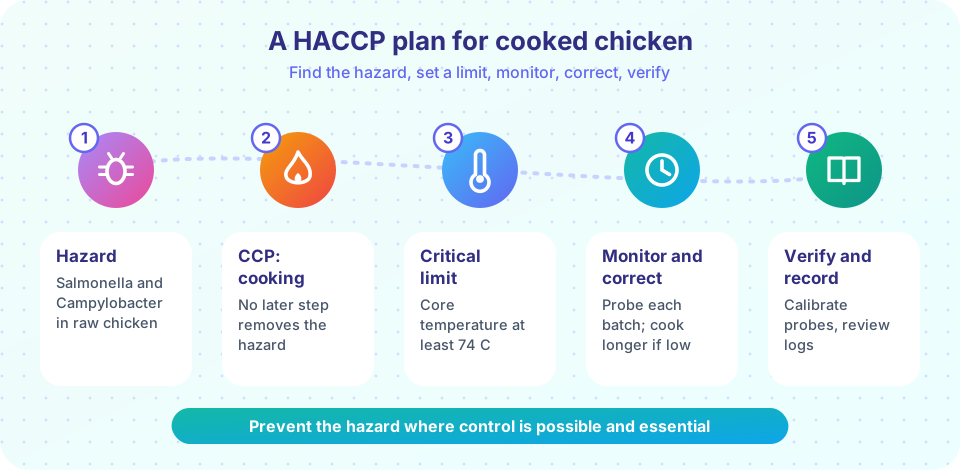
At the cooking CCP, the critical limit is the minimum core temperature (and sometimes a minimum time). Monitoring is a calibrated probe thermometer reading, recorded for each batch. If the limit is missed, the corrective action is to continue cooking until the limit is reached, and if the product cooled below limits and sat too long, to hold and evaluate or discard it. Verification includes thermometer calibration and a supervisor reviewing the records.
Time and temperature rules
These rules grew out of the growth science of the previous lesson. Exact numbers differ by country, so always follow your local authority.
- Cold holding: at or below about 5 °C (41 °F in the US; 8 °C is the legal maximum in the UK, with 5 °C advised).
- Hot holding: at or above about 57-63 °C (US 135 °F = 57 °C; UK/EU 63 °C).
- Cooking core temperatures (common US guidance): poultry 74 °C (165 °F); ground meat 71 °C (160 °F); whole cuts of beef, pork, lamb and fish 63 °C (145 °F) with a rest time. Other countries use time-temperature combinations: for example 70 °C for 2 minutes is equivalent to 75 °C instantaneous in some guidance.
- Cooling: in US food code guidance, cooked food should fall from 57 °C (135 °F) to 21 °C (70 °F) within 2 hours and to 5 °C (41 °F) within a total of 6 hours.
- Reheating: to at least 74 °C (165 °F) in US guidance (some countries accept 70-75 °C).
- Two-hour rule: perishable food left out of refrigeration for more than 2 hours (1 hour above 32 °C) should be discarded.
Personal hygiene and cleaning
- Handwashing with soap and warm running water for at least 20 seconds, before handling food, after the toilet, after touching raw meat, waste, phones, and after sneezing or coughing.
- Illness exclusion: staff with vomiting or diarrhea should not handle food until they are symptom free, commonly for at least 48 hours.
- Clean and sanitize: cleaning removes dirt and food residue with detergent; sanitizing reduces microbes on a clean surface with heat or approved chemicals. Sanitizers work poorly on dirty surfaces.
- Separate raw and ready-to-eat foods in storage, equipment and workflow (color-coded boards are common).
- Pest control and protected storage.
Allergens
Food allergens are a major chemical hazard. A food allergy is an immune reaction that can be severe or fatal even at very small doses. In the US, nine allergens must be declared: milk, eggs, fish, crustacean shellfish, tree nuts, peanuts, wheat, soybeans and sesame. The EU requires 14: cereals containing gluten, crustaceans, eggs, fish, peanuts, soybeans, milk, tree nuts, celery, mustard, sesame, sulphur dioxide and sulphites, lupin and molluscs. Control measures include supplier declarations, segregation, dedicated equipment or scheduling and validated cleaning, correct labeling and staff training, and strict rework controls. "May contain" statements should reflect an assessed risk, not be used instead of good control. Handling allergen incidents is not something to improvise; follow your authority's rules.
Traceability and recall
If a hazard reaches the market, businesses must be able to trace ingredients one step back and products one step forward by batch or lot number, and withdraw or recall affected product quickly. Good records, accurate labeling and regular mock recall exercises save time when it matters.
Common misconceptions
"HACCP is paperwork." The documents record real controls; the point is preventing hazards at the right step. "Every step is a CCP." If everything is critical, nothing is; CCPs are the few steps where control is essential and cannot be done later. "Testing the final product proves safety." Sampling cannot detect low-level or uneven contamination, and results come late. "Sanitizer replaces cleaning." It works only on already clean surfaces. "Rules are identical everywhere." Limits differ between countries; follow local law.
Try it
Press Run (or Ctrl + Enter) to see the result here.
Program input · what you'd type while the program runs
Type the answers before you press Run, one per line. Each time the program reads a line (with input()), it gets the next line from this box.
Press Run (or Ctrl + Enter) to see the result here.
Program input · what you'd type while the program runs
Type the answers before you press Run, one per line. Each time the program reads a line (with input()), it gets the next line from this box.
Press Run (or Ctrl + Enter) to see the result here.
Program input · what you'd type while the program runs
Type the answers before you press Run, one per line. Each time the program reads a line (with input()), it gets the next line from this box.
Check your understanding
Quick check · 6 questions
of 6 answered You scored / 6 · perfect!
-
1. What is a critical limit?
Critical limits are measurable values (temperature, time, pH, aw) that must be met at a CCP. -
2. Which HACCP principle covers what to do when a limit is missed?
Principle 5 establishes corrective actions for deviations. -
3. A thermometer is calibrated and records are reviewed by a supervisor. This is...
Verification confirms that the system works as planned. -
4. Which is a physical hazard?
Glass, metal, stones and bone fragments are physical hazards. -
5. Why is rapid cooling a CCP for cooked rice and gravy?
Slow cooling gives surviving spores time to germinate and multiply. -
6. Which pair of countries/regions require declaration of 14 and 9 major allergens respectively?
The EU lists 14 allergens; the US lists 9 including sesame.
Summary
- HACCP prevents hazards by controlling critical steps; it rests on prerequisite programs and good hygiene.
- Seven principles: hazard analysis, CCPs, critical limits, monitoring, corrective actions, verification and records.
- Time and temperature rules (cold, hot, cooking, cooling) come straight from microbial growth science, with local variations.
- Allergen control, traceability and personal hygiene are essential parts of food safety.
Track your progress
Create a free account to tick off lessons and pick up where you left off on any device.
of Food Science lessons completed