


















Lesson 28 of 45 · Sensory Science
Taste, Smell and Flavor Perception
How the tongue and nose detect food: the five tastes and their receptors, olfaction, retronasal smell, chemesthesis, taste interactions and Stevens' power law.
When you bite into a ripe strawberry, your mouth detects sugar and a little acid, your nose detects dozens of fruity molecules, your lips notice the juice and temperature, and your brain fuses these streams into one impression: strawberry. This lesson follows each stream from molecule to receptor to brain. You will learn which compounds trigger which taste, how the nose can tell thousands of aromas apart with only about four hundred receptor types, and why turning down sugar or salt changes more than the taste.
What you will learn
- Name the five basic tastes, their typical stimuli and the main receptor types.
- Explain how smell works, including orthonasal and retronasal routes.
- Describe chemesthesis (spiciness, cooling, carbonation) and taste interactions.
- Use Stevens' power law and relative sweetness to compare intensities.
Key terms
Taste bud: a cluster of 50 to 100 receptor cells embedded in the tongue, palate and throat; a person has several thousand.
Olfactory receptor: a protein on a nerve cell in the nose that binds odor molecules; humans have roughly 400 functional types.
Retronasal smell: smelling aroma that travels from the back of the mouth up to the nose while you chew and swallow.
Chemesthesis: the sense of chemical irritation or cooling felt by pain and temperature nerves, such as chili burn.
Relative sweetness: how many times sweeter a compound is than sucrose, weight for weight.
Taste: five basic messages
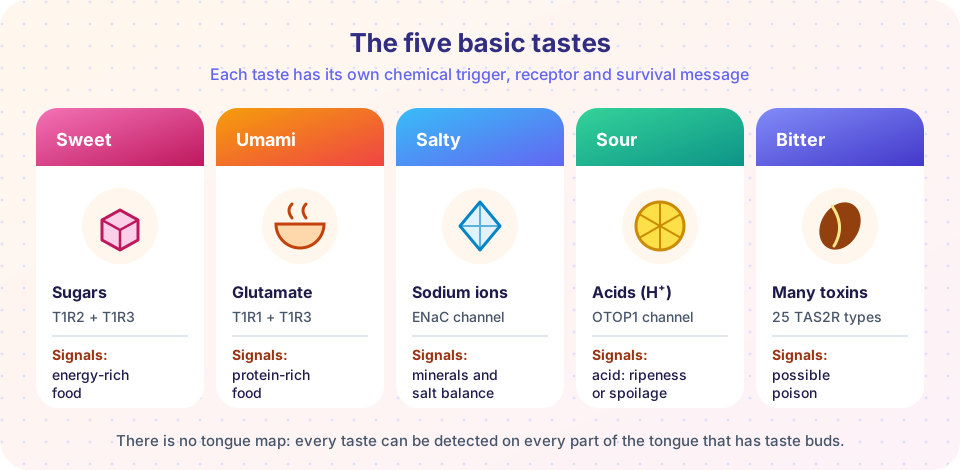
A basic taste is a taste quality with its own receptor machinery and a distinct purpose. Five are accepted by most researchers.
| Taste | Typical stimulus | Receptor | What it tells you |
|---|---|---|---|
| Sweet | Sugars, some amino acids, many sweeteners | T1R2 + T1R3 (G-protein-coupled) | Energy-rich food |
| Umami | Glutamate, some nucleotides | T1R1 + T1R3 | Protein-rich food |
| Salty | Sodium (and some other) ions | ENaC sodium channel and other pathways | Minerals and salt balance |
| Sour | Acids (hydrogen ions) | OTOP1 proton channel and others | Acidity: ripeness or spoilage |
| Bitter | Many different compounds | About 25 types of TAS2R | Possible poison |
Notice how well the list matches survival. Sweet and umami draw you toward calories and protein. Bitter makes you cautious, since many plant toxins are bitter, although people learn to enjoy coffee, beer and dark chocolate. Sour warns you about unripe fruit and spoilage. Salty is attractive in modest amounts and aversive when very strong.
Taste cells detect molecules dissolved in saliva. The signal passes along cranial nerves to the brainstem and then to the cortex, where it joins the other senses. Researchers debate other candidate tastes, such as fat (fatty acids), starch, calcium and carbonation, but none has the same consensus as the five above.
People differ. About one in four people are supertasters with more taste buds and a strong response to bitter compounds such as PROP; they often find brassicas, coffee and grapefruit more bitter. Genetic variation in bitter receptors such as TAS2R38 explains part of this. A food company must therefore test on many people, not on one expert tongue.
Sweeteners compared
Sugars are not the only sweet compounds. Relative sweetness is measured against sucrose (= 1) at equal weight, and the exact figures depend on concentration and the method used. The ranges below are typical, not exact.
| Compound | Relative sweetness (approx.) |
|---|---|
| Sucrose | 1 |
| Glucose | about 0.7 |
| Fructose | about 1.2 to 1.7 |
| Steviol glycosides (rebaudioside A) | about 200 to 300 |
| Aspartame | about 200 |
| Sucralose | about 600 |
High-intensity sweeteners need only milligrams, but they also lack the bulk, browning and texture of sugar, and some have a lingering or bitter aftertaste, so reformulating a product is more than swapping one ingredient for another.
Smell: the great variety
Aroma molecules are small, volatile compounds. Air carries them into the nose, where they dissolve in mucus on the olfactory epithelium (a patch of tissue about the size of a postage stamp, high in the nasal cavity) and bind to olfactory receptors on nerve endings. Humans have about 400 types of functional receptors, but each odor molecule binds several types and each receptor binds many molecules. The brain reads the pattern of receptors that fire: a combinatorial code. It lets us distinguish a very large number of smells, though the exact number is debated and often quoted as tens of thousands or more.
Two routes exist:
- Orthonasal: sniffing in through the nostrils. This is how you smell food before you eat.
- Retronasal: aroma released in the mouth travels up behind the palate to the nose when you breathe out. This is how most of what we call flavor arrives, and it explains the pinched-nose experiment in the previous lesson.
Odor compounds come from many chemical sources: esters in fruit, aldehydes in cut grass, thiols in coffee and garlic, and the large family of molecules from the Maillard reaction and fat oxidation. Some strongly smelling compounds are present in extremely small amounts, because their odor thresholds are tiny, so a trace of an off-flavor molecule can ruin a product. Temperature matters too: warm foods release more volatiles, which is why cold pizza smells less than hot, and why melted ice cream tastes sweeter than frozen.
Chemesthesis: heat, cool and fizz
Not every sensation in the mouth is a taste or smell. Pain, temperature and touch nerves also respond to chemicals.
- Capsaicin, in chili peppers, activates the TRPV1 channel, which also responds to heat above about 43 °C. That is why chili feels "hot." Pungency is traditionally reported on the Scoville scale.
- Menthol activates TRPM8, a cold-sensing channel, which is why mint feels cool even at room temperature.
- Carbonation is detected partly as the dissolved carbon dioxide forms acid on nerve endings and partly as the tingle of bubbles.
- Astringency, the drying, puckering feel of strong tea or red wine, comes from tannins binding salivary proteins and is usually counted as a touch sensation.
How the signals interact
Real foods are mixtures, and the senses influence one another:
- Sweetness suppresses sourness and bitterness, and salt suppresses bitterness. That is why a pinch of salt improves coffee and sugar rounds out lemon.
- Adaptation: a constant stimulus fades. Hold a salty broth in your mouth and it tastes less salty after a minute.
- Cross-modal effects: some aromas feel sweet even without sugar (vanilla, strawberry). A drink that smells fruitier is often rated as sweeter, which lets formulators lower sugar by raising aroma.
- Enhancement: umami compounds boost savory flavor, which is why seasonings with glutamate and nucleotides can allow lower salt.
How intensity grows: Stevens' power law
S. S. Stevens found that perceived magnitude ψ often follows a power law of the physical intensity S:
ψ = k × S^n
The exponent n depends on the sense. Reported exponents for taste are around 1.3 or so for sucrose, which means intensity grows faster than concentration, while many odors have exponents well below 1, which means a large increase in concentration is needed for a modest rise in perceived strength. The exponents below are illustrative, typical of the literature; real values vary with compound, method and person.
Common misconceptions
"Spicy is a taste." Chili burn is chemesthesis: pain and temperature nerves, not taste buds.
"Sugar-free means no sweetness work needed." Sugar gives sweetness and bulk, browning, preservation and mouthfeel. High-intensity sweeteners replace only the first.
"A bigger sniff means a bigger smell." Sniffing helps, but receptors adapt quickly, and a long smell fades. Perfumers and wine tasters take short sniffs with breaks.
Try it
A calculator for sweetness equivalence. It uses typical values from the table above, so treat the result as an estimate and not as a recipe.
Now Stevens' power law. The plot compares an expansive exponent (n above 1), a roughly linear one, and a compressive one. The exponents are illustrative of the typical order of magnitude, not measurements.
Press Run (or Ctrl + Enter) to see the result here.
Program input · what you'd type while the program runs
Type the answers before you press Run, one per line. Each time the program reads a line (with input()), it gets the next line from this box.
Finally, the idea of combinatorial coding. If each odor activates a pattern of receptor types, even a small pattern size gives an enormous number of distinguishable patterns. This is a counting exercise, not a model of the real nose.
Press Run (or Ctrl + Enter) to see the console output here.
No output.
Check your understanding
Quick check · 5 questions
of 5 answered You scored / 5 · perfect!
-
1. Which receptor family detects bitter compounds?
About 25 types of TAS2R receptors detect bitter compounds; T1R2+T1R3 is the sweet receptor and TRPM8 senses cold. -
2. Why does a food seem flavorless when you have a blocked nose?
Most flavor arrives by retronasal smell. A blocked nose leaves only taste and touch. -
3. Capsaicin feels hot because it activates which kind of sensor?
Capsaicin opens TRPV1, which normally responds to harmful heat, so chili feels hot. -
4. With Stevens' law and an exponent of 0.5, doubling the stimulus multiplies the perceived intensity by about:
2 to the power 0.5 is the square root of 2, about 1.41. -
5. Why can adding salt make bitter coffee seem less bitter?
Taste interactions: salt suppresses bitterness, an effect cooks use deliberately.
Summary
- Five basic tastes (sweet, umami, salty, sour, bitter) each have specific receptors and a survival message.
- People differ: supertasters, genetic variation and learning change what tastes good.
- Smell uses about 400 receptor types and a combinatorial code; most flavor arrives by the retronasal route.
- Chemesthesis (chili, menthol, carbonation, astringency) uses pain, temperature and touch nerves, not taste buds.
- Tastes and aromas interact: sweet suppresses sour and bitter, salt suppresses bitter, aroma can make a drink seem sweeter.
- Stevens' power law links stimulus to perception: expansive for sweetness, compressive for many odors.
Next: Texture and rheology
Track your progress
Create a free account to tick off lessons and pick up where you left off on any device.
of Food Science lessons completed