


















Lesson 22 of 45 · Preservation
Chapter review: Preservation
Review Chapter 4: D, z and F values, pasteurization and canning, cold and drying, salt, acid, fermentation and hurdle technology, with a ten-question quiz.
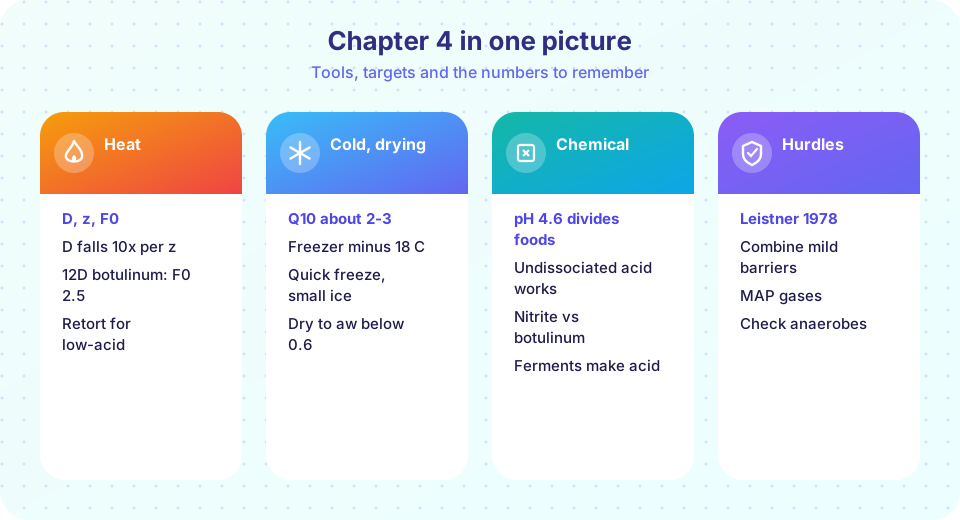
You have covered the main ways to keep food safe and acceptable for longer: kill microbes with heat, slow them with cold, deprive them of water, make the food hostile with acid, salt, sugar and preservatives, and combine mild barriers. This review ties them together with one picture and one table, then tests you with mixed questions.
Try the picture first. For each tool, name the factor it acts on, one food it protects and one drawback.
What you will learn
- Recall the key principles and numbers from each preservation lesson.
- Choose appropriate preservation methods for different foods.
- Practice with a mixed quiz.
Key terms
Must know: D-value, z-value, F₀, 12D, retort, commercial sterility, pasteurization, UHT, cold spot, Q₁₀, freeze concentration, sublimation, drying curve, aw, weak-acid preservative, pKa, undissociated fraction, curing, nitrite, fermentation, hurdle technology, MAP.
Recap
| Lesson | Core idea | Numbers and examples to remember |
|---|---|---|
| Heat treatment | Death is first-order; D falls tenfold per z | D₁₂₁.₁ about 0.2 min for botulinum spores; z about 10 °C; F₀ minimum about 2.5 min (12D); milk HTST 72 °C for 15 s; UHT 135-150 °C for 2-5 s |
| Cold and drying | Slow reactions; remove water | Q₁₀ about 2-3; freezer at -18 °C; quick freezing gives small crystals; freeze-drying by sublimation; stable below aw about 0.6 |
| Chemical methods and hurdles | Lower aw or pH, add barriers | Undissociated fraction 1/(1+10^(pH−pKa)); sorbate up to about pH 6, benzoate best below 4.5; nitrite against botulinum; hurdle technology (Leistner); MAP gases |
Choose the method
A useful exercise: match the food to its main protection.
- Canned corn (low-acid): retort sterilization with F₀ above the 12D minimum; sealed can prevents recontamination.
- Pickled cucumber: acid (pH about 3.5), salt and sometimes heat; hot-fill or boiling-water bath is enough because it is an acid food.
- Yogurt: lactic fermentation to pH about 4.2-4.6 plus refrigeration.
- Raisins: drying to aw about 0.55-0.65 (stable at room temperature if protected from moisture).
- Frozen peas: blanching (enzymes) then quick freezing and storage at -18 °C.
- Dry-cured ham: salt, nitrite, drying (low aw) and time.
- Fresh packed salad: low oxygen and carbon dioxide atmosphere plus cold chain; no kill step, so hygiene is vital.
Kill
Slow
Hostile
Combine
Worked problems with solutions
Problem 1: a D-value and a process. A spore has D = 0.5 min at 115 °C and z = 10 °C. (a) How long at 115 °C gives a 6-log reduction? (b) What is D at 125 °C? (c) How long at 125 °C gives the same 6 logs?
Solution. (a) 6 × 0.5 = 3.0 min. (b) 125 °C is 10 °C hotter, so D falls tenfold to 0.05 min. (c) 6 × 0.05 = 0.3 min. The hotter process is ten times shorter, which is the basis of high-temperature short-time processing.
Problem 2: F₀ for a hold. A can's cold spot is held at 118 °C for 8 minutes (ignore heating and cooling). What F₀ does that deliver, using z = 10 °C and reference 121.1 °C?
Solution. The lethal rate is L = 10^((118 − 121.1)/10) = 10^(−0.31) ≈ 0.49. F₀ ≈ 8 × 0.49 ≈ 3.9 min. That exceeds the 12D minimum of about 2.5 min for botulinum spores with D = 0.21 min, though real processes add the contribution of heating and cooling and a safety margin.
Problem 3: shelf life and temperature. A chilled dessert lasts 12 days at 4 °C. Assuming Q₁₀ = 2.5, estimate its shelf life if a warm delivery van holds it at 14 °C for the whole journey.
Solution. A 10 °C rise makes the process 2.5 times faster, so shelf life falls to 12 / 2.5 = 4.8 days. This is why cold chain breaks are so costly.
Problem 4: preservative choice. A beverage has pH 3.4 and another has pH 6.0. Which preservative, benzoate (pKa 4.2) or sorbate (pKa 4.76), is likely to be effective, and how much of it would be undissociated at each pH?
Solution. Fraction undissociated = 1/(1 + 10^(pH − pKa)). Benzoate at pH 3.4: 1/(1 + 10^(−0.8)) = 1/1.158 ≈ 86%. Sorbate at pH 6.0: 1/(1 + 10^(1.24)) = 1/18.4 ≈ 5.4%. The acidic beverage is well suited to weak-acid preservation; in the near-neutral beverage, only about 5% of the sorbate is active, so another hurdle, such as heat or refrigeration, is needed.
Revisit the heat lesson for problems 1 and 2, cold and drying for problem 3, and the chemical lesson for problem 4.
Try it
Common misconceptions
"All preservation kills microbes." Many methods only stop growth. "Colder is always better." Chilling injury, freezer burn and ice damage show limits. "Preservative levels can be raised to compensate for poor hygiene." Preservatives do not replace hygiene and may not work at neutral pH.
Press Run (or Ctrl + Enter) to see the result here.
Program input · what you'd type while the program runs
Type the answers before you press Run, one per line. Each time the program reads a line (with input()), it gets the next line from this box.
Press Run (or Ctrl + Enter) to see the result here.
Program input · what you'd type while the program runs
Type the answers before you press Run, one per line. Each time the program reads a line (with input()), it gets the next line from this box.
Check your understanding
Quick check · 10 questions
of 10 answered You scored / 10 · perfect!
-
1. If D = 1 min at a temperature, how long to reduce a population by 6 logs?
Each D-value gives one log reduction, so 6 logs need 6 D, which is 6 min. -
2. If z = 10 °C, how does D at 131 °C compare to D at 121 °C?
A 10 °C rise cuts D to one tenth. -
3. The botulinum minimum cook is based on...
The '12D' concept means 12 decimal reductions. -
4. Which food needs a retort for shelf-stable canning?
Green beans are low-acid, so botulinum spores must be destroyed under pressure. -
5. Why does quick freezing give better texture?
Small crystals damage cells less than large ones. -
6. At what water activity does microbial growth generally stop?
No growth is known below about 0.6. -
7. Sorbic acid has pKa 4.76. At pH 4.76, what fraction is undissociated?
At pH = pKa half of the acid is undissociated. -
8. Which is the main purpose of the vacuum in freeze-drying?
Low pressure lets ice turn directly to vapor without melting. -
9. A risk of vacuum-packed chilled fish is...
Without oxygen, anaerobes may grow slowly even at refrigerator temperatures. -
10. Hurdle technology is best described as...
Each hurdle may be modest, but together they prevent growth while keeping quality.
Summary
- Heat kills (D, z, F₀; 12D for botulinum); cold and drying slow or stop growth; acid, salt, sugar, preservatives and fermentation make food hostile.
- The pH 4.6 and aw 0.6 numbers, and the -18 °C freezer standard, recur everywhere.
- Weak-acid preservatives need acidic foods; nitrite and low aw protect cured meats; hurdles and MAP combine barriers.
- Choose methods by the food's pH, water activity, heat sensitivity and intended storage.
Track your progress
Create a free account to tick off lessons and pick up where you left off on any device.
of Food Science lessons completed