


















Lesson 39 of 45 · Food Innovation and Regulation
Novel Foods and Alternative Proteins
Learn what makes a food novel, how safety is assessed, and the science of plant-based, fermentation, cultivated and insect proteins, with mass-balance examples and a decision helper.
Some of the most active areas of food science today involve foods people did not eat a generation ago: burgers made from pea protein, mycoprotein grown in fermenters, meat produced from animal cells, and flour ground from crickets. They are driven by concerns about land, climate, animal welfare and food security, and by the plain fact that demand for protein keeps growing. They also raise a question that ordinary foods do not: how do we know a new food is safe? This lesson explains what regulators call a novel food, how it is assessed, and the science that makes each alternative protein route possible.
What you will learn
- Define a novel food and outline the EU and US approaches to approval.
- List the main parts of a safety assessment for a new food.
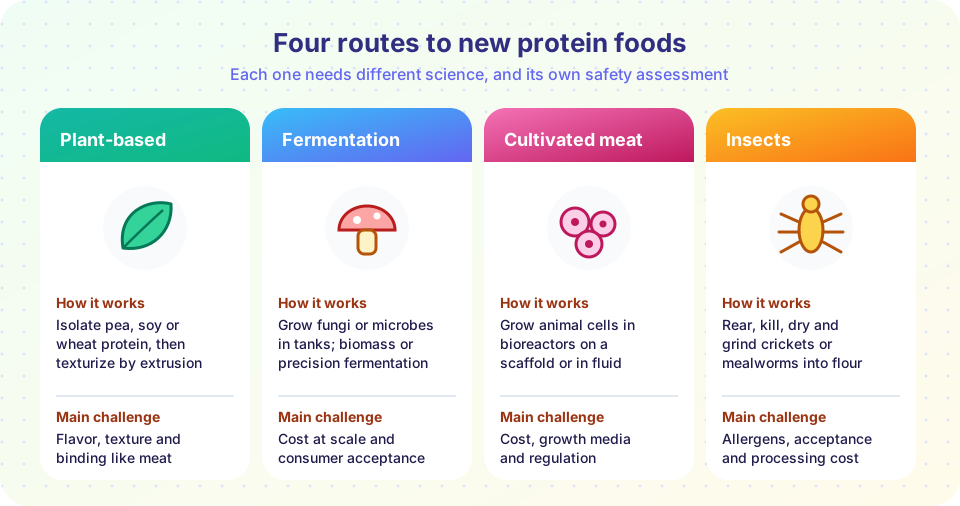
- Explain how plant-based, fermentation, cultivated and insect proteins are made.
- Do mass-balance calculations for protein extraction and extrusion.
Key terms
Novel food: in the EU, a food not consumed to a significant degree before 15 May 1997, or one made by a new process or from a new source; it needs authorization before sale.
GRAS (generally recognized as safe): a US status for a substance that qualified experts consider safe for its intended use.
Texturization: giving plant protein a fibrous, meat-like structure, usually by extrusion.
Precision fermentation: using microorganisms as tiny factories to make a specific ingredient, such as a protein.
Cultivated meat: meat made by growing animal cells in a bioreactor instead of raising and slaughtering animals.
What counts as a novel food
The idea of "novel" is practical: it means we do not have a long history of safe eating. In the EU, Regulation (EU) 2015/2283 defines a novel food as one that was not used for human consumption to a significant degree in the EU before 15 May 1997. This covers new ingredients (for example, a protein from a microalga), foods made from cell cultures, insects, foods from new production processes, and engineered nanomaterials. A company must apply, the European Food Safety Authority (EFSA) prepares a scientific opinion, and the European Commission and Member States decide whether to add the food to the Union list of authorized novel foods, with conditions of use.
In the US, there is no single novel-food law. A new ingredient is usually either a food additive, which needs an FDA premarket approval, or a GRAS substance, where experts judge the ingredient safe by scientific procedures. Companies may notify the FDA of a GRAS conclusion. Cell-cultured meat and poultry involve a joint arrangement, with the FDA overseeing cell collection and growth and the US Department of Agriculture overseeing processing and labeling. Other countries, such as Singapore, have their own novel food frameworks; Singapore was the first to authorize the sale of cultivated chicken, in 2020. Regulations are changing quickly, so always check the current rules.
What a safety assessment looks at
A dossier for a new food usually has to address:
- Identity and composition: what exactly is it, with a specification, nutrients, and possible contaminants.
- Production process: each step, the materials and aids used, and how consistency is controlled.
- History of use: whether the food or its source has been eaten elsewhere in the world, which can support safety.
- Intended use and intake: which foods will contain it, at what levels, and the exposure of different population groups.
- Nutritional information: effects on the diet, and whether anti-nutritional factors exist.
- Toxicology: for example tests for genetic damage and, usually, a 90-day repeated-dose study in animals, depending on the product.
- Allergenicity: whether it could cause new allergies or cross-react with known allergens (for example, insect proteins and shellfish allergens).
The assessment is a weight of evidence, with the level of testing scaled to what is known about the source. A novel food with a long history in another region may need little toxicology; a completely new organism needs more.
Plant-based proteins
The aim is to give plant protein the structure, flavor and cooking behavior of meat, egg or dairy.
- Protein extraction. Pea, soy, faba bean and other seeds are milled, mixed with water, adjusted to alkaline pH to dissolve the protein, separated from starch and fiber, and then the pH is lowered to the isoelectric point (typically around pH 4 to 5) where the protein is least soluble and precipitates. The curd is washed, neutralized and dried into an isolate (often 80 percent protein or more) or a concentrate (lower protein).
- Texturization. In high-moisture extrusion, a mix of protein and water (often 50 percent water or more) is heated and sheared in an extruder, and then forced through a cooling die. The protein unfolds, forms new bonds, and aligns into fibers as it flows, yielding a fibrous structure. Low-moisture extrusion gives dry puffed pieces that are rehydrated (textured vegetable protein).
- Flavor and binding. Legume proteins can taste "beany" or bitter, so processing aims to remove flavor precursors, and flavors and fats mask or balance the rest. Binders such as methylcellulose hold burgers together on the grill. Some products add heme produced by precision fermentation to give a meat-like flavor.
Fermentation: biomass and precision
Microorganisms grow fast, use little land, and can be fed with sugars from crops or from waste streams.
- Biomass fermentation grows the organism itself and uses it as food. The best-known example is mycoprotein, from the filamentous fungus Fusarium venenatum, sold since the 1980s under the brand name Quorn. Fungal biomass is rich in protein and fiber and grows into a fibrous texture on its own.
- Precision fermentation programs a microbe (such as a yeast or bacterium) to make a specific molecule. An early success is chymosin, the cheesemaking enzyme, which has been made by engineered microbes since the early 1990s, replacing a calf-stomach extract. Today the same idea is used for milk proteins (for example beta-lactoglobulin), egg proteins and heme. The microbes are removed and the purified product is used as an ingredient.
Challenges are cost at scale (fermenters and downstream purification are expensive), energy use, removal of nucleic acids from biomass (high RNA can raise uric acid), allergen labeling, and consumer acceptance of products from genetically modified microbes.
Cultivated meat
Cultivated meat begins with a small sample of cells from an animal, often stem cells that can multiply and then become muscle or fat. The cells are placed in a bioreactor with a growth medium that supplies nutrients, amino acids, sugars and signaling proteins (growth factors), and they multiply many times. For structured products they grow on an edible scaffold or on microcarriers and are then triggered to differentiate into muscle fibers. Fetal bovine serum, once a standard medium ingredient, is being replaced by animal-free media for ethical and cost reasons.
The difficulties are formidable: growth factors and other medium components are costly, large bioreactors must stay sterile, getting thick, structured tissue requires blood-vessel-like nutrient delivery, and regulation requires proof of safety and of consistent composition. Approvals have started in a few countries, and the technology is still developing.
Insects
Insects such as crickets and mealworms are commonly eaten in many parts of the world. In the EU several have been authorized as novel foods, including dried yellow mealworm, the migratory locust and the house cricket, in powders, whole dried forms and as ingredients. Insects are rich in protein and fat, grow quickly on organic by-products and use little space. The challenges include consumer acceptance in some markets, processing (killing, cleaning, drying, grinding), microbiological control, and allergens: people allergic to crustaceans or house dust mites may also react to insect proteins, so labels must warn them.
Other directions
Microalgae and seaweed, protein from leaf juice, upcycled ingredients from brewing and juicing by-products, 3D-printed foods and personalized nutrition are all being explored. Each, again, comes with its own composition, process and safety questions.
Common misconceptions
"Alternative proteins are all the same." They rely on very different biology and engineering, with different costs, nutrition, allergen risks and regulations.
"Plant-based always means healthier." Nutrition depends on the recipe: fats, salt, fiber and micronutrients vary widely, so read the label as you would for any food.
"Cultivated meat is genetically modified." Many projects use unmodified animal cells, although some processes may use genetic changes to help cells grow; each product is assessed on its facts.
"Novel means untested." Novel foods go through a safety assessment before they are sold in jurisdictions that regulate them, which is the point of the framework.
Try it
First, a decision helper that imitates the first questions of an EU novel food check. It is a teaching sketch, not legal advice, and real decisions need an expert and the current regulation.
Second, the protein-recovery mass balance of the isoelectric extraction. The recovery values are assumptions for the exercise, and real plants differ.
Press Run (or Ctrl + Enter) to see the result here.
Program input · what you'd type while the program runs
Type the answers before you press Run, one per line. Each time the program reads a line (with input()), it gets the next line from this box.
Third, the water balance for high-moisture extrusion: how much water must be added to a dry protein mix to reach a target moisture?
Press Run (or Ctrl + Enter) to see the console output here.
No output.
Check your understanding
Quick check · 5 questions
of 5 answered You scored / 5 · perfect!
-
1. In the EU, what makes a food novel?
The 1997 cut-off, together with new sources and processes, defines novel foods. -
2. What does the cooling die do in high-moisture extrusion?
As the protein flows through the die and cools, it forms aligned fibers that resemble muscle. -
3. Why can insect protein cause labeling concerns?
Insect proteins can cross-react with shellfish and dust mite allergens. -
4. In an extraction, 80 percent of protein is extracted and 85 percent of that is precipitated. What fraction of the original protein remains?
0.80 × 0.85 = 0.68, so 68 percent. -
5. What is precision fermentation?
Microbes act as tiny factories that make one chosen molecule.
Summary
- A novel food is one without a significant history of consumption (EU: before 15 May 1997) or made by a new source or process; it needs authorization or a safety conclusion before sale.
- A safety assessment covers identity, process, history of use, intake, nutrition, toxicology and allergenicity.
- Plant proteins are extracted (isoelectric precipitation) and texturized by extrusion; fermentation makes biomass or specific ingredients; cultivated meat grows animal cells in bioreactors; insects are processed into flours and ingredients.
- Each route has different challenges: flavor, cost, scale-up, regulation and allergens.
- Mass balances show how losses multiply through multi-step processes.
Next: Chapter 8 review
Track your progress
Create a free account to tick off lessons and pick up where you left off on any device.
of Food Science lessons completed