


















Lesson 18 of 45 · Preservation
Chapter overview: Food Preservation
Preview Chapter 4: the principles of preserving food by heat, cold, drying, acid, salt, fermentation and combined hurdles, and what each lesson covers.
Food spoils because living things (microbes, enzymes, even the food's own cells) and chemistry (oxidation, browning) keep working. Preservation is the set of techniques that slow, stop or prevent those changes so food lasts longer and stays safe. Humans have done this for ten thousand years with fire, sun, salt, smoke, cold caves, pickling and fermentation; modern science explains why each works and helps combine them.
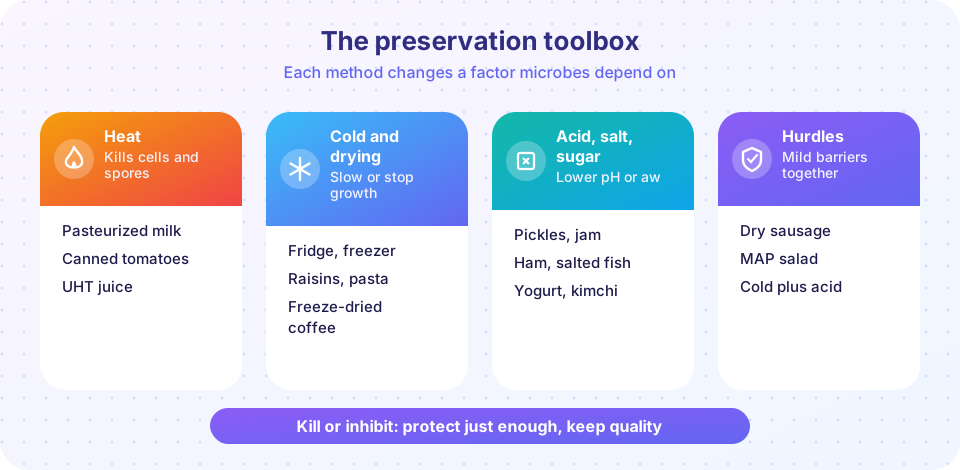
Every method works by attacking one or more of the factors you met in Chapter 3: temperature, water, acidity, oxygen, time and microbial numbers. Once you know the list, preservation looks less like a catalog of tricks and more like a design problem: which factors can I change in this food without ruining it?
What you will learn
- Name the main preservation principles and the factor each one targets.
- Explain the difference between killing microbes and merely stopping their growth.
- See how methods combine in hurdle technology.
- Know what each lesson of the chapter covers.
Key terms
Preservation: treatments that extend the safe, acceptable life of food. Sterilization: destroying all viable microorganisms. Commercial sterility: a condition in which no organisms capable of growing under normal storage remain. Pasteurization: a mild heat treatment that reduces pathogens and spoilage organisms. Hurdle technology: combining several mild obstacles to microbial growth. Shelf life: time during which a food stays safe and acceptable.
Two strategies: kill or inhibit
Preservation methods divide into those that kill microbes and those that inhibit them.
- Killing: heat (pasteurization, canning), irradiation, high-pressure processing. The food must then be protected from recontamination by packaging.
- Inhibiting: cold (refrigeration, freezing), drying, salting and sugaring, acidifying, fermenting, chemical preservatives, modified atmosphere. Microbes are still there but cannot grow, as long as the conditions are maintained.
Some methods mix both. Smoking dries, deposits antimicrobial compounds and cooks lightly. Cheese uses acid, salt, low moisture and competition.
| Principle | Targets | Examples |
|---|---|---|
| Heat | Kills cells and spores | Pasteurized milk, canned tomatoes, UHT juice |
| Cold | Slows growth and reactions | Refrigerated meat, frozen peas |
| Drying | Lowers water activity | Pasta, raisins, milk powder |
| Acid | Lowers pH | Pickles, yogurt, vinegar sauces |
| Salt and sugar | Lower water activity | Ham, salted fish, jam |
| Chemical agents | Inhibit specific microbes | Sorbate, benzoate, nitrite |
| Atmosphere | Limits oxygen or adds CO₂ | Vacuum packs, modified atmosphere |
The chapter at a glance
Heat
Cold and drying
Chemical and hurdles
What each lesson covers
- Heat treatment: pasteurization and canning: death kinetics with D, z and F values, how to design a heat process and why botulinum sets the standard.
- Cold and drying: refrigeration, freezing, drying curves, freeze-drying and their limits.
- Salt, sugar, acid, ferments and hurdles: chemical preservation, fermentation, packaging atmospheres and combining barriers.
- Chapter review: a summary picture and quiz.
Preservation is a trade-off
Every preservation method has costs. Heat destroys vitamins and changes flavor. Freezing alters texture through ice crystals. Drying shrinks and can darken food. Salt raises sodium. Acid changes taste. The engineer's goal is to deliver just enough protection to meet the safety target and shelf life while keeping as much quality and nutrition as possible. That balance (safe enough, good enough) is a theme you will see again in Chapter 5 (processing) and Chapter 7 (nutrition).
Shelf life itself is not one number. It depends on storage temperature, packaging, humidity and the initial microbial load. A date on a label is a manufacturer's promise under stated conditions, and the type of date matters: a use by date is about safety for highly perishable foods, while best before is about quality.
Common misconceptions
"Preservatives are the only way to make food last." Heat, cold, drying and acid are older and more important. "A preserved food is sterile." Most are not; pasteurized and acidified foods still contain living cells. "Freezing improves or restores quality." It stops change but cannot improve a food that was already old.
Try it
Press Run (or Ctrl + Enter) to see the result here.
Program input · what you'd type while the program runs
Type the answers before you press Run, one per line. Each time the program reads a line (with input()), it gets the next line from this box.
Press Run (or Ctrl + Enter) to see the result here.
Program input · what you'd type while the program runs
Type the answers before you press Run, one per line. Each time the program reads a line (with input()), it gets the next line from this box.
Check your understanding
Quick check · 3 questions
of 3 answered You scored / 3 · perfect!
-
1. Which method mainly works by lowering water activity?
Drying removes water, and salt binds it; both lower aw. -
2. Which is a killing (rather than inhibiting) method?
Canning uses heat to destroy microbes; the others mainly prevent growth. -
3. What does a 'use by' date mainly refer to?
Use by indicates a safety limit; best before is about quality.
Summary
- Preservation kills or inhibits microbes and slows chemical change by acting on temperature, water, acidity, oxygen and time.
- The main tools are heat, cold, drying, acid, salt and sugar, chemicals and atmosphere control.
- Methods trade safety and shelf life against flavor, texture and nutrition.
- The chapter explains heat, cold and drying, then chemical methods and hurdle technology.
Track your progress
Create a free account to tick off lessons and pick up where you left off on any device.
of Food Science lessons completed