


















Lesson 25 of 45 · Processing Technology
Mixing, Emulsions and Homogenization
Learn how oil and water are mixed and kept together in milk, mayonnaise and dressings: emulsifiers, HLB, Stokes' law, homogenizers and the four ways emulsions fail.
Oil and water do not mix, yet milk, mayonnaise, ice cream, butter, chocolate and salad dressing all contain both. They are emulsions: one liquid dispersed as tiny droplets in another. Making a good emulsion is a mixing problem (break the liquid into small droplets) and a chemistry problem (stop the droplets from joining again). This lesson covers both halves, with the one equation, Stokes' law, that explains why droplet size decides how long a product stays smooth.
What you will learn
- Distinguish oil-in-water and water-in-oil emulsions, and name examples of each.
- Explain what an emulsifier does and use HLB to choose and blend them.
- Apply Stokes' law to predict creaming and explain why homogenization works.
- Name the four instability mechanisms and one way to slow each.
Key terms
Emulsion: a mixture of two immiscible liquids in which one is dispersed as droplets in the other.
Continuous and dispersed phase: the liquid that surrounds the droplets, and the liquid that forms them.
Emulsifier: a molecule with a water-loving (hydrophilic) head and an oil-loving (lipophilic) tail that lowers the interfacial tension and stabilizes droplets.
HLB (hydrophilic-lipophilic balance): a 0 to 20 scale describing how water-loving an emulsifier is.
Homogenization: forcing a coarse emulsion through a very narrow gap at high pressure to shatter droplets into much smaller ones.
Two kinds of emulsion
In an oil-in-water (O/W) emulsion the water is the continuous phase and oil forms the droplets. Milk, cream, mayonnaise, most salad dressings, ice cream mix and cream soups are O/W. In a water-in-oil (W/O) emulsion the oil is continuous and water is dispersed: butter (about 80 percent fat, with tiny water droplets) and margarine are W/O.
A simple test tells you which is which: a drop of the emulsion spreads in water if water is the continuous phase, and a water-soluble dye colors the whole mix. Many foods are more complicated, such as ice cream, which contains fat droplets, air bubbles and ice crystals together.
Why droplets need help: surface and interfacial tension
The boundary between oil and water carries energy, called interfacial tension. Every extra square meter of boundary costs energy, so left alone, droplets merge to reduce their total area. Breaking a liquid into droplets creates enormous new area. A single drop of 1 mm radius has an area of about 0.13 cm². Split the same volume into 1 µm droplets and there are a billion of them with a total area of about 126 cm², a thousand times more. All that new boundary needs a coat of emulsifier or it will collapse.
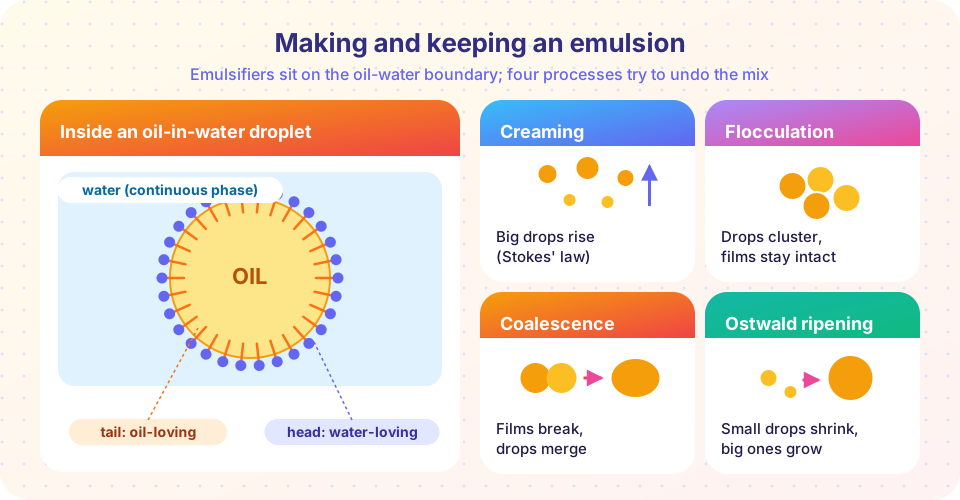
Emulsifiers are the molecules that sit on the boundary. Their tail dissolves in oil, their head in water, so they straddle the interface like a chain of tiny anchors, as in the illustration. They do three jobs: lower the interfacial tension, so droplets are easier to make; form a protective film, so droplets that touch do not merge; and in the case of charged or bulky molecules, repel neighboring droplets with electric charge or a physical layer (steric hindrance).
Types of emulsifier
| Emulsifier | Where it comes from | Typical use |
|---|---|---|
| Lecithin (phospholipids) | Egg yolk, soy, sunflower | Mayonnaise, chocolate, margarine |
| Proteins (casein, whey, egg, soy) | Milk, egg, plants | Milk, cream, sauces, plant drinks |
| Mono- and diglycerides | Fats reacted with glycerol | Bread, ice cream, spreads |
| Polysorbates (such as polysorbate 80) | Synthetic from sorbitol | Frozen desserts, dressings |
| Particles and gums (Pickering and thickeners) | Starch, mustard seed, xanthan | Dressings, sauces |
Bancroft's rule gives a rough prediction: the phase in which the emulsifier dissolves best becomes the continuous phase. A water-loving emulsifier tends to make O/W emulsions; an oil-loving one tends to make W/O.
HLB: choosing an emulsifier
The HLB scale, introduced by William Griffin, gives each emulsifier a number from 0 (fully oil-loving) to 20 (fully water-loving). As rough guides, values of about 3 to 6 favor W/O emulsions and values of about 8 to 18 favor O/W emulsions. Each oil also has a required HLB, the emulsifier value that suits it best, found by experiment.
You can blend two emulsifiers to hit a target. The HLB of a blend is the weight-average of its parts:
HLB(blend) = w₁ × HLB₁ + w₂ × HLB₂ (weight fractions w add to 1)
Example. You want HLB = 10 using sorbitan oleate (Span 80, HLB 4.3) and polysorbate 80 (Tween 80, HLB 15.0). With x as the fraction of polysorbate: 15.0x + 4.3(1 − x) = 10, so x = 5.7 / 10.7 = 0.533. A blend of about 53 percent polysorbate and 47 percent sorbitan oleate gives HLB 10. HLB is a starting point; real formulations are fine-tuned by trial.
Making droplets: mixers and homogenizers
Droplets form by shear and turbulence. A paddle or propeller mixer produces large drops (often tens to hundreds of micrometers), fine for a rough pre-emulsion. A rotor-stator (high-shear) mixer forces liquid between a spinning rotor and a fixed stator and reaches a few micrometers. A high-pressure homogenizer pushes the coarse emulsion at about 10 to 25 MPa (and up to hundreds of MPa in special machines) through a valve gap a fraction of a millimeter wide. In that gap the liquid accelerates sharply, and shear, turbulence and cavitation rip the droplets apart. Typical homogenized milk has fat globules of about 1 µm or smaller, compared with several micrometers in raw milk. Ultrasonic and microfluidic devices also exist.
Two practical details matter. First, the fresh surface made during homogenization must be coated at once, which is why the emulsifier or protein must be present in the feed. In milk, casein and whey proteins quickly cover the new fat surface. Second, a two-stage homogenizer adds a second, lower-pressure valve that breaks up clusters formed after the first stage.
Mixing is not only for liquids. Dough kneading develops gluten by repeated folding and stretching, solid mixing of powders is judged by how uniform samples are, and blending viscous materials needs a mixer that moves fluid through the whole vessel, not just near the blades.
Stokes' law: why small is stable
Droplets lighter than the surrounding liquid rise; heavier ones sink. For a single small sphere moving slowly, Stokes' law gives the velocity:
v = 2 r² (ρ_c − ρ_d) g / (9 μ)
r is the droplet radius, ρ_c and ρ_d the densities of the continuous and dispersed phases, g the gravitational acceleration (9.81 m/s²) and μ the viscosity of the continuous phase. The key feature is r²: halve the radius and the speed drops to a quarter; reduce the radius by a factor of four and it drops by sixteen.
Worked example. A raw milk fat globule of diameter 4 µm (r = 2 µm) rises through skim milk (ρ = 1,030 kg/m³, μ about 2 mPa·s) with fat density about 920 kg/m³. The speed is about 4.8 × 10⁻⁷ m/s, which is about 41 mm per day, so a visible cream layer forms in a bottle on standing. If homogenization reduces the diameter to 1 µm, the speed falls sixteen-fold, to about 2.6 mm per day, and the milk looks uniform for its whole shelf life. The same law explains the other ways to improve stability: raise the viscosity of the continuous phase with a gum such as xanthan, or reduce the density difference.
Four ways emulsions fail
| Process | What happens | Main defense |
|---|---|---|
| Creaming (or sedimentation) | Droplets rise or sink because of density difference | Smaller droplets, thicker continuous phase |
| Flocculation | Droplets stick together in clusters, but keep their films | Electrical charge, steric layers, correct pH and salt |
| Coalescence | Films break and droplets merge permanently | Strong, elastic interfacial film; enough emulsifier |
| Ostwald ripening | Small droplets dissolve and the oil moves to larger droplets | Poorly soluble oil, narrow size distribution |
Creaming and flocculation are often reversible, since shaking redistributes the droplets. Coalescence and Ostwald ripening are not. When mayonnaise "splits," the droplets coalesce and the product separates into oil and a watery layer. A classic cause is adding the oil too quickly, so there is not enough emulsifier to coat the new surface.
Kitchen link. In mayonnaise, egg yolk lecithin and proteins are the emulsifiers, and mustard adds more. Adding oil slowly while whisking lets the emulsifiers coat each new droplet, and the final product is so densely packed with oil droplets (often around 70 percent or more oil) that it behaves like a soft solid. Many food standards set a minimum oil content for products sold as mayonnaise.
Common misconceptions
"An emulsifier makes oil dissolve in water." The oil does not dissolve; it stays as tiny separate droplets. The emulsifier only makes those droplets easy to form and hard to merge.
"Homogenized milk has less fat." The total fat is the same. Only the size of the fat globules changes.
"A stable emulsion is stable forever." Emulsions are thermodynamically unstable; a good formulation is one that stays kinetically stable for the product's shelf life.
Try it
First, plot Stokes' law for milk fat. The code uses the numbers from the worked example and shows how much the cream layer would rise in 24 hours for different droplet sizes. This is an idealized single-droplet model; real milk droplets hinder each other, so actual creaming is somewhat different.
Press Run (or Ctrl + Enter) to see the result here.
Program input · what you'd type while the program runs
Type the answers before you press Run, one per line. Each time the program reads a line (with input()), it gets the next line from this box.
Now see it happen. The tube below is a time-lapse in which one second equals one hour. Move the slider to change droplet size and watch the cream layer form. It is a demonstration based on Stokes' law with arbitrary pixel scaling, not a measurement of any real product.
Finally, an HLB blend calculator. Change the target and the two emulsifiers' HLB values to see the weight fraction needed.
Press Run (or Ctrl + Enter) to see the console output here.
No output.
Check your understanding
Quick check · 5 questions
of 5 answered You scored / 5 · perfect!
-
1. Which product is a water-in-oil emulsion?
Butter has water droplets dispersed in a continuous fat phase. Milk, mayonnaise and cream soup are oil-in-water. -
2. A droplet's radius is halved. By Stokes' law, how does its creaming speed change?
Speed is proportional to r squared, so halving r gives one quarter of the speed. -
3. What is the main role of an emulsifier at the oil-water boundary?
Emulsifiers adsorb at the interface with the tail in oil and head in water, making droplets easier to form and harder to merge. -
4. A blend of two emulsifiers with HLB 5 and HLB 15 in equal weights has what HLB?
The blend HLB is the weight-average: 0.5 × 5 + 0.5 × 15 = 10. -
5. Which failure is generally NOT reversible by shaking?
Once films break and droplets merge, the emulsion cannot be restored by simple shaking.
Summary
- An emulsion disperses one liquid as droplets in another; milk and mayonnaise are oil-in-water, butter is water-in-oil.
- Emulsifiers sit on the interface (tail in oil, head in water), lower interfacial tension and protect droplets.
- HLB runs 0 to 20; blend two emulsifiers by weight-averaging their HLB to reach a target.
- High-pressure homogenization shatters droplets to about 1 µm or less; the new surface needs emulsifier at once.
- Stokes' law,
v = 2r²(ρ_c − ρ_d)g / 9μ, shows that smaller droplets and thicker continuous phases slow creaming. - Creaming, flocculation, coalescence and Ostwald ripening are the four instabilities; coalescence and ripening are irreversible.
Next: Chapter 5 review
Track your progress
Create a free account to tick off lessons and pick up where you left off on any device.
of Food Science lessons completed