


















Lesson 19 of 45 · Preservation
Heat treatment: pasteurization, UHT and canning with D, z and F values
Learn how microbes die in heat, how D, z and F values design pasteurization, UHT and canning, why botulinum needs a 12D process and how cold spots matter.
In 1809 Nicolas Appert showed that heating sealed food keeps it. For about 150 years that was empirical knowledge: process times were found by trial, and spoiled cans were the feedback. Early in the twentieth century, scientists realized that heat kills microbes in a regular, predictable way, and the arithmetic of that regularity turned canning from craft to engineering. Today a process authority can calculate the minimum heating time for a product from a few numbers.
This lesson introduces those numbers: the D-value, the z-value and the F-value. You will see why pasteurization and sterilization are different, how the botulinum "12D" rule sets the standard for low-acid canned foods, and why the slowest-heating point of a container, the cold spot, decides the process.
What you will learn
- Describe first-order thermal death and calculate log reductions from D-values.
- Use the z-value to compare processes at different temperatures.
- Calculate F-values, F₀ and lethal rate and explain the 12D botulinum concept.
- Distinguish pasteurization, UHT sterilization and retort canning, and explain acid versus low-acid foods.
Key terms
D-value: time at a fixed temperature to destroy 90% (one log) of a population. z-value: temperature change that changes D by a factor of ten. F-value: equivalent minutes at a reference temperature. F₀: F-value with reference temperature 121.1 °C (250 °F) and z = 10 °C. Log reduction: number of factors of ten by which the count falls. Retort: pressure vessel used to sterilize sealed containers.
How microbes die in heat
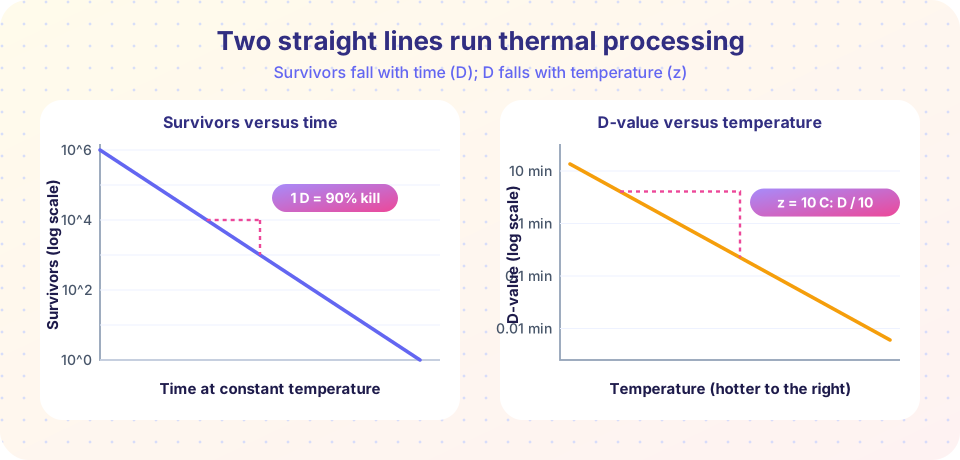
When a population of cells or spores is held at a lethal temperature, the number of survivors falls by the same fraction in each equal time interval. This is first-order kinetics, the same math as radioactive decay. Plotted on a log scale, survivors form a straight line. The time for the line to fall by one log cycle (to 10% of the starting number) is the decimal reduction time, or D-value:
log₁₀ N = log₁₀ N₀ − t / D
So after time t = n × D the population has fallen by n log cycles. If N₀ = 10⁶ spores per can and D = 1 min, then 6 minutes gives one survivor per can on average; 12 minutes gives one survivor in a million cans. The D-value depends on the organism (spores are far more resistant than vegetative cells), the temperature and the food (pH, fat, water activity and solutes change heat resistance).
Typical values (approximate, for illustration):
| Organism | Temperature | Approx. D-value |
|---|---|---|
| Salmonella (milk) | 60 °C | about 0.2-0.5 min |
| Listeria monocytogenes | 60 °C | about 1-3 min |
| C. botulinum spores (type A/B) | 121.1 °C | about 0.2 min |
| Geobacillus stearothermophilus spores | 121.1 °C | about 1-3 min |
Spore D-values show why spores are the design challenge: a few tenths of a minute at 121 °C, but the same spores survive hours of boiling at 100 °C.
The z-value: temperature dependence
Higher temperatures kill faster. Plot log₁₀ D against temperature and, over a useful range, you again get a straight line. The z-value is the number of degrees by which temperature must rise to cut D to one tenth:
D(T) = D_ref × 10^((T_ref − T) / z)
For spores of C. botulinum z is about 10 °C; for many vegetative cells it is 5-8 °C. If D₁₂₁.₁ = 0.2 min and z = 10 °C, then D₁₃₁.₁ = 0.02 min (10 times faster at 10 °C hotter), and D₁₁₁.₁ = 2 min. This is the engine of high-temperature short-time (HTST) processing: because lethality rises tenfold per 10 °C while the damage to color, flavor and vitamins rises much more slowly (nutrient and quality z-values are larger, typically 20-40 °C), a hotter, shorter process kills more microbes for the same quality loss.
The F-value and F₀
The F-value is the time at a reference temperature that delivers the same lethal effect as the actual process. For sterilization the standard reference is 121.1 °C (250 °F) with z = 10 °C, giving F₀:
F₀ = ∫ 10^((T(t) − 121.1) / 10) dt
The term L = 10^((T − 121.1)/10) is the lethal rate: 1 at 121.1 °C, 0.1 at 111.1 °C and 0.01 at 101.1 °C. Heating and cooling phases contribute, and F₀ is found by adding up lethal rates through time. For a process holding at 121.1 °C, F₀ equals the hold time.
The 12D botulinum concept
Clostridium botulinum is the organism of greatest concern in low-acid canned foods (pH above 4.6, aw above 0.85), because spores can germinate in the anaerobic can and make a deadly toxin. Regulators set a minimum botulinum cook that reduces the number of the most resistant spores by 12 log cycles (a "12D" process). Taking D₁₂₁.₁ ≈ 0.21 min, the minimum is F₀ = 12 × 0.21 ≈ 2.5 min. Commercial processes usually go well above this, with F₀ values between 3 and over 10 minutes, depending on spoilage organisms (such as Geobacillus stearothermophilus) and the product. The extra margin protects against spoilage rather than safety. Cooling must also be quick, and cans are sealed so that recontamination cannot occur.
Acid versus low-acid foods
The pH boundary of 4.6 (Chapter 3) divides canning into two worlds.
- Acid foods (pH ≤ 4.6: fruits, tomatoes with added acid, pickles, jams) cannot support botulinum, so spoilage organisms (yeasts, molds, acid-tolerant bacteria such as Alicyclobacillus) are the target. Heating in boiling water at about 100 °C or hot filling at 85-95 °C is enough.
- Low-acid foods (pH > 4.6: vegetables, meat, fish, soups, milk) must be sterilized in a retort, a pressure vessel, typically at about 116-130 °C (121 °C is the classic point), with F₀ targets above the botulinum minimum. Boiling water is not hot enough to kill spores in a reasonable time.
Commercial sterility does not mean zero organisms; it means no viable organisms able to grow under normal, non-refrigerated storage conditions and no pathogens or toxins. Some heat-resistant spores may survive but cannot germinate in the product.
Pasteurization and UHT
Pasteurization reduces the number of pathogens and many spoilage organisms enough to make food safe and extend shelf life, typically under refrigeration. Examples:
| Process | Typical conditions | Product |
|---|---|---|
| Low-temperature long-time (LTLT or batch) | 63 °C for 30 min | Milk, some small-scale operations |
| High-temperature short-time (HTST) | 72 °C for 15 s | Milk (US, many other countries) |
| Higher-heat shorter-time | 89-100 °C for 0.01-1 s | Some milks, creams |
| UHT (ultra-high temperature) | 135-150 °C for 2-5 s | Shelf-stable milk, creams, juices |
| Acid-food hot fill / tunnel pasteurization | 85-95 °C for tens of seconds to minutes | Juices, beer, sauces |
Milk pasteurization was designed with the hardest-to-kill pathogen of its time (first Mycobacterium tuberculosis, then Coxiella burnetii, the cause of Q fever) as the benchmark. A check of alkaline phosphatase activity, an enzyme destroyed slightly more easily than those organisms, confirms that proper pasteurization occurred. UHT milk, packaged aseptically in sterile packs, is commercially sterile and keeps for months unrefrigerated, with a slightly cooked flavor from Maillard reactions and whey protein denaturation.
Getting heat into the container
Heat travels into food by conduction (solid foods, thick pastes, where heat passes molecule to molecule) or convection (thin liquids, where currents move heat). In a conduction-heated can, the geometric center, the cold spot, heats last and slowest, and the process is calculated from its temperature. Heat penetration tests with thermocouples at the cold spot of the real container provide the data. Factors that slow penetration include larger containers, thicker or more solid contents, tight packing, headspace and lower starting temperature. Agitating retorts, flexible retort pouches (thin, so they heat quickly) and smaller cans all speed it. Because a can's cold spot can be many minutes behind the heating medium, a process designed only from the retort temperature would be unsafe.
Heat and quality
Heat harms quality: vitamin C and thiamin degrade, colors fade and textures soften. Because the z-values for these quality losses are typically larger than those for spore killing, shorter, hotter treatments protect quality better, which is why UHT and aseptic processing (sterilize the food and the container separately, then fill) beat long retort cycles for liquids. Challenges include fouling (protein deposits on hot surfaces) and the need for particles in the flow to receive enough heat. Chapter 5 covers equipment such as plate heat exchangers and retorts.
Common misconceptions
"Boiling sterilizes food." Boiling kills vegetative cells but not spores such as those of C. botulinum. "Pasteurized means sterile." Pasteurized foods contain surviving organisms and need refrigeration (unless also acidic or dry). "A shorter time at a hotter temperature is always worse for quality." Often it is better, because quality loss has a larger z-value. "Home canning of low-acid vegetables in a boiling-water bath is fine." It is not; use a pressure canner and tested recipes, or avoid it.
Try it
Press Run (or Ctrl + Enter) to see the result here.
Program input · what you'd type while the program runs
Type the answers before you press Run, one per line. Each time the program reads a line (with input()), it gets the next line from this box.
Press Run (or Ctrl + Enter) to see the result here.
Program input · what you'd type while the program runs
Type the answers before you press Run, one per line. Each time the program reads a line (with input()), it gets the next line from this box.
Press Run (or Ctrl + Enter) to see the result here.
Program input · what you'd type while the program runs
Type the answers before you press Run, one per line. Each time the program reads a line (with input()), it gets the next line from this box.
Press Run (or Ctrl + Enter) to see the result here.
Program input · what you'd type while the program runs
Type the answers before you press Run, one per line. Each time the program reads a line (with input()), it gets the next line from this box.
Check your understanding
Quick check · 7 questions
of 7 answered You scored / 7 · perfect!
-
1. A D-value of 2 minutes means...
One D-value is the time for one log (90 percent) reduction at a given temperature. -
2. A z-value of 10 °C means D falls by a factor of ten when temperature rises by...
z is the temperature rise that reduces D tenfold. -
3. A 12D process with D = 0.2 min gives F₀ of about...
12 × 0.2 = 2.4 min at the reference temperature. -
4. Why must low-acid canned foods be processed in a retort?
Spore destruction needs temperatures well above 100 °C, which requires pressure. -
5. Where is the cold spot of a conduction-heated can?
The center is farthest from the hot wall, so it heats last. -
6. What is the main idea behind UHT processing?
Microbial killing rises faster with temperature than quality loss, so hot-short is better. -
7. Commercial sterility means...
Some dormant survivors may exist but cannot grow in the product.
Summary
- Thermal death is first-order: survivors fall by one log per D-value; D falls tenfold per z degrees.
- F₀ expresses a process as equivalent minutes at 121.1 °C; the minimum botulinum cook is 12D, about 2.5 min, with practical processes higher.
- Acid foods (pH ≤ 4.6) can be heated at about 100 °C; low-acid foods need a retort; pasteurization is milder than sterilization; UHT uses very high temperature for seconds.
- The cold spot decides the process, and hotter-shorter treatments protect quality because quality has a larger z-value.
Next: Cold and drying
Track your progress
Create a free account to tick off lessons and pick up where you left off on any device.
of Food Science lessons completed