


















Lesson 26 of 45 · Processing Technology
Chapter 5 Review: Processing Technology
Review chapter 5 in one picture: unit operations, D, z and F values, heat penetration, emulsions, Stokes' law and HLB, with flashcards and a 9-question quiz.
You have now seen processing as a chain of unit operations, learned the arithmetic of heat treatment, and met the physics of emulsions. This review pulls the chapter into one picture, one table and one quiz. If a row of the table feels shaky, go back to the lesson linked beside it before you take the quiz.
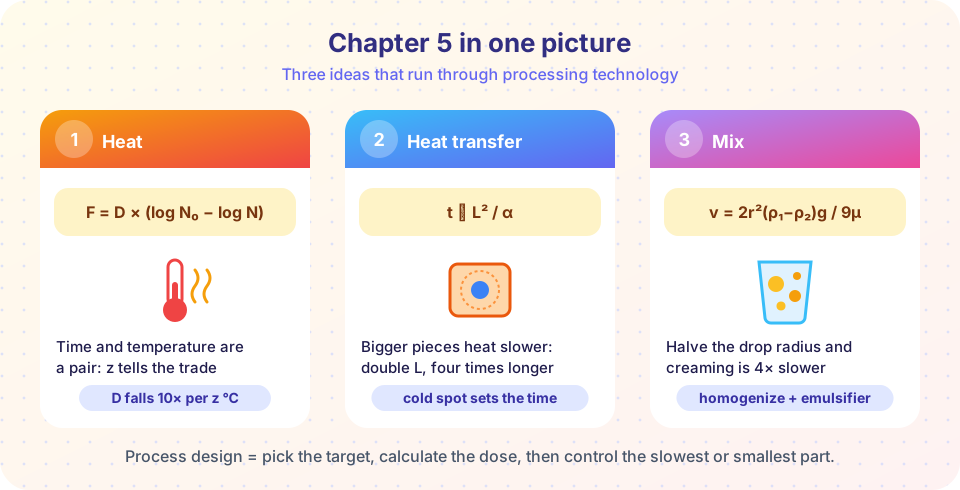
What you will learn
- Recall the main formulas of the chapter and when each applies.
- Link each idea to the lesson where it was developed.
- Test yourself with flashcards and a mixed 9-question quiz.
Key terms
Unit operation: one reusable processing step such as mixing, heating or drying.
D, z, F0: decimal reduction time, temperature change for a tenfold D change, and the lethality of a whole process at 121.1 °C.
Cold spot: the slowest-heating point of a container.
HLB: a 0 to 20 scale for an emulsifier's water-loving character.
Stokes' law: creaming speed is proportional to droplet radius squared.
Recap table
| Idea | Formula or rule | Remember | Lesson |
|---|---|---|---|
| Mass balance | in = out + accumulation | Track dry solids when drying | Overview |
| Log kill | log N = log N0 − t/D |
Survival is never exactly zero | Thermal |
| z value | D(T) = D_ref × 10^((T_ref − T)/z) |
z of spores is about 10 °C | Thermal |
| Lethal rate | L = 10^((T − 121.1)/10) |
F0 = area under L over time | Thermal |
| 12D cook | 12 × D at 121.1 °C | Low-acid foods, pH above 4.6 | Thermal |
| Conduction | t ∝ L²/α |
Double the size, four times slower | Thermal |
| HTST | Higher T, shorter time | Spores have smaller z than quality | Thermal |
| HLB blend | Weight-average of HLB values | 3–6 W/O, 8–18 O/W (rough) | Emulsions |
| Stokes | v = 2r²(ρ_c − ρ_d)g/9μ |
Halve r, creaming is 4× slower | Emulsions |
| Instability | Creaming, flocculation, coalescence, ripening | Coalescence cannot be shaken back | Emulsions |
Common misconceptions
"Heat treatment is a single number." It is a pair: a temperature and a time, linked by z, and measured at the cold spot.
"Homogenizing removes fat." It only shrinks the globules.
"I can add more emulsifier to fix anything." Too little emulsifier lets droplets merge, but the interface only holds a limited amount; the droplet size and continuous-phase viscosity matter too.
Try it
Flip the cards, think of your own answer first, then check. The cards are a revision aid, not a test of your whole understanding.
A quick calculator for the heat part of the chapter. It gives the lethal rate and the hold time that delivers a chosen F0 at each temperature (z = 10 °C).
Press Run (or Ctrl + Enter) to see the console output here.
No output.
Check your understanding
Quick check · 9 questions
of 9 answered You scored / 9 · perfect!
-
1. 100 kg of a product at 80 percent water is dried to 10 percent water. What mass of product results?
Solids are 20 kg. Final mass = 20 / 0.90 = 22.2 kg. -
2. D = 0.4 min. How many log reductions in 2 minutes?
Reductions = 2 / 0.4 = 5. -
3. Which temperature gives the highest lethal rate (z = 10 °C, reference 121.1 °C)?
L rises tenfold for every 10 °C above the reference, so the highest temperature has the highest L. -
4. Why can a thick purée in a can need much longer than clear soup?
Without convection currents the center heats by conduction, and time scales with size squared. -
5. Which statement about HTST is correct?
Hotter and shorter increases spore kill faster than it increases quality loss. -
6. Which is an oil-in-water emulsion?
Mayonnaise has oil droplets in a watery continuous phase. Butter and margarine are water-in-oil. -
7. Homogenization reduces fat globules from 4 µm to 1 µm diameter. By what factor does Stokes creaming speed fall?
Radius falls by four, so speed falls by four squared, which is 16. -
8. Which instability is irreversible?
Once droplet films break and droplets merge, shaking cannot separate them again. -
9. A blend of 50 percent emulsifier A (HLB 3) and 50 percent emulsifier B (HLB 13) has which HLB?
0.5 × 3 + 0.5 × 13 = 8.
Summary
- A process is a chain of unit operations; start with a mass balance and the key variable for each step.
- Heat: log kill, D, z, lethal rate and F0; low-acid foods get a 12D botulinum cook; the cold spot decides.
- Conduction time scales with size squared, which is why shape, size and agitation matter.
- HTST preserves quality because spore kill is more temperature-sensitive than quality loss.
- Emulsions need emulsifiers, small droplets (homogenization) and viscosity; coalescence is irreversible.
- Chapter 6 turns from making food to experiencing it: the science of taste, smell and texture.
Track your progress
Create a free account to tick off lessons and pick up where you left off on any device.
of Food Science lessons completed