


















Lesson 43 of 45 · Projects and Practice
Glossary of Food Science Terms (Chapters 5 to 9)
A searchable glossary of food science terms from processing, sensory science, nutrition and labeling, innovation and regulation, with short definitions and a term-matching game.
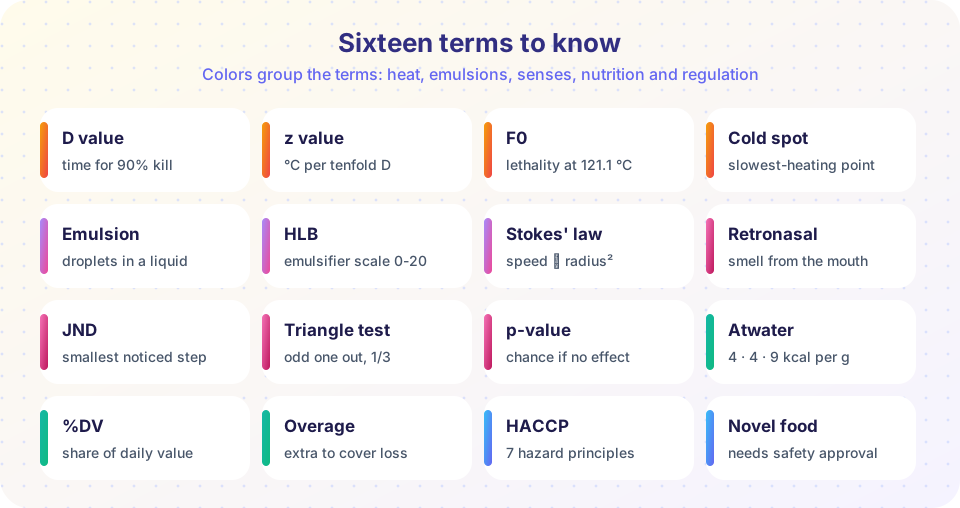
Every field has its own vocabulary, and food science borrows from physics, chemistry, biology, statistics and law. This glossary collects the terms from the second half of the course in alphabetical order, with a short definition for each and a pointer to the lesson that explains it. Use it for revision, search it in the interactive version below, and test yourself with the matching game.
What you will learn
- Recall short definitions of the main terms of chapters 5 to 9.
- Find the lesson where each idea is explained.
- Search and self-test with the interactive tools.
Key terms
Glossary: an alphabetical list of terms with definitions.
Definition: a short statement of what a term means; a good definition says what the thing is, not only what it does.
Spaced repetition: reviewing terms at growing intervals to remember them longer.
Glossary A to H
| Term | Meaning | Lesson |
|---|---|---|
| Accelerated shelf-life test | Storing food at higher temperature to see spoilage sooner and predict normal shelf life | Project |
| Activation energy (Ea) | The energy barrier of a reaction; larger values mean stronger temperature sensitivity | Project |
| Aseptic processing | Sterilizing the food and the package separately, then filling under sterile conditions | Thermal |
| Atwater factors | Average energy per gram: protein 4, carbohydrate 4, fat 9 kcal | Energy |
| Bioavailability | The share of a nutrient that is absorbed and used | Micronutrients |
| Bingham plastic | A material that needs a yield stress and then flows with constant viscosity | Texture |
| Codex Alimentarius | International food standards and codes from FAO and WHO | Law |
| Coalescence | Droplets merging after the film between them breaks; irreversible | Emulsions |
| Cold spot | The slowest-heating point of a container | Thermal |
| Commercial sterility | No organisms able to grow under normal storage, though not zero microbes | Thermal |
| Corrective action | A planned response when a critical limit is missed | Law |
| Creaming | Droplets rising because they are lighter than the liquid | Emulsions |
| Critical control point (CCP) | A step where control is essential to prevent a hazard | Law |
| Critical limit | The measurable value a control must meet at a CCP | Law |
| D value | Time at a temperature for a 90 percent (one log) reduction | Thermal |
| Daily Value (DV) | A reference amount used for %DV on US labels | Labels |
| Detection threshold | The weakest stimulus a person can notice | Overview |
| DIAAS | A protein quality score using digestibility of each amino acid, uncapped | Energy |
| Emulsifier | A molecule with water-loving and oil-loving ends that stabilizes droplets | Emulsions |
| Emulsion | Droplets of one liquid dispersed in another | Emulsions |
| Essential nutrient | One the body cannot make enough of, so it must come from food | Overview |
| F0 | Lethality of a heat process expressed as minutes at 121.1 °C (z = 10 °C) | Thermal |
| Flocculation | Droplets sticking in clusters while their films stay intact | Emulsions |
| Fortification | Adding nutrients to food | Micronutrients |
| GRAS | Generally recognized as safe: a US status for ingredients | Novel foods |
| HACCP | Hazard Analysis and Critical Control Points: a preventive safety system with seven principles | Law |
| Hazard | A biological, chemical or physical agent that can cause harm | Law |
| Herschel-Bulkley model | τ = τ₀ + K γ̇^n, a flow model with yield stress |
Texture |
| HLB | Hydrophilic-lipophilic balance, an emulsifier scale from 0 to 20 | Emulsions |
| Homogenization | Forcing an emulsion through a narrow gap to shrink droplets | Emulsions |
| HTST | High-temperature, short-time heat treatment | Thermal |
Glossary J to Z
| Term | Meaning | Lesson |
|---|---|---|
| Just-noticeable difference (JND) | The smallest change a person can notice | Overview |
| Lethal rate (L) | 10^((T − 121.1)/z): minutes at 121.1 °C per minute at T |
Thermal |
| Novel food | A food with no significant history of use, or from a new source or process, needing authorization | Novel foods |
| Ostwald ripening | Small droplets dissolve and the oil moves into larger ones | Emulsions |
| Overage | Extra nutrient added to cover storage losses | Micronutrients |
| p-value | Probability of a result at least this extreme if there were no difference | Testing |
| PDCAAS | Protein score from amino acids and digestibility, capped at 1.0 | Energy |
| Power | Probability that a test detects a real difference | Testing |
| Prerequisite programs | General hygiene and management conditions that support HACCP | Law |
| Q10 | Factor by which a rate rises for a 10 °C increase | Project |
| Retronasal smell | Aroma reaching the nose from the mouth during eating | Taste and smell |
| Scale-up | Moving a recipe from the laboratory to the factory | Innovation |
| Shear-thinning | Viscosity that falls as shear rate rises | Texture |
| Stage-gate | A development process of stages and decision gates | Innovation |
| Stevens' power law | Perceived intensity equals k times stimulus to the power n | Taste and smell |
| Stokes' law | Creaming speed grows with radius squared | Emulsions |
| Texture profile analysis | A two-bite compression test giving hardness, cohesiveness and more | Texture |
| Thixotropy | Viscosity that falls with stirring and recovers slowly at rest | Texture |
| Traceability | Ability to follow food one step back and one step forward | Law |
| Triangle test | Three samples, two alike, pick the odd one; chance is 1/3 | Testing |
| UHT | Ultra-high-temperature treatment, about 135 to 150 °C for seconds | Thermal |
| Viscosity | Resistance to flow, stress divided by shear rate, in Pa·s | Texture |
| Weber's law | JND is roughly a constant fraction of intensity | Overview |
| Yield stress | Minimum stress before a material flows | Texture |
| z value | Temperature rise that makes D ten times smaller | Thermal |
Common misconceptions
"A glossary is for memorizing." Definitions help only if you can use the term in a calculation or an explanation. Pair each term with an example.
"If I know the formula I know the term." The formula is one part. You also need the units, the assumptions and the situation where it applies.
Try it
A searchable glossary. Type part of a word or a definition to filter.
Now a matching game. A definition appears and you pick the term. It uses its own shorter list.
Check your understanding
Quick check · 4 questions
of 4 answered You scored / 4 · perfect!
-
1. Which term means droplets rising because they are lighter than the surrounding liquid?
Creaming is the rise of lighter droplets; Stokes' law describes its speed. -
2. What is a CCP?
CCPs are the steps in a HACCP plan where a hazard must be controlled. -
3. Which term describes extra nutrient added to cover storage loss?
Overage ensures that the label amount is still present at the end of shelf life. -
4. Q10 is best defined as:
Q10 summarizes the temperature sensitivity of a rate.
Summary
- The glossary covers heat processing, emulsions, sensory science, nutrition, labeling, regulation and shelf life.
- Each term is best learned with its formula, unit, assumption and an example.
- Use the lesson links to revisit the full explanation of any term.
- Active recall (searching, matching, explaining aloud) beats rereading.
Track your progress
Create a free account to tick off lessons and pick up where you left off on any device.
of Food Science lessons completed