


















Lesson 47 of 47 · Projects and Practice
Further Study: Where Statics Leads
A roadmap beyond statics: strength of materials, structural engineering, dynamics, fluid mechanics, materials and aerospace, with study tips and a choose-your-path tool.
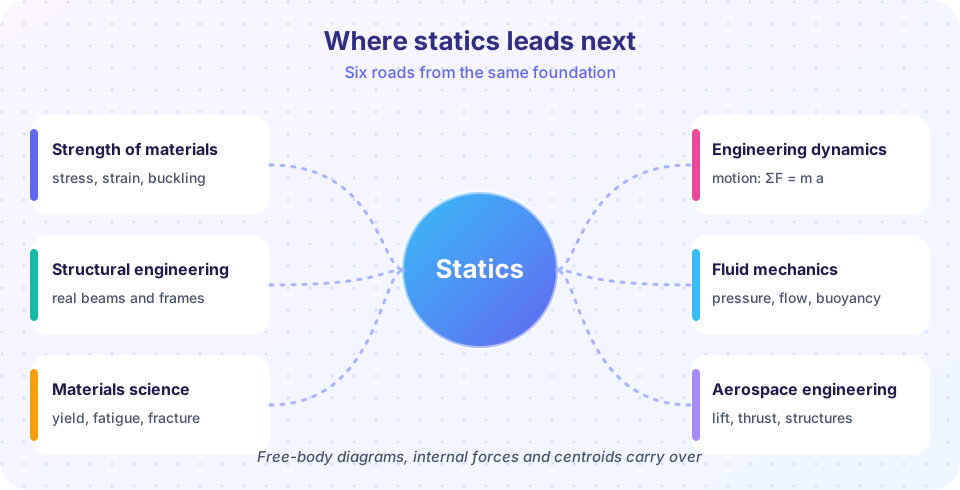
You now have the foundation of mechanical, civil and aerospace engineering. Statics answers one question: what forces must exist for a structure to stay still? The next courses ask what those forces do to the material, how fast things move when the forces do not balance, and how fluids and heat enter the picture. This last lesson shows you the map and helps you pick your next step.
What you will learn
- See how each later subject builds on a specific part of statics.
- Choose a study path that matches your goals.
- Plan how to keep your statics skills sharp.
Key terms
Stress: internal force per unit area, σ = F / A, the bridge from statics to strength.
Deflection: how far a structure bends or stretches under load.
Dynamics: the study of bodies that accelerate, where ΣF = m a replaces ΣF = 0.
Load path: the route by which a load travels through a structure to the ground.
Where each subject takes you
| Next subject | It builds on | What you gain |
|---|---|---|
| Strength of materials | Internal forces, centroids | Stress, strain, bending and shear stress, deflection, buckling, torsion |
| Structural engineering | Trusses, beams, frames | Design of real beams, columns, frames, and the load combinations in building codes |
| Engineering dynamics | Free-body diagrams, moments | Motion, ΣF = m a, energy, momentum, vibration |
| Fluid mechanics | Distributed loads, hydrostatic pressure | Flow, pipes, buoyancy, forces on submerged bodies |
| Materials science | Tension, compression, friction | Why metals yield, how composites work, fracture and fatigue |
| Civil engineering basics | Beams, trusses, loads | The full picture of buildings, bridges, foundations and construction |
| Aerospace engineering | Equilibrium, moments | Lift, thrust, structure of aircraft, stability |
| Physics: mechanics | Vectors, equilibrium | The physical principles behind all of the above |
The natural next step: strength of materials
Statics gives you N, V and M at every section of a beam. Strength of materials turns each into a stress: normal stress from the axial force, σ = N / A, bending stress σ = M y / I, shear stress from V. Then it asks whether the material can take it. The centroid calculations of chapter 6 now locate the neutral axis, and the I in the bending formula is built from the same table method. If you only study one thing next, study this.
For structural designers
Trusses and frames become real design problems: select a steel section, check buckling of compression bars, size connections, and combine dead, live, wind and snow loads. The statics you have learned finds the forces; structural engineering decides what to build to carry them.
For anything that moves
If forces do not balance, the body accelerates. Dynamics begins with exactly the free-body diagram you now draw instinctively, then replaces ΣF = 0 with ΣF = m a.
How to keep your skills sharp
- Solve a problem a day. Ten minutes of a free-body diagram beats an hour of reading.
- Look at structures. Cranes, bridges, shelves, bicycles: find the two-force members, the supports and the load path.
- Build a small model. Straws and pins make a truss; a ruler on two books is a beam.
- Check with code. Rewrite a hand solution in Python, as in this course; the code catches sign errors.
- Teach someone. Explaining a free-body diagram is the fastest way to find the gaps in your own understanding.
Common misconceptions
"Statics is only for civil engineers." Machine design, robotics, biomechanics, aerospace and even film set design all start with free-body diagrams.
"Once I know the formulas, I know statics." Exam and workplace problems differ in setup, not in formulas. Practice with new geometries.
"Computers made hand calculation obsolete." Software only solves what you set up. A quick hand check is what tells you when the model is wrong.
Try it
Press Run (or Ctrl + Enter) to see the result here.
Program input · what you'd type while the program runs
Type the answers before you press Run, one per line. Each time the program reads a line (with input()), it gets the next line from this box.
Check your understanding
Quick check · 4 questions
of 4 answered You scored / 4 · perfect!
-
1. Which subject turns the internal forces N, V and M into stresses?
Strength of materials uses σ = N/A, σ = My/I and shear formulas to convert statics results into stresses. -
2. Dynamics replaces ΣF = 0 with:
When forces do not balance, the body accelerates according to Newton's second law. -
3. Why is the centroid calculation of chapter 6 important later?
The neutral axis passes through the centroid, and the bending formula depends on it. -
4. What is a load path?
Following the load path is how engineers check that every part of a structure has a way to deliver its force.
Summary
- Statics feeds strength of materials, structures, dynamics, fluids, materials and aerospace.
- The free-body diagram, internal forces and centroids carry over directly.
- Keep practising: small problems, real structures, and code checks.
This is the end of the course. Return to the Engineering Statics course page any time to review a chapter.
Track your progress
Create a free account to tick off lessons and pick up where you left off on any device.
of Engineering Statics lessons completed