


















Lesson 2 of 47 · Getting Started
What statics studies: forces, rigid bodies and Newton's laws
Learn what statics is, how engineers idealize real objects as particles and rigid bodies, what a force really is, and why ΣF = 0 follows from Newton's laws.
Mechanics is the study of how forces affect motion. It splits into statics, where nothing accelerates, and dynamics, where things do. In statics the question is never "how fast?" but "how much force?" How hard does the wall push on a shelf? How much does each cable of a crane carry? Can the bolt hold? Because the answers do not depend on time, statics is the cleanest and most useful place to start engineering.
This lesson sets the vocabulary and the three ideas you will use in every problem: the idealized body, the force as a vector, and Newton's laws.
What you will learn
- The difference between statics and dynamics and what "equilibrium" means.
- How real objects are idealized as particles and rigid bodies.
- The four things that describe a force and the principle of transmissibility.
- How Newton's three laws lead to the equations ΣF = 0 and ΣM = 0.
Key terms
- Equilibrium: a state with no acceleration; the body is at rest or moves at constant velocity.
- Particle: an object whose size does not matter, so all forces act at one point.
- Rigid body: an object whose shape never changes, however large the forces.
- Force: a push or pull, described by magnitude, direction, sense and point of application.
- Line of action: the infinite straight line along which a force acts.
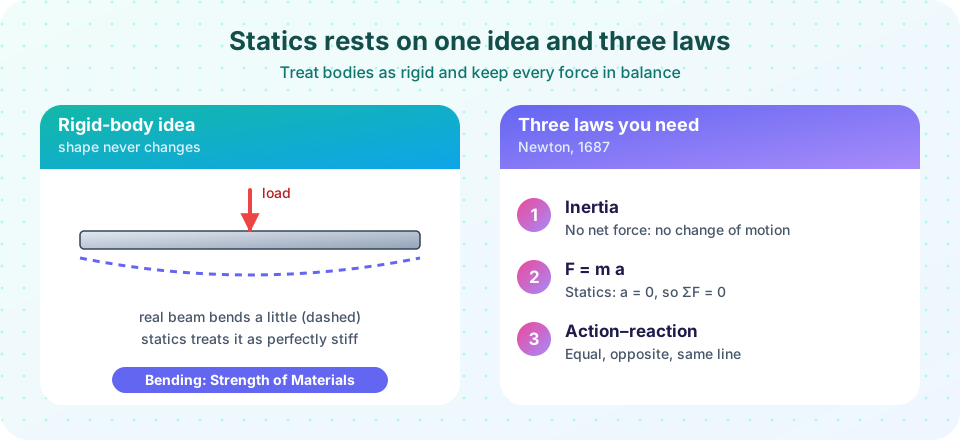
Idealizing the real world
Real objects bend, stretch and vibrate. If you tried to include all that, every problem would be impossible. Engineers therefore choose a model that keeps the essentials and drops the rest.
- Particle. A particle has mass but no size. A satellite seen from Earth, or a ring where several cables meet, can be treated as a particle. All forces then pass through one point, so you only need to balance forces (Chapter 3).
- Rigid body. A rigid body has size and shape, but the distance between any two of its points never changes. A steel beam under normal loads bends by a fraction of a millimeter, and for finding support reactions that tiny movement is irrelevant. Rigid bodies need both force and moment balance.
- Concentrated force. A force applied at one point. In reality a force always spreads over some area, but if the area is small compared with the body, a single arrow is a good model. A person standing on a bridge is a concentrated load; the weight of the bridge itself is a distributed load (Chapter 6).
The rigid-body model is not always valid. To find out how much a beam deflects or whether it breaks, you must model its deformation. That is the subject of strength of materials, which comes after statics.
What a force is
A force is a vector. To describe it completely you need four pieces of information:
- Magnitude in newtons (N).
- Direction, the line along which it acts, such as "30° above the horizontal".
- Sense, which way along that line: toward or away from the body.
- Point of application, where it touches the body.
In a drawing, the arrow's length is proportional to magnitude, its angle shows direction, its head shows sense and its tail (or tip) sits at the point of application. Forces come in two families. Contact forces act where bodies touch: a hand pushing, a rope pulling, the ground supporting. Body forces act at a distance through the whole volume. In statics the only body force you meet is gravity, which acts as weight at the body's center of gravity.
The principle of transmissibility
For a rigid body, a force can slide along its line of action without changing the effect on the body's equilibrium. Pushing a stalled car at the back or pulling it with a rope at the front along the same line gives the same result for the car as a whole. This is the principle of transmissibility. It fails the moment you slide the force sideways, because a different line of action produces a different turning effect. Try it below.
The first slider changes nothing: the readout stays put. The second slider changes the moment, because the line of action has moved. You will learn why in Chapter 4.
Newton's laws and the equations of equilibrium
Isaac Newton published his three laws in 1687.
- Inertia. A body stays at rest, or moves in a straight line at constant speed, unless a net force acts on it.
- F = m a. The net force on a body equals its mass times its acceleration. For rotation there is an equivalent statement for moments.
- Action and reaction. If body A pushes on body B, then B pushes back on A with an equal force along the same line in the opposite direction.
Statics is the special case where a = 0. The second law then becomes ΣF = 0: the vector sum of all forces is zero. The rotational version becomes ΣM = 0: the sum of the moments about any point is zero. These two equations are the engine of the whole course. The third law is just as important in practice: when you separate a structure into parts, the forces at the cut are equal and opposite on the two sides.
Checking equilibrium with a calculation
The program below sums the forces and the moments of a list of forces on a plate. It is a calculator that applies the formulas. A moment about the origin of a force (Fx, Fy) applied at (x, y) is x·Fy − y·Fx (counterclockwise positive).
Press Run (or Ctrl + Enter) to see the result here.
Program input · what you'd type while the program runs
Type the answers before you press Run, one per line. Each time the program reads a line (with input()), it gets the next line from this box.
The second case shows something important. The forces alone still add to zero, yet the plate would rotate. That is why we need both equations.
Common misconceptions
"Statics means nothing is happening." Plenty is happening: large forces flow through the structure. Only the motion is absent.
"If the forces add to zero, the body is in equilibrium." Not for a body with size. Two equal and opposite forces on different lines of action form a couple that spins the body.
"Weight and mass are the same." Mass is in kilograms. Weight is a force in newtons: W = m g.
Check your understanding
Quick check · 5 questions
of 5 answered You scored / 5 · perfect!
-
1. In statics, the acceleration of the body is
Statics deals with equilibrium, so a = 0 and Newton's second law gives ΣF = 0. -
2. Which description of a rigid body is correct?
A rigid body keeps its shape however large the forces are. Real bodies deform slightly, but the model ignores it. -
3. A force acts on a rigid body. Sliding the force along its line of action
This is the principle of transmissibility. -
4. The two forces in the second example add to zero in the vertical direction, yet the plate is not in equilibrium because
Force balance stops translation only; moment balance is also needed to stop rotation. -
5. Newton's third law says that
Action and reaction are equal, opposite and collinear, and they act on different bodies.
Summary
- Statics studies bodies in equilibrium (
a = 0), soΣF = 0andΣM = 0. - Real objects are modeled as particles or rigid bodies; bending is ignored.
- A force has magnitude, direction, sense and point of application.
- A force may slide along its line of action (transmissibility), never across it.
- Newton's third law lets you cut a structure and give equal, opposite forces to each piece.
Track your progress
Create a free account to tick off lessons and pick up where you left off on any device.
of Engineering Statics lessons completed