


















Lesson 19 of 47 · Moments and Couples
The moment vector and Varignon's theorem
Compute moments from components with x·Fy − y·Fx, apply Varignon's theorem, and use the cross product M = r × F in 3D, including the moment about a given axis.
In the previous lesson you found a moment as force times perpendicular distance. That is perfect when the geometry is simple. But often the force is inclined and the distance is awkward to see. Two methods remove the awkwardness: split the force into components (Varignon's theorem) and, in three dimensions, use the vector formula M = r × F. Between them you can handle any moment problem without drawing a perpendicular.
What you will learn
- The component formula
M_O = x F_y − y F_xand where it comes from. - Varignon's theorem: the moment of a force equals the sum of the moments of its components.
- The cross-product formula
M_O = r × Fand the meaning of the moment vector. - How to find the moment about a particular axis with a dot product.
Key terms
- Position vector
r: the vector from the moment point O to any point on the force's line of action. - Moment vector
M_O: a vector perpendicular to the plane ofrandF, with magnitudeF d. - Varignon's theorem: the moment of a force about a point equals the sum of the moments of its components about that point.
- Moment about an axis: the component of the moment vector along that axis.
- Right-hand rule: fingers curl in the direction of rotation, thumb gives the moment vector.
Components and Varignon's theorem
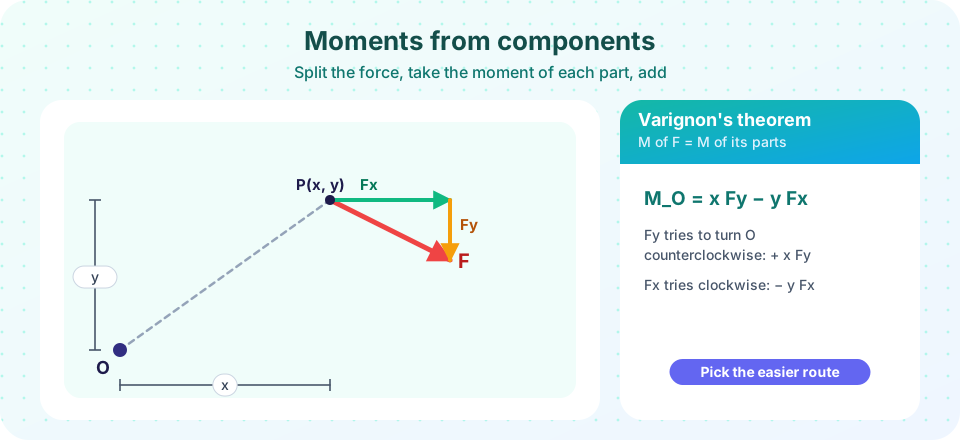
Place O at the origin and let the force act at point P = (x, y). Resolve F into Fx and Fy, both applied at P. The vertical component Fy has moment arm x (the horizontal distance to its line of action) and tends to turn the body counterclockwise if x and Fy are both positive. The horizontal component Fx has moment arm y and tends to turn it clockwise. Adding the two:
M_O = x F_y − y F_x
Varignon's theorem (named after the French mathematician Pierre Varignon) states that this sum equals the moment of the original force. Its proof is a one-liner: moments are linear in the force, so the moment of the sum equals the sum of the moments. The practical power is large. You never need to find the awkward perpendicular distance; you only need the coordinates of the point and the components of the force. And you can slide the force anywhere along its line of action and move to a point that makes one component pass through O.
Worked example. A force F = 300 i − 400 j N acts at the point (2, 5) m. Then
M_O = x Fy − y Fx = 2 × (−400) − 5 × 300 = −800 − 1500 = −2300 N·m
The negative sign means clockwise. The force has magnitude 500 N, so its moment arm is 2300/500 = 4.6 m, which you can confirm by finding the perpendicular distance from O to the force line.
Try moving the point along the force's line of action: the moment does not change. Change one coordinate by itself and it does.
The cross product: M = r × F
In three dimensions the moment is a vector:
M_O = r × F
with r running from O to any point on the line of action of F. Its magnitude is r F sin θ, which is F d because r sin θ = d, and its direction is perpendicular to the plane containing r and F, given by the right-hand rule. The determinant form, with r = (x, y, z) and F = (Fx, Fy, Fz), is
M_O = (y Fz − z Fy) i + (z Fx − x Fz) j + (x Fy − y Fx) k
The k component is exactly the 2D formula, so the plane result is a special case. Notice that the three components of M_O are the moments about the x, y and z axes.
Worked example. r = 2 i + 3 j + 4 k m and F = 10 i − 20 j + 30 k N.
- i:
y Fz − z Fy = 3 × 30 − 4 × (−20) = 170 - j:
z Fx − x Fz = 4 × 10 − 2 × 30 = −20 - k:
x Fy − y Fx = 2 × (−20) − 3 × 10 = −70
So M_O = 170 i − 20 j − 70 k N·m. Its magnitude is √(170² + 20² + 70²) = 185 N·m.
Moment about an axis
Sometimes you need only the part of the moment that tends to turn a body about one particular line, like a hinge axis. If u is the unit vector along the axis,
M_axis = u · (r × F)
a scalar that is positive if the rotation is right-handed about u. For u = 0.6 i + 0.8 j: M = 0.6 × 170 + 0.8 × (−20) = 102 − 16 = 86 N·m.
Press Run (or Ctrl + Enter) to see the result here.
Program input · what you'd type while the program runs
Type the answers before you press Run, one per line. Each time the program reads a line (with input()), it gets the next line from this box.
The third print shows that sliding the point of application along the force's line of action leaves r × F unchanged, because the extra piece 0.5 F is parallel to F and F × F = 0.
When to use which method
| Situation | Best method |
|---|---|
| Force perpendicular to a lever | F d |
| Inclined force, easy coordinates | x Fy − y Fx (Varignon) |
| Any 3D geometry | r × F |
| Moment about a hinge axis | u · (r × F) |
Common misconceptions
"r must be the vector to the point where the force touches the body." Any point on the line of action works; the cross product does not change.
"The moment vector points in the direction of the force." It is perpendicular to both r and F.
"Varignon only works for two components." It works for any number of forces or components.
Check your understanding
Quick check · 4 questions
of 4 answered You scored / 4 · perfect!
-
1. A force F = 50 j N acts at the point (4, 0) m. What is M_O?
M = x Fy − y Fx = 4 × 50 − 0 = 200 N·m, counterclockwise. -
2. r = 3 i m and F = 10 k N. What is r × F?
i × k = −j, so 3 × 10 × (−j) = −30 j N·m. -
3. What does Varignon's theorem say?
It follows from the linearity of the moment in the force. -
4. You slide the point of application of a force along its line of action. What happens to r × F?
The added part of r is parallel to F, and F × F = 0.
Summary
- 2D:
M_O = x Fy − y Fx, counterclockwise positive; this is Varignon's theorem in action. - 3D:
M_O = r × F, a vector perpendicular torandF; its components are moments about x, y, z. - Moment about an axis:
M_axis = u · (r × F). - Any point on the line of action may be used for
r.
Next: Couples
Track your progress
Create a free account to tick off lessons and pick up where you left off on any device.
of Engineering Statics lessons completed