


















Lesson 26 of 47 · Trusses and Frames
Frames and Machines
Analyze pin-connected frames and machines by taking them apart: two-force members, multi-force members, Newton's third law at pins, pliers and an A-frame worked.
A truss has only two-force bars. Real structures are not so tidy. A crane arm carries a load along its length, a pair of pliers has handles loaded at one end and jaws at the other, and a garden step ladder has legs that carry the person's weight halfway up. All of these are frames (rigid structures that carry loads at points other than the joints) or machines (frames with moving parts that change the size or direction of a force).
The key is to take the structure apart. You will draw a separate free-body diagram for each piece, and the forces at the pins between pieces appear in equal and opposite pairs, thanks to Newton's third law.
What you will learn
- Tell a two-force member from a multi-force member.
- Draw free-body diagrams of each part with equal and opposite pin forces.
- Solve a machine for the output force.
- Solve a three-pin A-frame for the support reactions and the pin forces.
Key terms
Two-force member: a member with forces only at two points and no couples; the forces must be equal, opposite and along the line joining the points.
Multi-force member: a member with three or more forces (or a couple); the forces can point in any direction.
Frame: a structure designed to stay put (a stepladder, a shelf bracket).
Machine: a structure with moving parts that transmits or changes force (pliers, a jack, a crane).
Spot the two-force members first
Before you write a single equation, scan the structure for members that are pinned at two points only, with no load in between. They carry a force along the line between the pins. That one observation fixes the direction of the force, so it cuts an unknown from the problem.
For example, a short hydraulic cylinder pinned at both ends of an excavator arm is always a two-force member, however the arm is positioned. A bar with a load in the middle is not.
Rules for a clean analysis
- Draw the free body of the whole structure and find the external reactions, if they are determinate.
- Disassemble into pieces at the pins.
- Draw each piece separately and show all forces on it: loads, reactions, and pin forces.
- For a pin shared by two members, the forces on the two members are equal and opposite. Assign a direction to each component on one member and the opposite direction on the other.
- Where a load is applied directly to a pin, decide which member it is attached to (or treat the pin as a separate body) and stay consistent.
- Use
ΣFx,ΣFy,ΣMon each multi-force member, and the line-of-action condition on two-force members.
Machine example: a pair of pliers
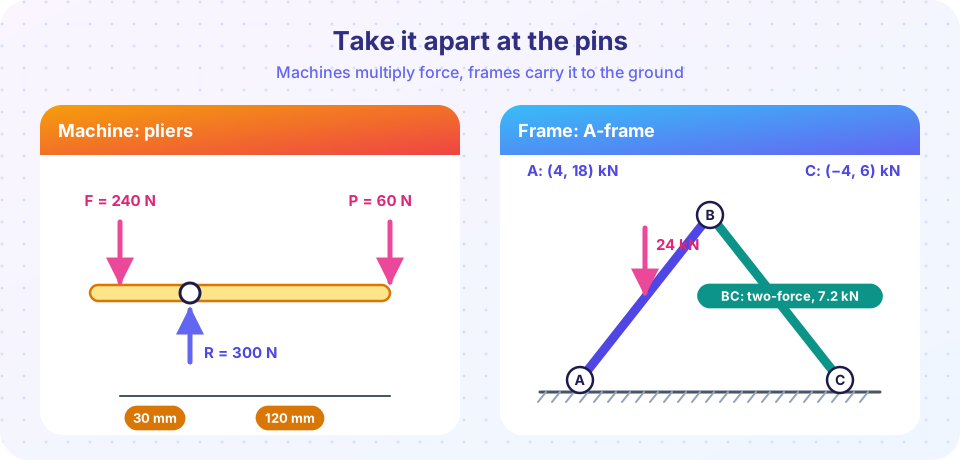
Squeeze the handles of a pair of pliers with P = 60 N each, at a distance of 120 mm from the pivot pin. The jaws grip at 30 mm from the pivot. What gripping force F does the jaw apply, and what is the force on the pivot pin?
Free body of one member (handle plus jaw, crossing at the pivot): the handle force P acts at 120 mm on one side, the grip force F at 30 mm on the other side, and the pin force R acts at the pivot. Because the members cross at the pin, P and F both point the same way and the pin supplies the balancing force.
ΣM_pin = 0:   P × 120 - F × 30 = 0   ->   F = 60 × 120 / 30 = 240 N
ΣF = 0:       R = P + F = 60 + 240 = 300 N
The pliers multiply the force by the lever ratio, 120 / 30 = 4. The price is motion: the jaws move only a quarter as far as your hand. The pin, however, has to carry the full 300 N, which is why pivot pins are strong.
Frame example: a three-pin A-frame
An A-frame has two members, AB and BC, pinned together at B and pinned to the ground at A (0, 0) and C (4, 0). The apex B is at (2, 3). A load of 24 kN acts vertically downward at the middle of AB, at (1, 1.5). Find the reactions at A and C and the pin force at B.
Spot the two-force member. BC has pins at B and C and no load between them, so the force in BC acts along the line CB. Call its size F, directed from C toward B for a compression bar. The direction of CB is (-2, 3) over a length of √13.
Free body of AB. AB carries the 24 kN load, the force from BC at B, and the reaction at A. Take moments about A to remove the unknown reaction:
Force from BC at B: (-2, 3) F / √13, acting at (2, 3)
Moment of this force about A: 2 × (3F/√13) - 3 × (-2F/√13) = 12 F / √13
Moment of the load about A:  -24 × 1 = -24 kN·m
ΣM_A = 0:  12 F / √13 - 24 = 0   ->   F = 2√13 = 7.21 kN (compression in BC)
The components of this force are (-4, 6) kN. Now the reaction at C is that same size pointing along CB: Cx = -4 kN, Cy = +6 kN. Return to AB:
ΣFx:  Ax - 4 = 0        ->   Ax = +4 kN
ΣFy:  Ay + 6 - 24 = 0   ->   Ay = +18 kN
Check against the whole frame: Ay + Cy = 24 ✓ and Ax + Cx = 0 ✓. The pin at B passes (-4, 6) kN onto AB and the opposite (4, -6) onto BC.
Try it
Press Run (or Ctrl + Enter) to see the result here.
Program input · what you'd type while the program runs
Type the answers before you press Run, one per line. Each time the program reads a line (with input()), it gets the next line from this box.
Press Run (or Ctrl + Enter) to see the result here.
Program input · what you'd type while the program runs
Type the answers before you press Run, one per line. Each time the program reads a line (with input()), it gets the next line from this box.
Common misconceptions
"A pin force can be drawn in either direction on both members." It cannot. If you draw Bx to the right on AB, you must draw it to the left on BC.
"Every member in a frame is a two-force member." Only members loaded at two points. A bar with a load in the middle carries bending.
"A distributed load can sit anywhere on a pin." A load on a pin must be assigned to one member (or the pin treated as a separate free body); doing neither double-counts it.
Check your understanding
Quick check · 4 questions
of 4 answered You scored / 4 · perfect!
-
1. What defines a two-force member?
With forces at only two points and no couples, equilibrium forces must be equal, opposite and collinear along the line between the pins. -
2. At a pin joining members 1 and 2, the force on member 1 is (4, -6) kN. The force on member 2 is:
Newton's third law: action and reaction are equal and opposite. -
3. A pair of pliers has a handle arm of 100 mm and a jaw arm of 25 mm. A hand force of 50 N gives a jaw force of:
F = P × 100 / 25 = 200 N, because the lever ratio is 4. -
4. In the A-frame example, why is the force in BC along the line CB?
BC has pins at B and C only and no load between them, so its force must act along the line joining the pins.
Summary
- Frames and machines contain multi-force members, so you must separate the pieces.
- Find two-force members first: their force direction is known.
- Pin forces on two members are equal and opposite.
- Solve each piece with
ΣFx,ΣFy,ΣM, then check against the whole structure.
Track your progress
Create a free account to tick off lessons and pick up where you left off on any device.
of Engineering Statics lessons completed