


















Lesson 27 of 47 · Trusses and Frames
Review: Trusses and Frames
Chapter 5 recap in one picture: method of joints, method of sections, zero-force members, frames and machines, with a recap table and a 9-question check.
You can now analyze structures made of bars and pins. This review puts the whole chapter on one page, gives you a recap table and then tests you with a mixed quiz.
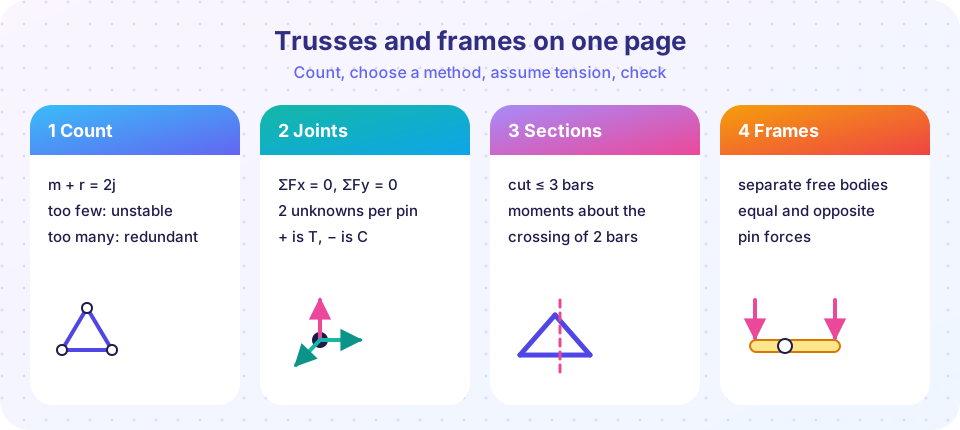
Recap table
| Topic | Key idea | Equation or rule |
|---|---|---|
| Determinacy | Enough bars, not too many | m + r = 2j |
| Method of joints | Each pin is a concurrent system | ΣFx = 0, ΣFy = 0 at each joint |
| Sign convention | Assume tension | Positive = T, negative = C |
| Zero-force bars | Unloaded joint, 2 bars, or 3 bars with 2 collinear | Third bar = 0 |
| Method of sections | Cut through at most 3 unknown bars | ΣM about the point where two bars meet |
| Chord force | Moment divided by depth | F ≈ M / h |
| Two-force member | Pinned at two points, no load between | Force along the line joining the pins |
| Pin pairs | Third law | Equal and opposite on the two members |
| Machine ratio | Lever arms | F_out = F_in × arm_in / arm_out |
Worked numbers to remember
For the 12 m truss with a 36 kN load at F: Ay = 12 kN, Dy = 24 kN; bottom chord forces 16, 32, 32 kN tension; top chord EF = 16 kN compression; FD = 40 kN compression; BF = 20 kN compression; BE = 12 kN tension; CF = 0.
Press Run (or Ctrl + Enter) to see the result here.
Program input · what you'd type while the program runs
Type the answers before you press Run, one per line. Each time the program reads a line (with input()), it gets the next line from this box.
Press Run (or Ctrl + Enter) to see the result here.
Program input · what you'd type while the program runs
Type the answers before you press Run, one per line. Each time the program reads a line (with input()), it gets the next line from this box.
Check your understanding
Quick check · 9 questions
of 9 answered You scored / 9 · perfect!
-
1. A truss has 15 bars, 9 joints and 3 reaction components. Is it determinate?
m + r = 18 and 2j = 18, so the equation count is balanced. -
2. In the method of joints, how many independent equations does one pin give?
Forces are concurrent, so only the two force equations are independent. -
3. A bar force comes out as +30 kN. What is the bar doing?
We took tension as positive, so +30 kN is tension. -
4. At an unloaded joint, bars AB and BC are collinear and a third bar BD is not. What is the force in BD?
No other force can balance a component of BD perpendicular to the collinear bars. -
5. To find a top chord force with a section, take moments about:
That point lies on the lines of action of the other two bars, so only the top chord has a moment. -
6. What does a section method need that the joints method does not?
A cut separates the truss into two rigid bodies, so you use ΣFx, ΣFy and ΣM on one of them. -
7. A pair of pliers has arms of 150 mm and 30 mm. A hand force of 40 N gives a jaw force of:
F = 40 × 150 / 30 = 200 N. -
8. At a pin between members 1 and 2, the force on member 2 is (0, 5) kN. The force on member 1 is:
Third law again: equal magnitude, opposite direction. -
9. A member has pins at two points and a load in the middle. What is it?
A load between the pins means three forces: it carries bending as well as axial force.
Summary
- Count first (
m + r = 2j), then choose joints for everything or sections for a few bars. - Assume tension; the sign tells the truth.
- Frames and machines need separate free bodies; pin forces appear in equal and opposite pairs.
- Chord forces follow the bending moment; zero-force bars still brace the structure.
Track your progress
Create a free account to tick off lessons and pick up where you left off on any device.
of Engineering Statics lessons completed