


















Lesson 13 of 47 · Equilibrium of Particles and Bodies
Free-body diagrams and support reactions
Learn to draw a correct free-body diagram: reactions for cables, rollers, pins and fixed supports, two-force members, 3D supports and how to count unknowns.
Ask any statics instructor what causes the most lost marks and the answer is the same: a wrong or missing free-body diagram. Once the diagram is right, the equations are mechanical. This lesson is a field guide to drawing it: which force each type of support can supply, how to treat members that carry load only along their axis, and how to tell whether a problem has enough equations to be solved.
What you will learn
- The rule that links a support's motion it prevents to the reaction it provides.
- The reactions of cables, smooth surfaces, rollers, pins, fixed supports and links.
- How to recognize and use two-force members.
- How to count unknowns and equations to test whether a problem is solvable.
Key terms
- Reaction: a force or moment a support applies to prevent a motion.
- External force: a force from outside the isolated body (loads, weight, reactions).
- Two-force member: a member loaded only at two points, with no loads in between and negligible weight; it can only carry force along the line joining the two points.
- Statically determinate: the unknowns can all be found from the equilibrium equations alone.
- Redundant constraint: a support beyond the minimum needed to hold the body.
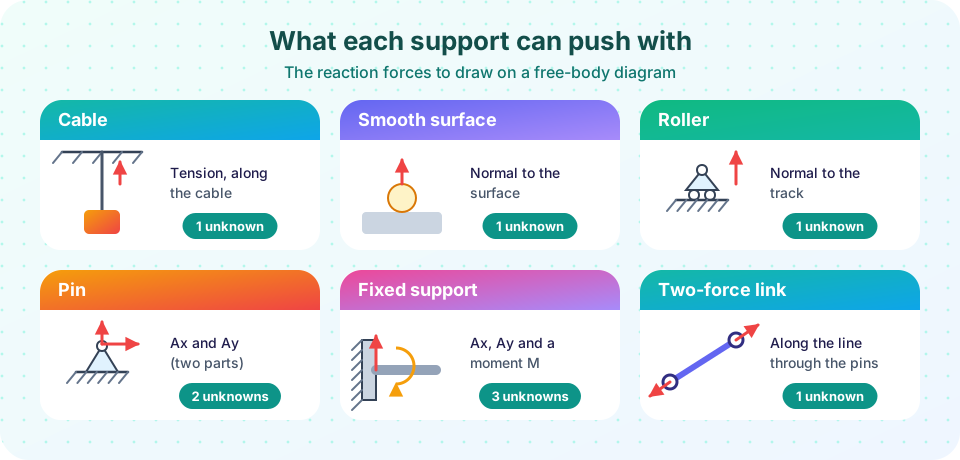
The golden rule of reactions
A support exerts a force in each direction in which it prevents translation, and a moment if it prevents rotation.
A roller lets the body slide along the track, so it exerts no force along the track, only perpendicular to it. A pin prevents the point from moving in any direction in the plane but lets the body spin, so it gives two force components and no moment. A fixed (built-in) support blocks everything, so it gives two components and a moment.
| Support in 2D | Prevents | Unknowns | Drawn as |
|---|---|---|---|
| Cable, rope, chain | Moving away along the cable | 1 | Pulling force along the cable |
| Smooth surface or roller | Moving into the surface | 1 | Force perpendicular to the surface |
| Rocker, roller on a track | Moving perpendicular to the track | 1 | Perpendicular force |
| Pin or hinge | Any translation | 2 | Ax and Ay (or magnitude and angle) |
| Fixed support | Translation and rotation | 3 | Ax, Ay and a moment M |
| Two-force link | Motion along its own line | 1 | Force along the line of the link |
| Rough surface | Slip as well as penetration | 2 | Normal force and friction force |
Friction is only a possible reaction: the friction force is at most μ N, as Chapter 7 shows.
Two-force members
A member that is pinned at two points, carries no load between them and ignores its own weight, is in equilibrium under just two forces. For two forces to cancel they must be equal, opposite and have the same line of action, so that line must pass through both pins. This is a huge shortcut: even though a pin can exert two components, the member's force direction is already known, so only its magnitude is unknown. Truss bars are the classic example, and so are the hydraulic cylinders on a digger. If a straight bar has an intermediate load, or if a bar is bent and loaded elsewhere, the shortcut is lost.
How to draw a free-body diagram
- Isolate the body: imagine a closed curve around it, cutting free from everything.
- Show the applied loads with their true directions, magnitudes and points of application.
- Show the weight
W = m gat the center of gravity, unless the problem says to ignore it. - Replace each connection you cut with its reactions, using the table. Draw reactions you do not know with a guessed sense and label them with letters.
- Add dimensions and angles needed for moments and components.
- Check each cut support against the table: have you drawn exactly as many reactions as unknowns?
Only forces on the body belong on its FBD. Do not draw forces the body exerts on others (those are the reaction partners, drawn on their diagrams), and do not draw internal forces between parts that remain inside your cut. When you separate two connected bodies, apply Newton's third law: the pin force on one is equal and opposite to the pin force on the other.
Support explorer
Pick a support and see which reactions it supplies.
Counting unknowns: is the problem solvable?
For a single rigid body in a plane there are three equations. Compare them with the number of unknown reactions r:
r = 3, properly arranged: statically determinate. Solve with equilibrium alone.r > 3: statically indeterminate (redundant). Equilibrium is not enough; you need material properties, as strength of materials shows.r < 3: partially constrained. Under general loads the body will move, so it is not in equilibrium.
Even with r = 3 the supports must be properly arranged. If all three reaction lines are parallel (three vertical rollers) or all pass through one point, the body can still move or rotate: the constraints are improper.
Press Run (or Ctrl + Enter) to see the result here.
Program input · what you'd type while the program runs
Type the answers before you press Run, one per line. Each time the program reads a line (with input()), it gets the next line from this box.
Supports in three dimensions
In 3D the same rule applies with six possible motions (three translations, three rotations). A ball-and-socket joint gives three force components. A fixed support gives three forces and three moments. A hinge (one rotation allowed) gives three forces and two moments. A smooth roller on a surface gives one force. These are used in three-dimensional equilibrium.
Common misconceptions
"The pin force is along the member." Only if the member is a two-force member. In general a pin force has both components.
"I should draw the force the body exerts on the support." The FBD of the body shows the force the support exerts on the body.
"Weight can be ignored because the problem says nothing." Unless told otherwise, heavy members have weight at their center of gravity. Light cables and trusses bars are often declared weightless.
Check your understanding
Quick check · 5 questions
of 5 answered You scored / 5 · perfect!
-
1. How many reaction components does a pin support provide in a plane?
A pin blocks translation in both directions but allows rotation, giving Ax and Ay. -
2. A roller on a horizontal track exerts a reaction that is
It cannot resist motion along the track, so the force is perpendicular to it (vertical). -
3. A straight bar is pinned at both ends and loaded only at the pins. The force in the bar acts
Two forces in equilibrium must be equal, opposite and collinear. -
4. A beam rests on one pin and two rollers. How many unknowns versus equations?
Pin (2) + two rollers (1 each) = 4 unknowns, one more than the three equations. -
5. A cantilever beam is built into a wall. How many reactions does the wall supply?
In 2D a fixed support supplies Ax, Ay and a moment M.
Summary
- A support supplies a force for each translation it blocks and a moment for each rotation it blocks.
- Cable 1, roller 1, link 1, pin 2, fixed 3 (in 2D).
- Two-force members carry force only along the line between their pins.
- Compare unknowns with equations; improper constraints can still fail.
Track your progress
Create a free account to tick off lessons and pick up where you left off on any device.
of Engineering Statics lessons completed