


















Lesson 3 of 47 · Getting Started
Units, accuracy and significant figures
Master the SI units used in statics, convert between SI and US customary, check answers with dimensions, and report results with sensible significant figures.
A statics answer is only useful if it carries the right unit and the right number of digits. In 1999 a spacecraft was lost partly because one team's software produced thrust in pound-force seconds while another team's software expected newton seconds. The physics was right; the units were not. This lesson gives you habits that make that kind of mistake rare, and shows how many digits an answer deserves.
What you will learn
- The SI units for length, mass, time, force, moment and pressure, and the common prefixes.
- How to compute weight from mass and convert to and from US customary units.
- How to use dimensional homogeneity to catch errors.
- How to round to significant figures and why you should not round early.
Key terms
- SI: the International System of Units, used by engineers worldwide.
- Newton (N): the force that gives 1 kg an acceleration of 1 m/s², so
1 N = 1 kg·m/s². - Dimensional homogeneity: every term in an equation must have the same units.
- Significant figures: the digits that carry real information in a measured or given value.
- Pascal (Pa): the unit of pressure and stress,
1 Pa = 1 N/m².
SI units in statics
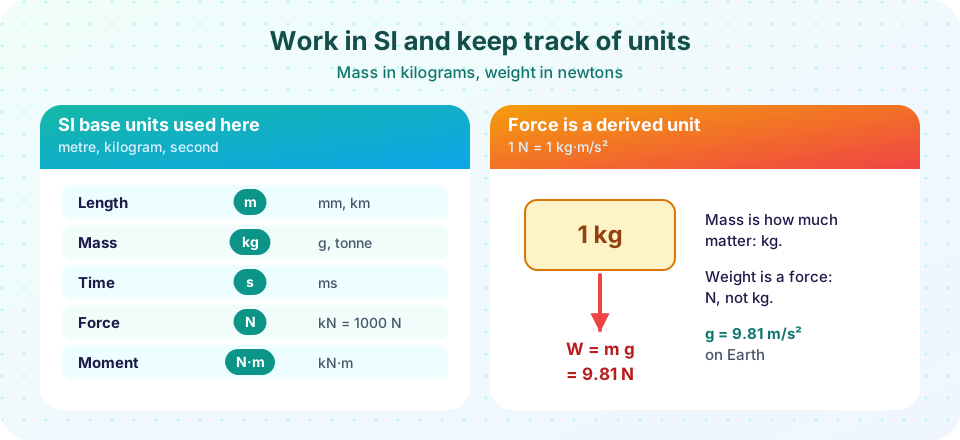
The SI system rests on base units. Four matter here: meter (m) for length, kilogram (kg) for mass, second (s) for time and, for electricity or temperature, others you will not need. Everything else is derived.
| Quantity | Unit | Symbol | In base units |
|---|---|---|---|
| Force | newton | N | kg·m/s² |
| Moment (torque) | newton meter | N·m | kg·m²/s² |
| Pressure, stress | pascal | Pa | N/m² |
| Distributed load | newton per meter | N/m | kg/s² |
| Angle | radian or degree | rad, ° | dimensionless |
Prefixes scale units by powers of 1000, and engineers prefer those steps: kilo (k) = 10³, mega (M) = 10⁶, giga (G) = 10⁹, milli (m) = 10⁻³, micro (μ) = 10⁻⁶. So 4.2 kN = 4200 N, 25 mm = 0.025 m, and 200 GPa is the stiffness of steel. Careful with capital and small letters: mN is a millinewton, MN is a meganewton, a factor of a billion apart.
Mass versus weight
Mass (kg) measures how much matter a body has and does not change from place to place. Weight is the gravitational force on that mass and is measured in newtons:
W = m g, with g = 9.81 m/s² near Earth's surface (the standard value is 9.80665 m/s²).
A person of mass 75.0 kg weighs 75.0 × 9.81 = 735.75 N, which we report as 736 N or 0.736 kN. On the Moon (g ≈ 1.62 m/s²) the same person has the same mass but weighs about 122 N. Everyday speech says "my weight is 75 kilograms", but in a statics problem you must convert mass to newtons before you put it on a free-body diagram.
US customary units
Many industries still use pounds and feet. The key facts are exact definitions:
1 ft = 0.3048 mand1 in = 25.4 mm.1 lb(pound-mass)= 0.45359237 kg.1 lbf(pound-force, the weight of one pound-mass in standard gravity)= 4.4482216 N.1 kip = 1000 lbf = 4.448 kN, and1 ksi = 6.895 MPa.
The safe method is to convert every input to SI at the start, work in SI and convert the final answer back if the client demands it. Mixing systems midway is how errors creep in.
Press Run (or Ctrl + Enter) to see the result here.
Program input · what you'd type while the program runs
Type the answers before you press Run, one per line. Each time the program reads a line (with input()), it gets the next line from this box.
Dimensional homogeneity
Every valid physical equation is dimensionally homogeneous: you may only add or equate quantities with the same units. Moment is force times distance, N·m. If you ever write "forces plus moments", something is wrong. Check as you work:
ΣFy = 0has all terms in newtons.ΣM = 0has all terms in newton meters.- A formula for a reaction such as
RB = P a / Lhas unitsN × m / m = N, as it should.
This check is quick and catches forgotten lengths, misplaced factors and wrong formulas. A result that has the wrong unit is certainly wrong. One with the right unit may still be wrong, but you have removed a whole class of mistakes for free.
Significant figures and accuracy
Input data in engineering problems are rarely exact. A load given as 600 N probably is not 600.000 N. Significant figures (s.f.) show how much you can trust a number.
- All non-zero digits count:
4.25has 3 s.f. - Zeros between digits count:
4.05has 3 s.f. - Leading zeros do not:
0.0042has 2 s.f. - Trailing zeros after a decimal point count:
4.20has 3 s.f. A number like600is ambiguous; write6.00 × 10²or0.600 kNto show 3 s.f.
Practical rules for statics:
- Report final answers to three significant figures unless the data are clearly less precise. Engineering data are seldom better than 0.1 percent.
- Carry extra digits (at least four, or all your calculator keeps) through intermediate steps. Round only the final answer. Rounding early makes errors pile up.
- Do not report more digits than the data justify. If a length is given as 2.5 m (2 s.f.), an answer of 1.7678 N is false precision.
Why precision of angles matters
Angles are the most sensitive inputs. For the horizontal component F cos θ, a small angle error Δθ changes the result by about tan θ × Δθ (in radians) in relative terms. At θ = 60°, a 1° error moves the result by 1.732 × 0.01745 ≈ 3.0 %. Near 0° it hardly matters; near 90° it explodes. So measure steep angles carefully.
Press Run (or Ctrl + Enter) to see the result here.
Program input · what you'd type while the program runs
Type the answers before you press Run, one per line. Each time the program reads a line (with input()), it gets the next line from this box.
The next program shows a significant-figures helper and the effect of rounding too early.
Press Run (or Ctrl + Enter) to see the result here.
Program input · what you'd type while the program runs
Type the answers before you press Run, one per line. Each time the program reads a line (with input()), it gets the next line from this box.
Common misconceptions
"kg is a unit of force." It is a unit of mass. A force of 100 "kilograms" really means a weight of about 981 N.
"More digits always means more accuracy." A calculator can print twelve digits, but only the digits supported by your data are meaningful.
"I can round each step to keep numbers tidy." Round only at the very end; early rounding is a common cause of answers that are slightly off.
Check your understanding
Quick check · 5 questions
of 5 answered You scored / 5 · perfect!
-
1. What is the weight of a 40.0 kg mass on Earth (g = 9.81 m/s²)?
W = m g = 40.0 × 9.81 = 392.4 N, reported as 392 N to 3 s.f. -
2. Which expression has the units of a moment?
Moment is force times distance, so newton meters. -
3. How many significant figures are in 0.00450?
Leading zeros do not count; 4, 5 and the trailing 0 after the decimal point do. -
4. When should you round in a multi-step calculation?
Keep extra digits through the steps and round the final answer. -
5. A student adds 120 N to 35 N·m. What does this tell you?
You cannot add a force and a moment. Check the setup.
Summary
- Use SI: m, kg, s, N, N·m, Pa; prefixes step by 1000.
- Weight is a force:
W = m gwithg = 9.81 m/s². - Convert US units at the start (
1 lbf = 4.448 N,1 ft = 0.3048 m). - Every term of an equation must have the same units.
- Report 3 significant figures, round only at the end, and respect angle sensitivity.
Track your progress
Create a free account to tick off lessons and pick up where you left off on any device.
of Engineering Statics lessons completed