


















Lesson 31 of 47 · Centroids and Distributed Loads
Distributed Loads and Fluid Pressure
Replace uniform, triangular and trapezoidal loads by one equivalent force at the right place, then apply the idea to water pressure on a dam wall.
A floor beam does not carry its load at a point. The floor, the furniture and the beam's own weight spread along its length. Wind pushes on every square meter of a sign. Water presses on every square meter of a dam. To use the equilibrium equations, you need the single force that has the same effect as the whole spread load. That equivalent force is called the resultant.
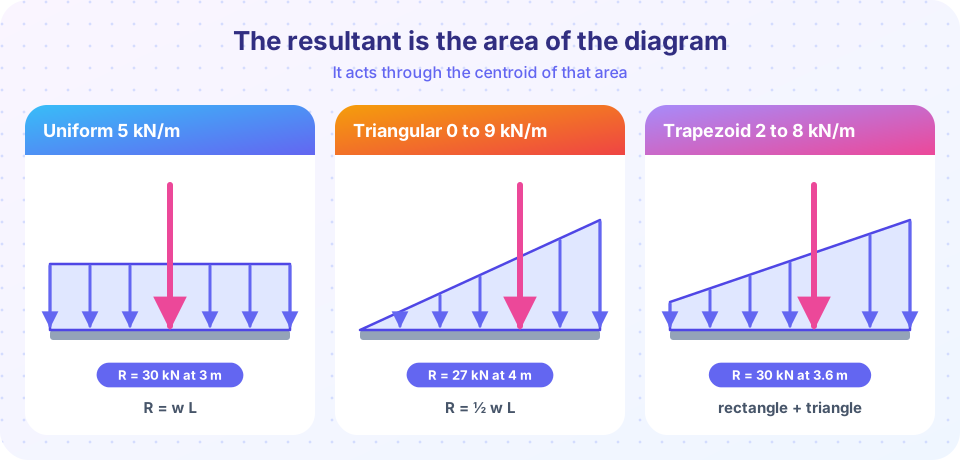
The rule is as beautiful as it is simple: the resultant equals the area under the load diagram, and it acts through the centroid of that area. All the centroid skills of the last two lessons go straight into use here.
What you will learn
- Read a load intensity
w(x)in N/m or kN/m. - Find the resultant and its line of action for uniform, triangular and trapezoidal loads.
- Split a complicated load into simple shapes.
- Apply the method to hydrostatic pressure on a flat wall.
Key terms
Load intensity w(x): force per unit length (kN/m) along a beam. For loads on surfaces, pressure p in Pa (N/m²).
Resultant R: the single force equivalent to the distributed load.
Line of action: the position of R, given by the centroid of the load diagram.
Hydrostatic pressure: pressure of a fluid at rest, p = ρ g h.
The rule
For a load w(x) over a span from x = a to x = b:
R   = ∫ w(x) dx                 (area under the diagram)
x_R = ∫ x w(x) dx / R           (centroid of the area)
Remember that the resultant is statically equivalent only for external equilibrium: reactions, overall moments. Inside the beam, the load is still spread out, and it matters for the bending moment diagrams you will draw in chapter 8.
Worked examples
Uniform load. w = 5 kN/m over 6 m. The diagram is a rectangle, so R = 5 × 6 = 30 kN, acting at the middle, 3 m from either end.
Triangular load. The load rises linearly from 0 at the left end to 9 kN/m at the right end, over 6 m. The area is ½ × 6 × 9 = 27 kN. The centroid of a triangle is one third of the base from the big end, so R acts 6/3 = 2 m from the large end, or 4 m from the zero end.
Trapezoidal load. The load varies from 2 kN/m to 8 kN/m over 6 m. Split it into a rectangle (2 × 6 = 12 kN at 3 m from the left) and a triangle (½ × 6 × 6 = 18 kN at 4 m from the left, since the triangle's big end is on the right and its centroid is 2 m from that end). Then:
R   = 12 + 18 = 30 kN
x_R = (12 × 3 + 18 × 4) / 30 = 108 / 30 = 3.6 m from the left
The resultant sits to the right of the middle, as expected, because the load is heavier on the right.
Beam reactions. A simply supported beam of span 6 m carries the triangular load above (zero at A on the left, 9 kN/m at B on the right). Moments about A: By × 6 = 27 × 4, so By = 18 kN, and Ay = 27 − 18 = 9 kN. The reaction is larger at the heavy end, again as it should be.
Fluid pressure on a dam wall
Water at rest pushes on a surface perpendicular to the surface. The pressure grows linearly with depth h:
p = ρ g h (gauge pressure, in Pa)
With ρ = 1000 kg/m³ and g = 9.81 m/s², the pressure at 4 m depth is 1000 × 9.81 × 4 = 39,240 Pa = 39.24 kPa.
Take a vertical wall 1 m wide holding water 4 m deep. The load per meter of height is w = p × width, which is triangular: 0 at the surface and 39.24 kN/m at the base. Its area is the resultant:
R = ½ × 4 m × 39.24 kN/m = 78.48 kN per meter of wall width
The line of action passes through the centroid of the triangle: one third of the depth from the base, which is 4/3 = 1.33 m above the base (2.67 m below the surface). Note that this is lower than the midpoint of the depth: the deep water pushes harder.
For a wall of height H with water depth h and width b: R = ½ ρ g h² b, acting h/3 above the bottom of the water. Doubling the depth quadruples the force, which is why dams are built so thick at the base.
Common misconceptions
"The resultant of a triangular load acts at the middle." No. It acts at one third of the length from the big end.
"The resultant is the peak intensity times the length." That is the area of the bounding rectangle. For a triangle the area is half that.
"Pressure acts only downward." A fluid pushes perpendicular to every surface it touches, so on a vertical wall the pressure pushes horizontally.
Try it
Press Run (or Ctrl + Enter) to see the result here.
Program input · what you'd type while the program runs
Type the answers before you press Run, one per line. Each time the program reads a line (with input()), it gets the next line from this box.
Check your understanding
Quick check · 5 questions
of 5 answered You scored / 5 · perfect!
-
1. A uniform load of 8 kN/m acts over 5 m. The resultant is:
R = 8 × 5 = 40 kN, through the centroid of a rectangle, which is the middle. -
2. A triangular load goes from 0 to 12 kN/m over 3 m. How far from the big end does the resultant act?
The centroid of a triangle is one third of the base from the large end: 3/3 = 1 m. R = 18 kN. -
3. Hydrostatic pressure at depth h is:
Pressure increases linearly with depth. The force on a wall grows with h², because pressure is integrated over the depth. -
4. If the water depth behind a dam doubles, the resultant force on 1 m of wall is multiplied by:
R = ½ ρ g h² b, so doubling h multiplies R by four. -
5. The resultant of a distributed load passes through:
The line of action is the centroid of the area under the load diagram.
Summary
- A distributed load's resultant equals the area under its diagram.
- It acts through that area's centroid: middle for uniform, one third from the big end for triangular.
- Complex diagrams are split into rectangles and triangles.
- Water pressure
p = ρ g hmakes a triangular load; the force is½ ρ g h² bath/3above the base.
Track your progress
Create a free account to tick off lessons and pick up where you left off on any device.
of Engineering Statics lessons completed