


















Lesson 36 of 47 · Friction
Belts, Wedges and Screws
Use friction on purpose: the capstan equation T2 = T1 e^(μβ) for ropes and belts, the wedge and the screw jack, and self-locking. With worked numbers.
Sailors have known for centuries that a rope wrapped a couple of times around a post lets one person hold a boat. Machine designers use the same fact in belt drives, and mechanics use two other friction machines daily: the wedge that splits a log and the screw that lifts a car. In all three, friction is not an annoyance but the working principle, and in all three, a small force controls a large one.
What you will learn
- Derive and apply
T2 = T1 e^(μβ)for flexible belts and ropes. - Compute the force to push a block up an incline or wedge, including friction.
- Find the torque to raise and lower a load with a square-thread screw.
- Explain self-locking.
Key terms
Wrap angle β: the angle, in radians, of contact between belt and drum.
Capstan equation: T_large / T_small = e^(μ β) at impending slip.
Lead angle θ: the angle of a screw thread, tan θ = lead / (2π r).
Self-locking: a machine that stays put when the effort is removed, because φ ≥ θ.
Belt and rope friction
A rope wraps around a fixed drum through an angle β. At one end, you pull with a large tension T2 that is about to make the rope slip around the drum. At the other end, the holding tension is T1. Consider a short element of rope subtending an angle dβ. Its tension changes by dT as friction acts along it, and the normal pressure from the drum is T dβ (to first order). At impending slip:
dT = μ T dβ     ->     dT / T = μ dβ
ln(T2 / T1) = μ β
T2 = T1 e^(μ β)
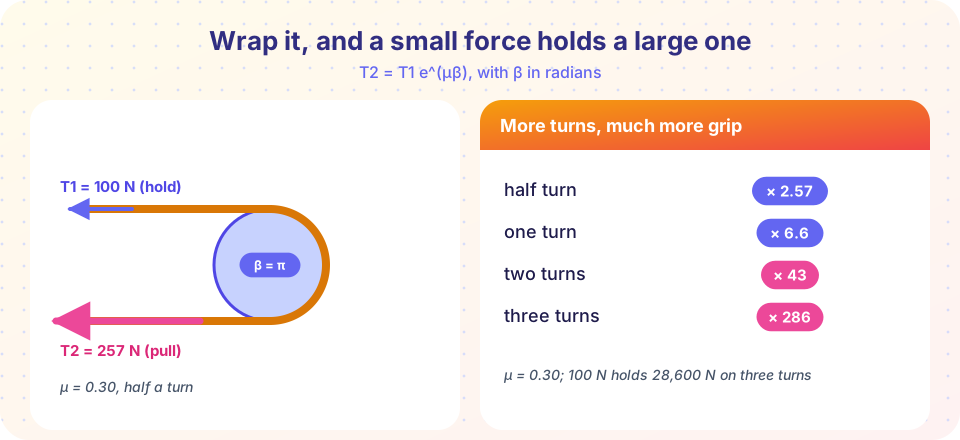
where β is in radians and T2 is the tension on the side toward which the rope is about to slip (the larger one). The result does not depend on the radius of the drum or on the shape of the contact, only on the total wrap angle.
Worked example. A rope wraps half a turn (β = π) around a fixed post, μ = 0.30:
T2 / T1 = e^(0.30 π) = e^0.9425 = 2.57
A holding force of 100 N can resist a pull of 257 N. Wrap two full turns (β = 4π):
T2 / T1 = e^(0.30 × 4π) = e^3.770 = 43.4
Now 100 N holds about 4,340 N. This exponential growth is why a few turns of rope on a bollard hold an ocean liner, and why a belt drive loses grip when the wrap angle on the smaller pulley is small.
Wedges and inclines
Consider a block of weight W on an incline of angle θ with friction angle φ = arctan μ_s. To push it up the slope with a force parallel to the plane at impending motion, friction acts down the slope:
P_up = W (sin θ + μ cos θ)
For W = 1000 N, θ = 15°, μ = 0.30: P_up = 1000 (0.2588 + 0.2898) = 548.6 N. The wedge is the same machine with the incline moving under the load: a small horizontal push produces a large vertical lift, at the price of moving the wedge a long way. If the wedge angle is smaller than the friction angle (θ < φ) it stays in place after the push is removed, which is why a door wedge holds a heavy door.
The screw jack
A square-thread screw is an incline wrapped around a cylinder. With a mean thread radius r, a lead (advance per revolution) ℓ, and a lead angle θ with tan θ = ℓ / (2π r), raising a load W needs a torque
M = W r tan(θ + φ)
and lowering it needs M = W r tan(θ − φ). For r = 15 mm, lead 6 mm, μ = 0.12, W = 10 kN:
θ = arctan(6 / (2π × 15)) = 3.64°
φ = arctan(0.12) = 6.84°
M_raise = 10 000 × 0.015 × tan(10.48°) = 27.8 N·m
Because θ < φ, lowering needs tan(θ − φ) < 0: the torque is negative, which means the screw holds the load by itself. The jack is self-locking. The efficiency is tan θ / tan(θ + φ) = 0.0637 / 0.1851 = 34%. A self-locking screw always has an efficiency below 50%.
Common misconceptions
"Belt friction depends on the drum radius." In the capstan equation only the wrap angle and μ matter, not the radius or the tension itself.
"β can be in degrees." The exponent needs radians. A half-turn is π, not 180.
"A self-locking screw is wasteful, so engineers avoid it." It is the whole point of a jack: the load does not run back down. The price is lower efficiency.
Try it
Press Run (or Ctrl + Enter) to see the result here.
Program input · what you'd type while the program runs
Type the answers before you press Run, one per line. Each time the program reads a line (with input()), it gets the next line from this box.
Press Run (or Ctrl + Enter) to see the result here.
Program input · what you'd type while the program runs
Type the answers before you press Run, one per line. Each time the program reads a line (with input()), it gets the next line from this box.
Check your understanding
Quick check · 5 questions
of 5 answered You scored / 5 · perfect!
-
1. A rope is wrapped one full turn around a post, with μ = 0.25. T2/T1 is about:
e^(0.25 × 2π) = e^1.571 = 4.81. -
2. In T2 = T1 e^(μβ), β must be given in:
The exponent is dimensionless: β must be in radians. -
3. Doubling the number of turns on a bollard changes T2/T1 by:
Since the ratio is e^(μβ), doubling β squares the ratio. -
4. A screw is self-locking when:
If θ < φ then tan(θ − φ) < 0: no torque is needed to hold the load, and the load cannot back-drive the screw. -
5. Does the capstan equation depend on the radius of the drum?
The radius cancels in the derivation: only the total angle of contact matters.
Summary
- Belt or rope friction:
T2 = T1 e^(μβ), withβin radians. - Block on an incline:
P_up = W (sin θ + μ cos θ); self-locking whenθ < φ. - Screw:
M = W r tan(θ + φ)to raise,M = W r tan(θ − φ)to lower. - Self-locking machines have an efficiency below 50%.
Next: Review: friction
Track your progress
Create a free account to tick off lessons and pick up where you left off on any device.
of Engineering Statics lessons completed