


















Lesson 1 of 47 · Getting Started
Course map: what Engineering Statics teaches
Start here: what engineering statics is, who the course is for, what you need first, how to study it, and a map of all nine chapters with a live beam demo.
Every bridge, crane, chair and shelf has one job in common: it must stay where it is while forces push on it. Engineering statics is the branch of mechanics that tells you how big those forces are, where they act and whether a structure can carry them. It is the first engineering course almost every civil, mechanical, aerospace and architectural student takes, and it is the foundation for strength of materials, structural design, dynamics and machine design.
This course teaches statics in nine chapters. It follows the common core of university first-year mechanics courses worldwide, uses SI units throughout, and mixes short explanations with worked examples, diagrams and small programs you can change and run.
This is an educational course, not a design code. Real structures are designed by licensed engineers using safety factors and official standards. Use these lessons to understand the physics, not to size a real load-bearing member.
What you will learn
- What statics is and which problems it can and cannot solve.
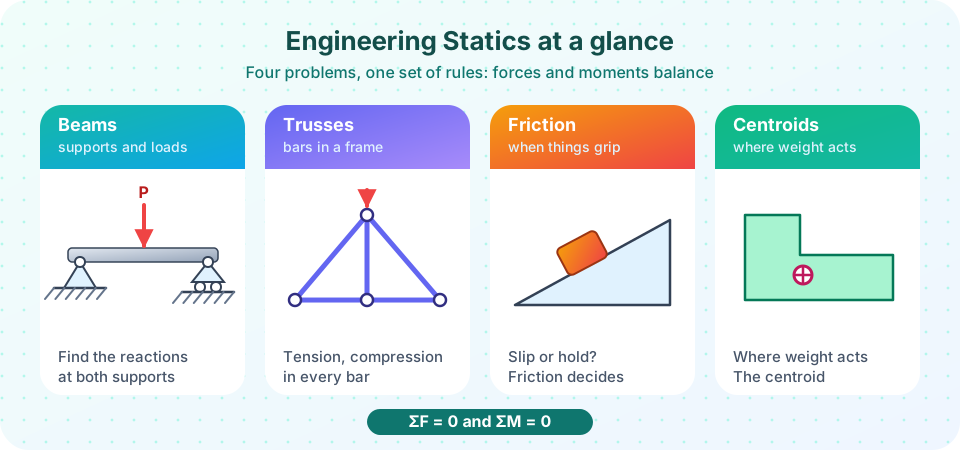
- How the five chapters of theory (vectors, equilibrium, moments, trusses, distributed loads) fit together.
- What background you need and how to study the course efficiently.
- How a simple beam problem already contains the whole method.
Who this course is for
The course suits first-year engineering and physics students, advanced high-school students who are taking mechanics, and adults who want to understand how structures carry loads. You do not need to have studied engineering before.
You should be comfortable with:
- Algebra: solving two or three linear equations at once.
- Trigonometry: sine, cosine, tangent and the Pythagorean theorem for right triangles.
- Basic physics: what a force is, and Newton's laws at a high-school level. If you want a refresher, the Physics: Mechanics track covers them.
Calculus appears only in Chapter 6 (centroids and distributed loads) and Chapter 8 (beam diagrams), and even there it is explained from scratch. Vector algebra is taught in Chapter 2, so you do not need it beforehand.
The nine chapters
Foundations
- Getting Started
- Vectors and Forces
Balance
- Equilibrium
- Moments and Couples
Structures
- Trusses and Frames
- Centroids, Loads
Real surfaces
- Friction
- Internal Forces
Put it together
- Projects
Each chapter starts with an overview and ends with a review quiz.
Chapters 1 to 4 (this first half) give you the toolkit: forces as vectors, free-body diagrams, the equilibrium equations and moments. Chapters 5 to 8 apply the toolkit to larger and more realistic problems. Chapter 9 combines everything in projects.
The whole method in one beam
Before any theory, here is a taste of the method. A beam 4.0 m long rests on a pin at the left end and a roller at the right end. A 600 N load sits at distance a from the left end. How hard does each support push up?
Two ideas solve it. First, if the beam does not move, the vertical forces must balance: RA + RB = 600 N. Second, if the beam does not spin, the moments must balance. Take moments about the left end: the load turns the beam one way with moment 600 × a, and the right support turns it the other way with RB × 4.0. Setting them equal gives
RB = 600 × a / 4.0 and RA = 600 − RB.
That is statics: draw the forces, write ΣF = 0 and ΣM = 0, solve. Everything else in the course is a richer version of this recipe. Try it yourself by sliding the load.
Notice that when the load sits right above a support, that support carries all of it. The plot below shows the same idea for every position at once.
Press Run (or Ctrl + Enter) to see the result here.
Program input · what you'd type while the program runs
Type the answers before you press Run, one per line. Each time the program reads a line (with input()), it gets the next line from this box.
How to study this course
- Read actively. After each worked example, cover the solution and redo it.
- Always draw. Statics is a visual subject. A neat diagram prevents more errors than any formula.
- Write units on every number. A newton and a newton-meter are different things, and the units catch mistakes early.
- Check the answer. Ask: is the direction sensible? Is the size plausible? Does the reaction sum match the loads?
- Use the quizzes and reviews. Each lesson ends with a check, and each chapter ends with a longer review.
Check your understanding
Quick check · 4 questions
of 4 answered You scored / 4 · perfect!
-
1. What does statics study?
Statics analyzes bodies in equilibrium, where nothing accelerates, so forces and moments balance. -
2. A beam carries a 600 N load right above the left support. What does the right support carry?
RB = P × a / L with a = 0, so RB = 0 and the left support carries the full 600 N. -
3. Which pair of conditions does the beam example use?
Force balance stops translation and moment balance stops rotation. Together they define equilibrium. -
4. Why do we write units on every number?
Mixing incompatible units is a classic error that a quick unit check reveals.
Summary
- Statics finds forces in structures that stay still; the key conditions are ΣF = 0 and ΣM = 0.
- The course has nine chapters: toolkit first (1 to 4), applications next (5 to 8), projects last.
- You need algebra and trigonometry; vectors and the needed calculus are taught here.
- The method is always: sketch, free-body diagram, equations, solve, check.
Next: What statics studies
Track your progress
Create a free account to tick off lessons and pick up where you left off on any device.
of Engineering Statics lessons completed