


















Lesson 14 of 47 · Equilibrium of Particles and Bodies
Equilibrium of a rigid body in two dimensions
Solve beams, ladders and frames with ΣFx = 0, ΣFy = 0 and ΣM = 0. Learn how to choose the moment point, handle inclined loads and use the three-force member rule.
A beam resting on two supports, a ladder against a wall, a crane arm: these are rigid bodies in a plane. Unlike a particle, a rigid body can rotate, so forces alone are not enough. You need all three equations: the forces must cancel in two directions, and the moments must cancel about a point. This lesson turns that into a reliable routine and shows the tricks that save algebra.
What you will learn
- The three equations of 2D equilibrium and the alternative sets of three.
- How to choose a moment point that eliminates unknowns.
- How to treat inclined loads and weights.
- The three-force member rule and a ladder example.
Key terms
- Moment point: the point about which you sum moments. You may pick any point, even one off the body.
- Overhang: the part of a beam that extends beyond a support.
- Cantilever: a beam fixed at one end and free at the other.
- Concurrent forces: forces whose lines of action meet at a single point.
- Three-force member: a body in equilibrium under exactly three forces, whose lines must meet at one point or be parallel.
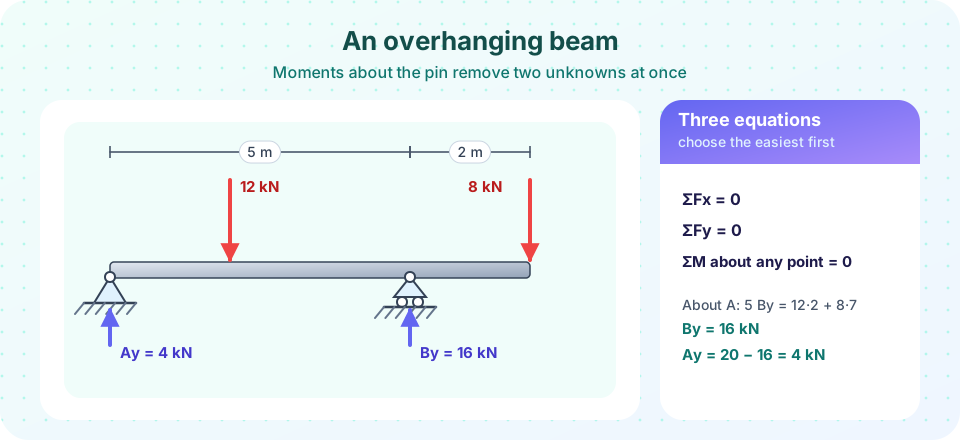
The three equations
For a body in the xy plane:
ΣFx = 0, ΣFy = 0, ΣM_O = 0 (about any point O).
These are independent, so they can determine at most three unknowns. You may replace one force equation with another moment equation about a different point, or both force equations with moment equations, as long as the points are not collinear (or, with two moment equations and one force equation, the force direction is not perpendicular to the line through the points). The best choice is the set that decouples the unknowns so each equation has one unknown.
Rule of thumb for the moment point: put it where several unknown forces act, since a force through the point has no moment about it. Pins and the intersection of two unknown force lines are good choices.
Sign of moments
Choose counterclockwise (CCW) positive. The moment of a force F about O is F × d where d is the perpendicular distance from O to the line of action. Chapter 4 develops moments formally; for now it is enough to know that a force pushing the body CCW around O contributes positively.
Worked example 1: overhanging beam
A 7 m beam rests on a pin at A (left end) and a roller at B, 5 m from A. A 12 kN downward load acts 2 m from A and an 8 kN load acts at the free end, 7 m from A. Find the reactions.
Unknowns: Ax, Ay, By.
ΣM_A = 0:5 By − 12 × 2 − 8 × 7 = 0givesBy = 80/5 = 16 kN.ΣFy = 0:Ay + 16 − 12 − 8 = 0givesAy = 4 kN.ΣFx = 0:Ax = 0.
Check with moments about B: −4 × 5 + 12 × 3 − 8 × 2 = −20 + 36 − 16 = 0. The heavy tip load pivots the beam about B, so the roller carries 16 kN and the pin only 4 kN.
Worked example 2: an inclined load
A 6 m beam has a pin at A (x = 0) and a roller at B (x = 6 m). A 10 kN force acts at x = 2 m, pointing right and down at 60° below the horizontal. Components: Px = 10 cos 60° = 5 kN (right) and Py = 10 sin 60° = 8.66 kN (down). Then
ΣM_A = 0:6 By − 8.66 × 2 = 0, soBy = 2.89 kN.ΣFy = 0:Ay = 8.66 − 2.89 = 5.77 kN.ΣFx = 0:Ax + 5 = 0, soAx = −5 kN, meaning the pin pushes left.
Only the pin can resist the horizontal part, because the roller carries no force along the track. Always ask which support can carry which direction.
Press Run (or Ctrl + Enter) to see the result here.
Program input · what you'd type while the program runs
Type the answers before you press Run, one per line. Each time the program reads a line (with input()), it gets the next line from this box.
Worked example 3: a cantilever
A cantilever beam 3 m long is built into a wall at A and carries a 5 kN load at its free end B. The fixed support supplies Ax, Ay and a moment M_A.
ΣFy = 0:Ay − 5 = 0, soAy = 5 kNupward.ΣM_A = 0:M_A − 5 × 3 = 0, soM_A = 15 kN·mcounterclockwise (it holds the beam up against the load's clockwise turning).
Drag the load below to see how the wall's moment grows with distance.
The three-force member rule
If a body is in equilibrium under only three forces, their lines of action must be concurrent (meet at one point) or all parallel. Otherwise the moment about the intersection of two of them would be nonzero. This gives you the direction of an unknown reaction for free.
Example: a ladder. A uniform ladder of weight 200 N leans against a smooth vertical wall, with its foot 3 m from the wall and its top 4 m up (length 5 m). The wall force is horizontal (smooth wall). The floor supplies a vertical force N and a horizontal force H.
ΣM_foot = 0: wall forceNw × 4 = 200 × 1.5(the weight acts at the middle, 1.5 m horizontally from the foot), soNw = 75 N.ΣFy = 0:N = 200 N.ΣFx = 0:H = Nw = 75 N. The wall pushes the ladder away from the wall, so the floor force must push toward the wall.
So the floor must supply a 75 N horizontal force. Whether the floor can actually provide it depends on friction, which Chapter 7 treats.
Press Run (or Ctrl + Enter) to see the result here.
Program input · what you'd type while the program runs
Type the answers before you press Run, one per line. Each time the program reads a line (with input()), it gets the next line from this box.
Common misconceptions
"I must take moments about the center of the beam." You may choose any point. Choosing a support removes unknowns.
"A roller can carry a horizontal load." A frictionless roller cannot; only the pin can.
"The support reactions always add up to the total load." Only the vertical reactions balance the vertical loads. Inclined or horizontal loads also need a horizontal pin reaction.
Check your understanding
Quick check · 5 questions
of 5 answered You scored / 5 · perfect!
-
1. A 4 m beam on a pin and a roller carries 800 N at 1 m from the pin. What does the roller carry?
ΣM about the pin: By × 4 = 800 × 1, so By = 200 N. -
2. Why take moments about a pin?
A force through the moment point has zero moment arm. -
3. A cantilever of length 2 m carries 3 kN at its tip. What is the wall moment?
M = 3 × 2 = 6 kN·m. -
4. A body in equilibrium has exactly three non-parallel forces. Their lines of action
Otherwise the moment about the meeting point of two lines would be nonzero. -
5. Which support can resist the horizontal part of an inclined load on a beam resting on a pin and a frictionless roller?
The roller only resists forces perpendicular to its track.
Summary
- A rigid body in 2D has
ΣFx = 0,ΣFy = 0,ΣM = 0; choose a moment point that kills unknowns. - Resolve inclined loads into components; the pin handles horizontal forces.
- A cantilever's fixed support supplies force and a moment:
M = P d. - Three-force bodies need concurrent (or parallel) lines of action.
Track your progress
Create a free account to tick off lessons and pick up where you left off on any device.
of Engineering Statics lessons completed