


















Lesson 46 of 47 · Projects and Practice
Statics Cheat Sheet: One-Page Recap
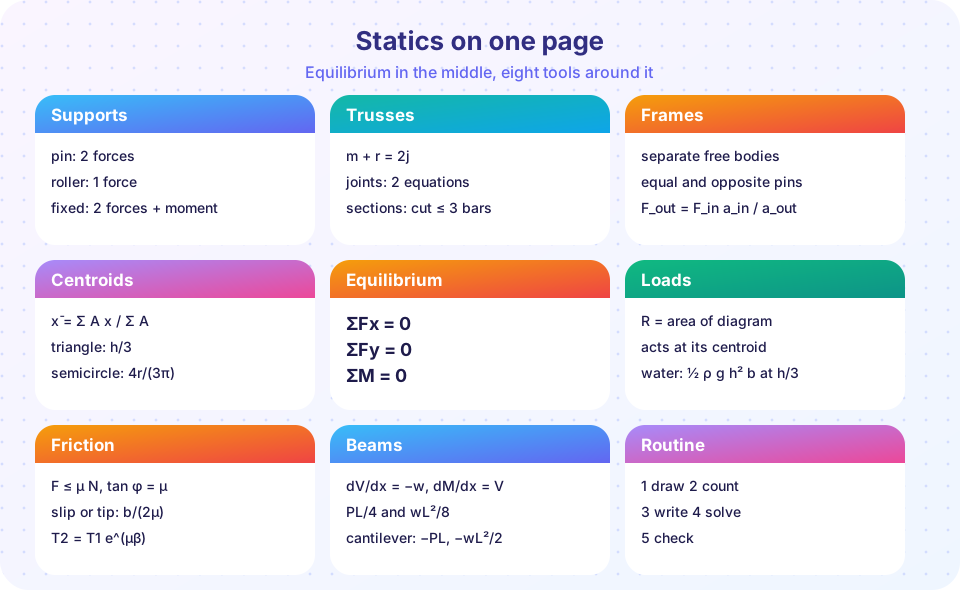
A one-page statics summary: equilibrium, supports, trusses, frames, centroids, distributed loads, friction and beams, with every key formula and a Python toolbox.
Everything in this course fits on a page, because statics is built on a single idea: a body at rest has no net force and no net moment. The rest is geometry and bookkeeping. This page collects the formulas and the method for each topic so you can review before an exam or check a calculation at the desk.
What you will learn
- Recall the key formulas of each chapter at a glance.
- Follow one routine that solves almost every statics problem.
- Use a small Python toolbox to check your arithmetic.
Key terms
Equilibrium: ΣFx = 0, ΣFy = 0, ΣM = 0 in the plane.
Free-body diagram: the sketch that decides which equations to write.
Sign convention: tension +, shear clockwise +, sagging +; stick to one.
Check: a second equation or a limiting case that confirms the answer.
The routine
- Draw the free-body diagram: body, loads, supports replaced by reactions, dimensions and angles.
- Count unknowns and equations. In 2D a rigid body gives 3 equations.
- Write
ΣFx = 0,ΣFy = 0,ΣM = 0. Choose a moment point where several unknowns cross. - Solve, keeping units. Positive or negative sign has a physical meaning.
- Check with an independent equation or a limiting case.
Fundamentals
| Topic | Formula |
|---|---|
| Moment of a force | M = F d (N·m), d perpendicular distance |
| Components | Fx = F cos θ, Fy = F sin θ |
| Couple | M = F d, a free vector |
| Weight | W = m g, g = 9.81 m/s² |
| Two-force member | force along the line joining the two pins |
| Support reactions in 2D | pin: 2 forces; roller: 1 force; fixed: 2 forces + 1 moment |
Trusses, frames and machines
| Topic | Rule |
|---|---|
| Determinacy | m + r = 2j |
| Joints | ΣFx = 0, ΣFy = 0; assume tension, + = T |
| Sections | cut ≤ 3 unknown bars, moments about the intersection of two bars |
| Zero-force | unloaded joint with 2 bars, or 3 bars with 2 collinear |
| Chord force | F ≈ M / H |
| Frames | separate free bodies, equal and opposite pin forces |
| Machine ratio | F_out = F_in × arm_in / arm_out |
Centroids and loads
| Topic | Result |
|---|---|
| Centroid | x̄ = Σ A_i x_i / Σ A_i (holes negative) |
| Triangle | h/3 from the base |
| Semicircle | 4r/(3π) from the diameter |
Spandrel y = b(x/a)² |
3a/4, 3b/10 |
| Distributed load | R = ∫ w dx, at the centroid of the load diagram |
| Uniform | w L at L/2 |
| Triangular | w_max L / 2 at L/3 from the big end |
| Water | p = ρ g h; wall force ½ ρ g h² b at h/3 |
Friction
| Topic | Result |
|---|---|
| Limit | F ≤ μ_s N, sliding F = μ_k N |
| Friction angle | tan φ = μ |
| Incline | slips at tan θ = μ_s |
| Pull at angle | best at α = φ, P_min = W sin φ |
| Slip vs tip | critical push height b/(2 μ) |
| Ladder | tan θ ≥ 1/(2 μ_s) |
| Belt | T2 = T1 e^(μ β) |
| Screw | M = W r tan(θ ± φ), self-locking if θ < φ |
Beams
| Topic | Result |
|---|---|
| Relations | dV/dx = −w, dM/dx = V |
| Area rules | ΔV = −∫ w dx, ΔM = ∫ V dx |
| Maximum moment | where V = 0 |
| Simply supported, central point load | P L / 4 |
| Simply supported, uniform load | w L² / 8 |
| Cantilever, tip load | −P L at the wall |
| Cantilever, uniform load | −w L² / 2 at the wall |
Common misconceptions
"A cheat sheet replaces understanding." The formulas only work when the free-body diagram is right. Memorize the method, not just the symbols.
"More significant figures mean more accuracy." Loads and dimensions are rarely known to better than 2-3 figures.
"Units don't matter if the numbers work out." A force in kN times a length in mm gives N·m only if you convert. Carry units through every line.
Try it
Press Run (or Ctrl + Enter) to see the result here.
Program input · what you'd type while the program runs
Type the answers before you press Run, one per line. Each time the program reads a line (with input()), it gets the next line from this box.
Press Run (or Ctrl + Enter) to see the result here.
Program input · what you'd type while the program runs
Type the answers before you press Run, one per line. Each time the program reads a line (with input()), it gets the next line from this box.
Check your understanding
Quick check · 4 questions
of 4 answered You scored / 4 · perfect!
-
1. How many equilibrium equations does a rigid body in the plane give?
ΣFx, ΣFy and ΣM. -
2. The best moment point for solving a section problem is where:
Forces through the point have no moment, so fewer unknowns remain. -
3. A uniform load of total W spread on a simply supported beam gives what maximum moment relative to the same W at midspan?
W L / 8 versus W L / 4. -
4. Capstan equation:
The tension ratio grows exponentially with the wrap angle (radians).
Summary
- One routine: draw, count, write, solve, check.
- Know the standard results:
PL/4,wL²/8,h/3,4r/3π,e^(μβ). - Carry units and signs through every line.
Track your progress
Create a free account to tick off lessons and pick up where you left off on any device.
of Engineering Statics lessons completed