


















Lesson 43 of 47 · Projects and Practice
Project: Design a Footbridge Truss
Apply the whole course to a 16 m Warren truss footbridge: loads, reactions, all bar forces with a solver, a depth study and a first sizing of the members.
Time to use what you have learned on something that looks like a real structure. You will analyze a 16 m pedestrian footbridge made as a Warren truss: two parallel chords joined by diagonals that zigzag between them. Warren trusses are common because every diagonal repeats the same triangle, so they are easy to build and cheap to analyze.
The project has four steps: model the loads, find the reactions, solve for every bar force, and use the results to size the bars and choose the depth of the truss. A short design study at the end shows why bridge trusses are deep in the middle of the span.
What you will learn
- Convert a deck load into joint loads.
- Check that a truss is determinate (
m + r = 2j) before solving. - Use a matrix solver for all joints at once and read the results.
- Check the solver by hand with a section.
- Size tension bars and see how depth controls chord force.
Key terms
Warren truss: parallel chords with diagonals alternating in direction, no verticals.
Panel: the stretch of chord between two adjacent joints on the same chord.
Tributary load: the part of a distributed load that a joint is responsible for.
Allowable stress: the stress limit used in design, here taken as 150 MPa for steel in tension.
Step 1: the model
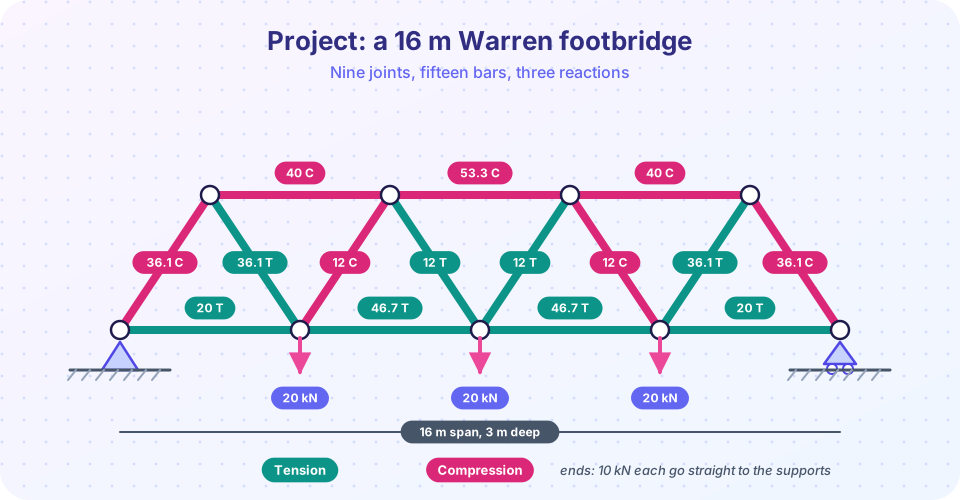
The bottom chord runs along the deck with joints B0 to B4 at x = 0, 4, 8, 12, 16 m. The top chord joints T1 to T4 sit at x = 2, 6, 10, 14 m, 3 m above. Count: j = 9 joints, m = 15 bars (4 bottom chord, 3 top chord, 8 diagonals), and r = 3 (a pin and a roller). Then m + r = 18 = 2j ✓ determinate.
Deck load: 5 kN/m over 16 m is 80 kN. Each panel point takes the load of half a panel on each side, which gives 20 kN at B1, B2, B3 and 10 kN at each end joint (B0 and B4). The end loads go directly into the supports, so they change the reactions but not the bar forces. By symmetry each support carries 40 kN.
Step 2: solve
The solver below is the same idea as the one in the method of joints lesson, written for members given as joint pairs.
Press Run (or Ctrl + Enter) to see the result here.
Program input · what you'd type while the program runs
Type the answers before you press Run, one per line. Each time the program reads a line (with input()), it gets the next line from this box.
You should see a bottom chord in tension (20, 46.7, 46.7, 20 kN), a top chord in compression (40, 53.3, 40 kN) and diagonals alternating between compression and tension, with the largest diagonal force (36.1 kN) next to the supports. The chord forces are largest at midspan, exactly as the bending moment diagram would predict.
Step 3: check by hand
Cut the truss with a vertical line at x = 7.5 m. It passes through three bars: the top chord T2-T3, the diagonal T2-B2 and the bottom chord B1-B2. Keep the left part and take moments about B2, where the diagonal and the bottom chord meet, so only the top chord has a moment. The external forces on the left part are the reaction 40 kN at x = 0, the load 10 kN at x = 0 and the load 20 kN at x = 4:
Moment of the external forces about B2 (x = 8):  40 × 8 − 10 × 8 − 20 × 4 = 160 kN·m
The top chord is 3 m above B2:                   F_T2T3 = −160 / 3 = −53.3 kN (compression)
This matches the solver: the chord force is the beam moment divided by the depth, F = M/H.
Step 4: size the bars
For a tension bar of steel, the required area is A = F / σ_allow. With σ_allow = 150 MPa = 150 N/mm²:
Bottom chord, 46.7 kN: A = 46,700 / 150 ≈ 311 mm²
Diagonal, 36.1 kN:     A = 36,100 / 150 ≈ 241 mm²
Compression bars (the top chord and every diagonal that is in compression) cannot be sized by area alone: long slender bars buckle well below the yield stress. Checking buckling is a job for strength of materials, so take the compression forces from this project into strength of materials when you study it.
Step 5: design study, how deep should the truss be?
Because F = M/H, chord forces fall as the truss gets deeper. But deeper trusses need longer diagonals and weigh more. The experiment below finds the chord force for several depths.
Press Run (or Ctrl + Enter) to see the result here.
Program input · what you'd type while the program runs
Type the answers before you press Run, one per line. Each time the program reads a line (with input()), it gets the next line from this box.
The curves tell the story: doubling the depth halves the chord force, but the end diagonal gets steeper, and its force 30 L / H approaches the vertical shear as H grows. Designers pick a depth of about one eighth to one tenth of the span. Here that would be 1.6 to 2 m, so our 3 m is generous for a footbridge.
Common misconceptions
"Decks load the bars directly." In a well-built truss, floor beams carry the deck load to the joints, so the bars see only axial force.
"If the solver gives an answer the truss is safe." The solver only gives forces. Buckling, connections, fatigue, wind and moving loads are separate checks.
"The center diagonals carry the most." In a Warren truss the diagonals near the supports carry the most, because they carry the shear; the chords near midspan carry the most, because they carry the moment.
Check your understanding
Quick check · 5 questions
of 5 answered You scored / 5 · perfect!
-
1. A Warren truss has 9 joints and 15 bars, with a pin and a roller. It is:
m + r = 15 + 3 = 18 = 2 × 9. -
2. The midspan chord force of a truss is approximately:
The chords form the force couple that resists the bending moment: F = M/H. -
3. If the depth of the truss doubles, the chord forces roughly:
F = M/H, so doubling H halves F. -
4. A tension bar carries 60 kN. With σ_allow = 150 MPa the required area is:
A = 60,000 N / 150 N/mm² = 400 mm². -
5. Why can't compression bars be sized only by F/σ_allow?
Slender compression members fail by buckling, which depends on length and stiffness.
Summary
- Convert deck loads to joint loads, check
m + r = 2j, and solve. - Chords carry the moment (
F = M/H), diagonals the shear. - Size tension bars with
A = F/σ_allow; compression bars need a buckling check. - Depth trades chord force against diagonal length and weight.
Next: Practice problem set
Track your progress
Create a free account to tick off lessons and pick up where you left off on any device.
of Engineering Statics lessons completed