


















Lesson 24 of 47 · Trusses and Frames
Method of Joints
Find every bar force in a truss by isolating one pin at a time. Free-body diagrams, support reactions, zero-force members and a runnable solver.
The method of joints is the workhorse of truss analysis. The idea is simple: if the whole truss is in equilibrium, then so is every pin in it. Cut a small circle around one joint, draw the forces that act on that circle, and write two equations. Then step to the next joint and repeat.
It works because each bar is a two-force member. Its force on a joint is always along the bar, so a joint free-body diagram is a concurrent force system: all forces pass through one point, so moments are automatically zero and only ΣFx = 0 and ΣFy = 0 remain.
What you will learn
- Compute support reactions for a whole truss before touching a joint.
- Draw a joint free-body diagram and assume every bar is in tension.
- Solve joint by joint, always starting at a joint with at most two unknowns.
- Spot zero-force members that save you work.
- Check the answer with a spare joint.
Key terms
Joint (node): a pin where bars meet; the free body for this method.
Tension (T): a bar being stretched; the bar pulls on the joint.
Compression (C): a bar being squeezed; the bar pushes on the joint.
Zero-force member: a bar whose force comes out as exactly 0 for the given loading.
Reaction: the force a support exerts on the truss.
The method in six steps
- Check
m + r = 2jand make sure the truss is rigid. - Find the reactions by treating the whole truss as one rigid body (
ΣM,ΣFx,ΣFy). - Pick a joint with no more than two unknown bars (usually a support joint).
- Draw its free-body diagram. Assume every unknown bar is in tension, so each arrow points away from the joint along the bar.
- Write
ΣFx = 0andΣFy = 0, split inclined forces into components, and solve. A negative result means compression. - Move to the next joint that now has two unknowns, using the forces you already found (a tension bar pulls on the next joint too, with the same size).
Worked example
A truss has pin A at (0, 0) and roller D at (12, 0), with joints B (4, 0), C (8, 0), E (4, 3) and F (8, 3). The nine bars are AB, BC, CD, AE, EF, FD, BE, CF and BF. A 36 kN load acts downward at F.
Reactions. Moments about A: Dy × 12 = 36 × 8, so Dy = 24 kN. Then Ay = 36 − 24 = 12 kN and Ax = 0 (there is no horizontal load).
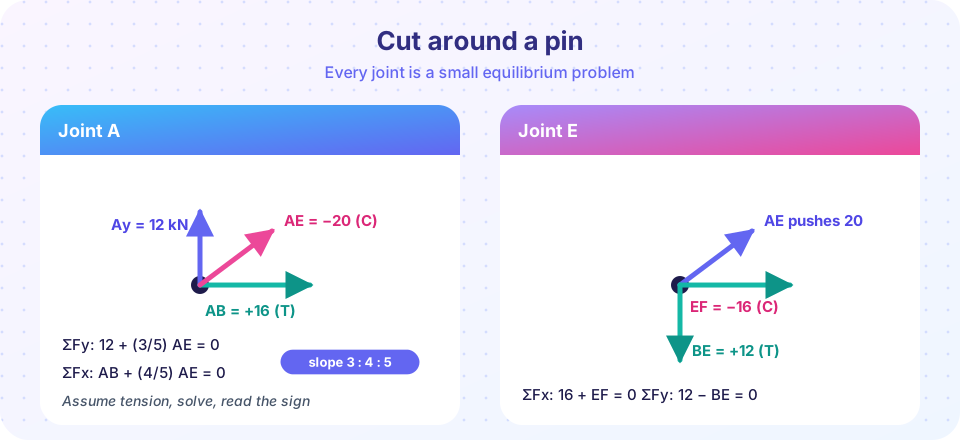
Joint A. Bar AE runs from (0,0) to (4,3): length 5, so it has direction (4/5, 3/5). The unknowns are F_AB and F_AE.
ΣFy:  12 + (3/5) F_AE = 0   ->  F_AE = -20 kN   (compression)
ΣFx:  F_AB + (4/5) F_AE = 0 ->  F_AB = +16 kN   (tension)
Joint E. The bars at E are AE (known), EF and BE. No load acts at E. AE pushes E with a force of 20 kN directed from A toward E: components (16, 12).
ΣFx:  16 + F_EF = 0   ->  F_EF = -16 kN  (compression)
ΣFy:  12 - F_BE = 0   ->  F_BE = +12 kN  (tension, BE pulls E down)
Joint B. Unknowns: BC and BF (AB and BE are known). BE pulls B upward with 12 kN and AB pulls B to the left with 16 kN.
ΣFy:  12 + (3/5) F_BF = 0     ->  F_BF = -20 kN  (compression)
ΣFx: -16 + F_BC + (4/5) F_BF = 0 -> F_BC = +32 kN (tension)
Joint D (roller, Dy = 24): bar FD runs from D toward F with direction (-4/5, 3/5).
ΣFy:  24 + (3/5) F_FD = 0   ->  F_FD = -40 kN  (compression)
ΣFx: -F_CD + (-4/5)(-40) = 0 ->  F_CD = +32 kN  (tension)
Joint C has only BC, CD and CF, and no load: ΣFy = 0 gives F_CF = 0. This is a zero-force member.
Check at joint F. All bars at F are now known. The sum of vertical forces is 12 + 24 − 36 = 0 and of horizontal forces 16 + 16 − 32 = 0. The check closes: the answers are consistent.
| Bar | Force (kN) | Type |
|---|---|---|
| AB | 16 | T |
| BC | 32 | T |
| CD | 32 | T |
| AE | 20 | C |
| EF | 16 | C |
| FD | 40 | C |
| BE | 12 | T |
| BF | 20 | C |
| CF | 0 | zero |
Notice the pattern: the bottom chord is stretched and the top chord is squeezed, exactly like the fibres in a beam under a downward load.
Zero-force members: shortcuts
Two simple tests save effort when a joint carries no external load and no support:
- If only two non-collinear bars meet at the joint, both are zero-force.
- If three bars meet and two of them are collinear, the third (non-collinear) bar is zero-force.
Joint C above is the second case: BC and CD are collinear, so CF must be zero. Zero-force members still matter. They brace the structure against other load cases, stop long compression bars from buckling and keep the shape rigid.
Common misconceptions
"A negative answer means I made a mistake." No. We assumed tension; a negative result simply says the bar is in compression. Do not redraw the diagram, just report the sign.
"A zero-force member can be removed." Not necessarily. It carries zero force for this load, but a different load (snow, wind, a moving vehicle) may need it, and removing it may make a long bar buckle.
"Bars carry forces perpendicular to themselves." Only if the bar carries load between its ends, which breaks the two-force assumption.
Try it
The solver below builds the 2j equations in matrix form and solves them all at once, which is how real software does it. Change the load and see how the signs flip.
Press Run (or Ctrl + Enter) to see the result here.
Program input · what you'd type while the program runs
Type the answers before you press Run, one per line. Each time the program reads a line (with input()), it gets the next line from this box.
Check your understanding
Quick check · 5 questions
of 5 answered You scored / 5 · perfect!
-
1. In the method of joints you first draw every unknown bar force as:
Assume tension. The sign of the answer then tells you the truth: positive is tension, negative is compression. -
2. Why does a joint free-body diagram give only two equations?
The forces are concurrent at the pin, so only ΣFx = 0 and ΣFy = 0 give new information. -
3. At an unloaded joint, three bars meet and two are collinear. The third bar carries:
Perpendicular to the collinear pair, nothing else can balance the third bar's component, so its force must be zero. -
4. A bar force comes out as -25 kN. What does it mean?
A negative sign means the bar pushes on the joint, so it is in 25 kN compression. -
5. Why should you find the support reactions first?
Reactions are external loads on the truss. A support joint would have too many unknowns without them.
Summary
- Isolate one pin, assume tension, and write
ΣFx = 0,ΣFy = 0. - Find the reactions first; start at a joint with two unknowns.
- Positive = tension, negative = compression.
- Zero-force members appear at unloaded joints with simple geometry.
- A spare joint gives a free check.
Next: Method of sections
Track your progress
Create a free account to tick off lessons and pick up where you left off on any device.
of Engineering Statics lessons completed