


















Lesson 39 of 47 · Internal Forces and Beams
Internal Forces in Members
Cut a beam or bar at any section and find the axial force, shear force and bending moment using free bodies and the standard sign convention. Worked example included.
You already know how to cut a truss in two and find the force in the bars you sliced. Cutting a beam works the same way, with one difference: a beam is a solid member, and the cut exposes not just one force along a bar, but a small system of forces on the whole face: an axial force, a shear force and a couple. This lesson shows you how to find all three at any section, and how to keep your signs straight.
What you will learn
- Define
N,VandMand their positive directions. - Find them by cutting at a section and applying
ΣFx,ΣFy,ΣM. - Choose the free body with the fewest loads to save work.
- Check results from both sides of the cut.
Key terms
Axial force N: the internal force along the member axis. Tension is positive.
Shear force V: the internal force perpendicular to the axis, in the plane of the cut face.
Bending moment M: the internal couple that bends the member. Sagging (concave up) is positive.
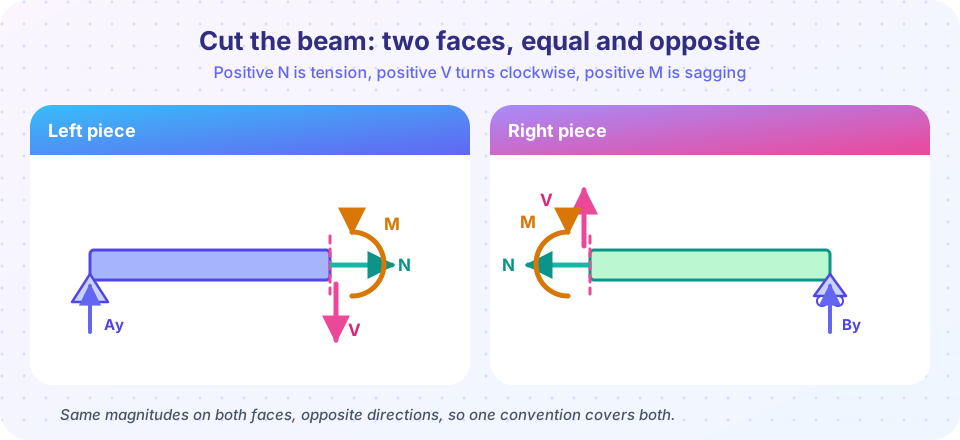
Sign convention: positive internal actions are defined on the two faces of the cut so that they are equal and opposite on each side.
The sign convention
Everyone must use the same convention, or diagrams are unreadable. The standard one for beams:
| Action | On the right face of the left piece | On the left face of the right piece |
|---|---|---|
Axial N (positive = tension) |
acts to the right, away from the cut | acts to the left, away from the cut |
Shear V (positive) |
acts downward | acts upward |
Moment M (positive = sagging) |
acts counterclockwise | acts clockwise |
A memory aid for shear: positive shear makes the piece it acts on want to rotate clockwise. A memory aid for moment: a positive moment makes the beam bend like a smile, with the top fibers shortened (compression) and the bottom fibers lengthened (tension).
The method
- Find the support reactions from the whole beam.
- Cut at the section of interest, a distance
xfrom a convenient end. - Draw the free body of one side, preferably the side with fewer loads. Show the loads and reactions on it as they really are, and show
N,V,Min their positive directions on the cut face. - Solve
ΣFx = 0forN,ΣFy = 0forVandΣM = 0(about the cut) forM. - If the answer is negative, the real action is opposite to the positive convention. Do not redraw: just keep the sign.
A useful shortcut once you are fluent: V at a section equals the sum of the vertical forces to its left (upward positive), and M equals the sum of the moments of those forces about the cut (with upward force at the left giving positive moment).
Worked example
A beam AB is 8 m long, with a pin at A and a roller at B. A 20 kN load acts at x = 4 m and is directed 60° below the horizontal, towards the right. Its components are
Px = 20 cos 60° = 10 kN (to the right)
Py = 20 sin 60° = 17.32 kN (down)
Reactions. The roller carries only a vertical force. Moments about A: By × 8 = 17.32 × 4, so By = 8.66 kN. Then Ay = 17.32 − 8.66 = 8.66 kN, and ΣFx: Ax + 10 = 0 gives Ax = −10 kN (the pin pushes left).
Section at x = 2 m (left of the load). Free body: the left piece of length 2 m, with Ax = 10 kN acting left and Ay = 8.66 kN up at A.
ΣFx:  -10 + N = 0            ->  N = +10 kN   (tension)
ΣFy:   8.66 - V = 0          ->  V = +8.66 kN
ΣM about the cut:  M - 8.66 × 2 = 0  ->  M = +17.32 kN·m   (sagging)
The portion of the beam between A and the load is being stretched, because the pin holds it back against the rightward push of the load.
Section at x = 6 m (right of the load). Use the right piece, 2 m long, which has only the roller force By = 8.66 kN up at B.
ΣFx:  N = 0
ΣFy:  V + 8.66 = 0           ->  V = -8.66 kN
ΣM about the cut:  M - 8.66 × 2 = 0  ->  M = +17.32 kN·m
Check with the left piece: M = 8.66 × 6 − 17.32 × 2 = 51.96 − 34.64 = 17.32 kN·m ✓. The two sides agree, so the answer is consistent.
Notice that the shear changed sign at the load: from +8.66 to −8.66, a jump of 17.32 kN, exactly the vertical component of the load. And the axial force vanished past the load, because only the left half of the beam resists the horizontal component.
Common misconceptions
"V and M are the same on both sides of the cut." Their magnitudes are equal; the arrows on the two faces point in opposite directions, which is why one convention covers both.
"A negative M means something is wrong." It means hogging (the beam bends concave down). Overhangs and cantilevers are normally hogging.
"I must always use the left piece." Use whichever side has fewer loads. The answer must agree.
Try it
Press Run (or Ctrl + Enter) to see the result here.
Program input · what you'd type while the program runs
Type the answers before you press Run, one per line. Each time the program reads a line (with input()), it gets the next line from this box.
Press Run (or Ctrl + Enter) to see the result here.
Program input · what you'd type while the program runs
Type the answers before you press Run, one per line. Each time the program reads a line (with input()), it gets the next line from this box.
Check your understanding
Quick check · 5 questions
of 5 answered You scored / 5 · perfect!
-
1. In the standard convention, positive shear on the right face of the left piece acts:
Positive shear makes the piece rotate clockwise: down on the right face, up on the left face of the other piece. -
2. A cantilever hangs 4 m from a wall with a 10 kN tip load. The moment at the wall is:
M = −P L = −40 kN·m: a cantilever with a downward tip load bends concave down. -
3. Which free body is best for a section near the right end of a long beam with many loads on the left?
The right piece has fewer loads, so less arithmetic; both sides must agree. -
4. A positive bending moment compresses:
Sagging shortens the top (compression) and lengthens the bottom (tension). -
5. V jumps by −12 kN at a point. What is there?
A downward point load makes the shear drop by its value when moving left to right.
Summary
- Internal actions are found by cutting, drawing one free body and applying equilibrium.
- Standard signs: tension +, shear clockwise +, sagging +.
V= sum of vertical forces on one side;M= sum of their moments about the cut.- Check by computing from both sides.
Track your progress
Create a free account to tick off lessons and pick up where you left off on any device.
of Engineering Statics lessons completed